







CONQUEST, William Henry
| Service Number: | 5235 |
|---|---|
| Enlisted: | 1 July 1913 |
| Last Rank: | Able Seaman |
| Last Unit: | HMAS Swan (I) |
| Born: | Camberwell, England , 3 May 1886 |
| Home Town: | Sutherland, Sutherland Shire, New South Wales |
| Schooling: | Not yet discovered |
| Occupation: | Seaman |
| Memorials: |
World War 1 Service
| 1 Jul 1913: | Enlisted Royal Australian Navy, Able Seaman, 5235 | |
|---|---|---|
| 15 Jul 1919: | Discharged Royal Australian Navy, Able Seaman, 5235, HMAS Swan (I) |
While Father Served at Sea
William Henry Conquest began his naval career in the Royal Navy and was seconded to the Royal Australian Navy in 1913. During the First World War, he served with the Australian Destroyer Flotilla in the Mediterranean, while his wife, Lily Conquest, raised their young sons at home in Australia.
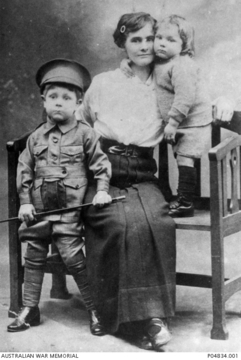
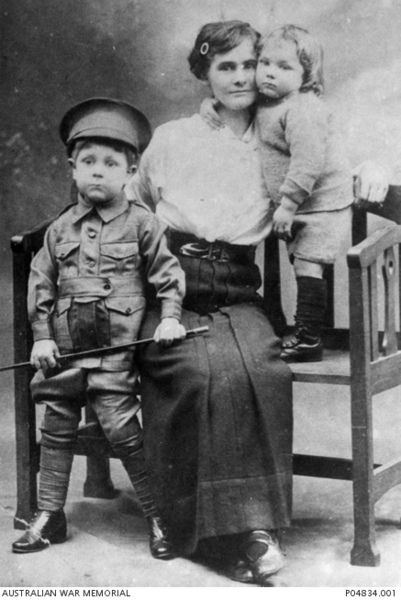
This photograph captures the domestic side of wartime service. Young Horatio Conquest is shown proudly dressed in a miniature infantry uniform, complete with swagger stick, puttees and polished boots. The pose may have been playful, but the family’s association with military service continued into the next generation. Both boys later followed their father into uniform: Horatio as a Flight Sergeant and Frederick as a Lance Sergeant.
Photo courtesy of the Australian War Memorial.
Research assistance: Chris Goddard, Historian, Australian War Memorial.
Submitted 1 July 2026 by Virginia Richmond
Signal from the Bridge: The World War One Service of William Henry Conquest, Royal Australian Navy
William Henry Conquest was born on 3 May 1886 in Camberwell, London. He enlisted in the British Royal Navy in 1904 and spent nearly a decade rising through the communication ranks before emigrating to Australia. On 1 July 1913 he was seconded to the Royal Australian Navy, making his home in Melbourne, Victoria.
As a Signaller, Conquest managed the visual communications on the bridges of active vessels — flag-hoisting, semaphore, and flashing-light Morse code.
His wartime service began on Australia's eastern seaboard, where he served aboard HMAS Warrego from 1 April to 25 May 1916. He then deployed to European waters with HMAS Swan from 1 October 1916, joining the Australian Destroyer Flotilla at Brindisi, Italy. The flotilla's mission was to maintain the Otranto Barrage — a naval blockade across the Strait of Otranto to intercept German and Austro-Hungarian U-boats entering the Mediterranean. From July 1917 to June 1918 he rotated between HMAS Parramatta and HMAS Torrens, before returning to Swan. On 2 October 1918 he took part in the Second Battle of Durazzo, screening Allied cruisers during the bombardment of the Austro-Hungarian held port of Durazzo on the Albanian coast.
The Armistice of 11 November 1918 did not end Swan's deployment. With Russia in civil war between Bolshevik and White Russian forces, the Allies committed to supporting any state prepared to resist Bolshevik expansion. On 25 November 1918, Swan and Parramatta joined a British, French, and Italian task force, passed through the Dardanelles and Bosphorus, and became the first Royal Australian Navy vessels to enter the Black Sea. They reached Sevastopol on 26 November 1918, where Swan was assigned to an Allied fleet tasked with taking over Russian anti-Bolshevik naval units and stabilising the port.
On 4 December 1918, Swan and the French destroyer Bisson departed on a special mission into the Sea of Azov. Embarking Russian Admiral Kernoff and an interpreter, the ship's purpose was to make contact with General Pyotr Krasnov, Ataman of the Don Cossacks, and report on the position of his White Russian forces. A delegation including Commander A.G.H. Bond was landed at Mariupol and travelled by train through blizzard conditions to Rostov and Novocherkassk, where they were received by large crowds and entertained at a banquet hosted by Krasnov. An advance by Bolshevik forces cut the mission short. Swan regrouped at Constantinople before sailing for Gibraltar, where she joined her sister ships and HMAS Melbourne for the return to Australia, departing 3 January 1919.
Conquest was discharged on 15 July 1919.
Submitted 1 July 2026 by Virginia Richmond
His Duty Nobly Done
Click images to start slideshow.