







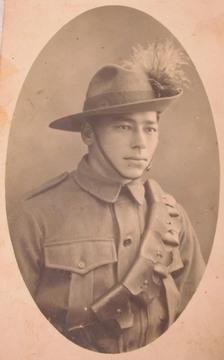
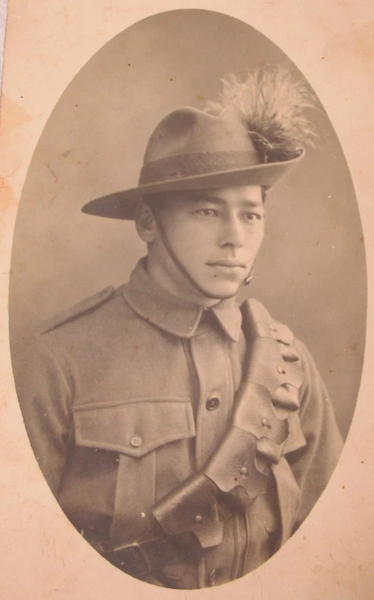
LOWE, Clarence Albert
| Service Number: | 933 |
|---|---|
| Enlisted: | 17 January 1915, Enlisted at Cunnamulla Queensland, and allocated to the 3rd reinforcements for the 11th Light Horse Regiment. |
| Last Rank: | Trooper |
| Last Unit: | 11th Light Horse Regiment |
| Born: | Grafton, New South Wales, Australia , 12 November 1891 |
| Home Town: | Frederickton, Kempsey, New South Wales |
| Schooling: | Not yet discovered |
| Occupation: | Shearer |
| Died: | Queensland, Australia , 24 February 1981, aged 89 years, cause of death not yet discovered |
| Cemetery: |
Mount Gravatt Cemetery & Crematorium, Brisbane ANZAC-3-546 |
| Memorials: |
World War 1 Service
| 17 Jan 1915: | Enlisted AIF WW1, Trooper, 933, 11th Light Horse Regiment, Enlisted at Cunnamulla Queensland, and allocated to the 3rd reinforcements for the 11th Light Horse Regiment. | |
|---|---|---|
| 16 Aug 1915: | Involvement Private, 933, 11th Light Horse Regiment, --- :embarkation_roll: roll_number: '3' embarkation_place: Brisbane embarkation_ship: HMAT Kyarra embarkation_ship_number: A55 public_note: '' | |
| 16 Aug 1915: | Embarked Private, 933, 11th Light Horse Regiment, HMAT Kyarra, Brisbane | |
| 12 Nov 1915: | Transferred AIF WW1, Trooper, 2nd Light Horse Regiment, Taken on strength as dismounted reinforcement with "D" Squadron of the 2nd LHR at Gallipoli. | |
| 12 Nov 1915: | Involvement AIF WW1, Trooper, 933, 2nd Light Horse Regiment, ANZAC / Gallipoli, Reinforcement for 2nd LHR. | |
| 22 Feb 1916: | Transferred AIF WW1, Trooper, 11th Light Horse Regiment, Returned to 11th LHR, as a member of "A" Squadron. | |
| 22 Feb 1916: | Involvement AIF WW1, Trooper, 933, 11th Light Horse Regiment, Egypt and Palestine - Light Horse and AFC Operations, Part of No. 2 Section, I ANZAC Corps, Egyptian Expeditionary Force. | |
| 19 Apr 1917: | Involvement AIF WW1, Trooper, 933, 11th Light Horse Regiment, Battles of Gaza | |
| 31 Oct 1917: | Involvement AIF WW1, Trooper, 933, 11th Light Horse Regiment, Battle of Beersheba, 11th LHR provided flank protection for other elements of 4th LH Bde. | |
| 30 Apr 1918: | Involvement AIF WW1, Trooper, 933, 11th Light Horse Regiment, Es Salt Raid | |
| 22 Jul 1919: | Embarked AIF WW1, Trooper, 933, 11th Light Horse Regiment, Embarked in Kantara aboard HMAT "Morvada" for return to Australia. | |
| 29 Oct 1919: | Discharged AIF WW1, Trooper, 933, 11th Light Horse Regiment, Discharged in 1st Military District Brisbane due to the termination of his period of enlistment. |
Help us honour Clarence Albert LOWE's service by contributing information, stories, and images so that they can be preserved for future generations.
Add my storyBiography contributed by Karan CAMPBELL-DAVIS
Clarence Albert LOW YOU was born on 12th November 1891 in Grafton, New South Wales, the youngest of six children born to parents Margaret (née REICHARDT) and James LOW YOU.
A 23 year old single shearer living in Frederickton NSW at the time, Clarence enlisted in the Australian Imperial Force in Cunnamulla, Queensland, on 17th January 1915. He gave his surname as "LOWE", a more anglicised version of the Chinese name of his father. Clarence was assigned as a Trooper, regimental number 933, and allocated to the 3rd reinforcements for the 11th Light Horse Regiment. Following completion of his recruit training at Enoggera Military Camp, Clarence embarked in Brisbane aboard HMAT "Kyarra" (A55) on 16th August 1915, for active service overseas.
Clarence was one of 50 Other Ranks and 1 Officer from the 11th Light Horse Regiment who were taken on strength as dismounted reinforcements for "D" Squadron of the 2nd Light Horse Regiment, upon their arrival on the Gallipoli Peninsula on the night of 12th November 1915. They were operating in a defensive role around ANZAC Cove in support of the 1st Infantry Division, until their withdrawal at midnight on 18th December during the Allied evacuation. They arrived in Mudros on the island of Lemnos on the 19th December, then disembarked from the HMAT "Ionian" in Alexandria, Egypt, on 26th December. Clarence rejoined the 11th Light Horse Regiment (LHR) in Heliopolis on 22nd February 1916, when he was taken on strength with "A" Squadron. He spent a brief period with the 11th LHR Training Squadron from 9th March, to refresh his mounted drills, after being reunited with the Squadron horses.
At his own request, Clarence marched into the AIF Training Battalion in Tel-el-Kebir on 26th April 1916, where he underwent further training for three weeks. He rejoined his Regiment in Serapeum on 17th May, with the daily routine including taskings for patrols and escorts, as part of the Egyptian Expeditionary Force (EEF). On 26th August 1916, Clarence was admitted to hospital with the 2/1st East Anglian (British) Field Ambulance at Ferry Post for reasons not specified, returning to duty on 5th September.
The 19th April 1917 saw Clarence involved in his first real taste of major battle, when the 11th LHR took part, dismounted, in the attack during the ill-fated 2nd Battle of Gaza. On 16th May 1917, Clarence marched into the Imperial School of Instruction in Zeitoun, where he successfully completed the 26th Hotchkiss Gunner's Course on 25th May. He rejoined his Unit in Rafa two days later. June 1917 saw the expansion of the EEF Desert Column, with the 4th Light Horse Brigade (of which the 11th LHR were part) becoming part of the Australian Mounted Division (AMD).
On 30th October 1917, the EEF received orders to prepare to attack and capture the town of Beersheba from the East, with the objective of seizing the town's water supply, "in order to form a base for future operations Northwards". Upon the arrival of "Z Day", the 31st October 1917, the 11th LHR were ordered to "follow up as support" for its' 4th Light Horse Brigade sister units, the 4th and 12th Light Horse Regiments, by forming outposts on the North-West and South flanks. Arriving in Beersheba about 1930hrs, the heavily fortified garrison town which was surrounded by entrenched Ottoman Infantry, was charged by the men of the 4th and 12th LHR with bayonets in hand, in the face of rifle, machine gun and artillery fire. By 2030hrs, Clarence's 11th LHR had rounded up and disarmed 275 Ottoman prisoners. This was the beginning of the Southern Palestine Offensive, which culminated in the capture of Jerusalem six weeks later.
Between 30th April and 3rd May 1918, the 11th LHR took part in the Second Action of Es Salt, East of the Jordan River, but after heavy fighting, were eventually forced to withdraw back to the Jordan Valley. Clarence was evacuated sick by the 4th Light Horse Field Ambulance to the 66th (British) Casualty Clearing Station on 11th May 1918, being admitted to the 75th Casualty Clearing Station in Al-Imara on the 16th May. He was transferred via the 47th (British) Stationary Hospital in Gaza, to the 31st General Hospital in Abbassia on 20th May, with pyrexia (fever) of unknown origin (PUO). Clarence was discharged and transferred to the Convalescent Depot in Boulac, Cairo, on 27th May to regain his strength, and to have some respite from the arduous desert operations in extreme heat. On 12th June 1918, Clarence marched into the 4th Light Horse Training Regiment in Moascar, returning to the 11th LHR on 20th June.
July 1918 again saw the reorganisation of the Australian Mounted Division which, apart from the Artillery, was now composed of almost entirely Australian units. Clarence was again evacuated sick with pyrexia of unknown origin on 14th August 1918, to the 76th Casualty Clearing Station. He was transferred to the 47th Stationary Hospital in Gaza on 16th August, then to the 31st General Hospital in Abbassia two days later. On 4th September he returned to the Convalescent Depot in Boulac, for another 10 days of recovery, before being taken on strength with the 4th Light Horse Training Regiment from 14th September until 5th October, when he returned to the 11th LHR. Clarence was then detached to the Desert Column Rest Camp in Damascus from 28th October until 4th November 1918.
By the time he returned to his Unit, the Armistice of Mudros had already come into effect (at noon on 31st October 1918), ending hostilities in the Middle East. On 16th March 1919, the 11th LHR returned to Egypt from Syria, when they were made aware of the civilian unrest and riots which had erupted in the previous week (1919 Egyptian Revolution), and warned of possible damage to the railway. They posted an armed firing party on their train journey from Port Said to Moascar, but it went without incident. Two days later, the 4th Light Horse Brigade, which included the 11th LHR, were ordered to carry out patrol taskings along the railway and roads to Tel-el-Kebir, and enforce a night time curfew. They also assisted the Egyptian Police to arrest ring leaders, including one native wanted for murder. These taskings continued until the end of March, after which the Brigade relocated to Mansoura. On 6th April, a party of one Officer and 10 Other Ranks from the 11th LHR were performing an armed escort aboard a railway construction train, as it repaired sections of the line which had been damaged by rioters. Upon reaching Menzala railway station, they were met by 600 angry Egyptians on the platform, who pelted them with stones. When orders to disperse were ignored, the Escort Party fired upon the natives, killing 2 and wounding 8. The 11th LHR continued to carry out daily patrols and armed escorts while the railway and telephone lines were being repaired, right up to the time they left Egypt.
On 22nd July 1919, Clarence and the 11th LHR embarked in Kantara aboard HMAT "Mervada" for return to Australia, departing at 1530hrs. Clarence disembarked in Sydney on 30th August, and was subsequently discharged due to the termination of his period of enlistment in the 1st Military District, Brisbane, on 29th October 1919. For his service, Clarence was later awarded the 1914-15 Star, the British War Medal and the Victory Medal, along with a Discharged Returned Soldier's Badge. He also qualified for the ANZAC Commemorative Medallion, which was instituted in 1967 and awarded to those who served on the Gallipoli Peninsula.
Clarence Albert LOWE died in Brisbane, Queensland on 24th February 1981. He was 89 years old. He was interred at the Mount Gravatt Cemetery and Crematorium.
Compiled by Karan CAMPBELL-DAVIS from historical records held by the National Archives of Australia (Service Record); Australian War Memorial (2nd LHR and 11th LHR Unit War Diaries); Births, Deaths and Marriages NSW; Births, Deaths and Marriages Qld; and Find A Grave website.
Click images to start slideshow.