







BAINES, Edward Albert
| Service Number: | 729 |
|---|---|
| Enlisted: | 15 February 1916 |
| Last Rank: | Private |
| Last Unit: | 3rd Pioneer Battalion |
| Born: | London, England, June 1887 |
| Home Town: | Beechmont, Queensland |
| Schooling: | Not yet discovered |
| Occupation: | Labourer |
| Died: | Brisbane Mental Hospital, Goodna, Queensland, Australia, 19 August 1958, cause of death not yet discovered |
| Cemetery: |
Lutwyche Cemetery, Brisbane, Qld Anzac Portion 9, Lutwyche Cemetery, Brisbane. |
| Memorials: |
World War 1 Service
| 15 Feb 1916: | Enlisted AIF WW1, Private, 729, 3rd Pioneer Battalion | |
|---|---|---|
| 6 Jun 1916: | Involvement Private, 729, 3rd Pioneer Battalion, --- :embarkation_roll: roll_number: '5' embarkation_place: Melbourne embarkation_ship: HMAT Wandilla embarkation_ship_number: A62 public_note: '' | |
| 6 Jun 1916: | Embarked Private, 729, 3rd Pioneer Battalion, HMAT Wandilla, Melbourne | |
| 11 Jul 1918: | Discharged AIF WW1, Private, 729, 3rd Pioneer Battalion, 1st MD, Medically discharged |
Help us honour Edward Albert Baines's service by contributing information, stories, and images so that they can be preserved for future generations.
Add my storyBiography contributed by Evan Evans
From Australian Remembrance Army
Over the past six years we have submitted the service records and causes of death of several hundred veterans to the Office of Australian War Graves for assessment for Official Commemoration. To date, more than 100 of these veterans interred at Lutwyche Cemetery have been accepted as Official Commemorations, and their graves are now being formally marked and will be maintained in perpetuity by the Office of Australian War Graves.
Private Edward Albert Baines (Service No. 729), an Australian World War One veteran, is one of the previously unmarked WWI veterans’ graves in Lutwyche Cemetery that has been accepted as Official Commemorations by the Office of Australian War Graves.
See Australian Remembrance Army Facebook page
OAWG Official Commemoration link: https://connect.dva.gov.au/.../viewCommemoration.html...
Edward Albert Baines was born in London, England, in 1888 and later migrated to Queensland, where he worked as a labourer. On 15 February 1916 he enlisted in the Australian Imperial Force at Brisbane, aged 28 years.
Baines embarked from Melbourne on 6 June 1916 aboard the troopship Wandilla, arrived in England in July, and proceeded to France on 24 November 1916 with his unit. On 29 August 1917 he was admitted to hospital and, on 3 September 1917, entered No. 8 General Hospital at Rouen suffering from acute mania. He was evacuated to England, admitted to the Royal Victoria Hospital at Netley, and then transferred to Dykebar War Hospital in Scotland for psychiatric treatment. Medical boards diagnosed him with recurrent mania and noted that he had previously been treated at the Abergavenny asylum in Wales several years earlier. His condition was considered hereditary but aggravated by war service.
He returned to Australia on 30 January 1918 and was discharged from the army on 11 July 1918 as permanently unfit for military service due to mental disability, assessed as causing 50 percent incapacity. Post-war medical reports recorded ongoing nervous symptoms that prevented sustained manual labour, and his war pension continued at a partial rate.
Private Edward Albert Baines spent much of his later life in psychiatric care at the Brisbane Mental Hospital, Goodna. He died there on 19 August 1958, aged 70, and was buried in Anzac Portion 9, Lutwyche Cemetery, Brisbane.
He never married and had no known children. His estate was administered by the Public Curator, and among his effects officials found his Returned from Active Service badge. As no next of kin could be identified, the badge was forwarded to the Central Army Records Office for destruction.
In 2024, we received notification that the Office of Australian War Graves had accepted our application for an Official War Graves Commemoration.
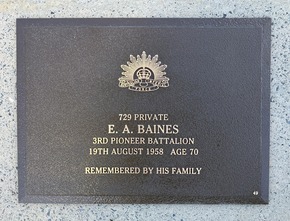
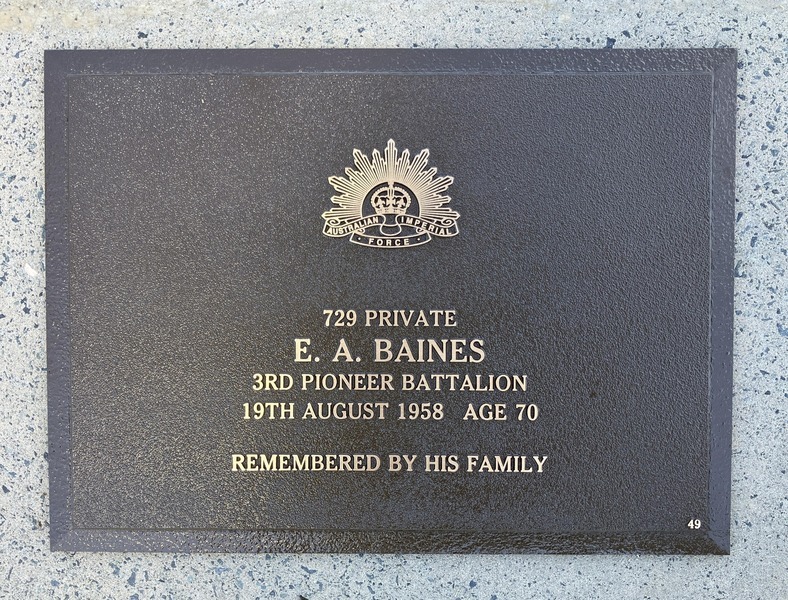
After decades in an unmarked grave, his final resting place now bears a plaque commemorating his service to Australia — ensuring his name endures among those remembered for their duty and sacrifice. His identity and dignity have now been restored.
Lest We Forget
Click images to start slideshow.