







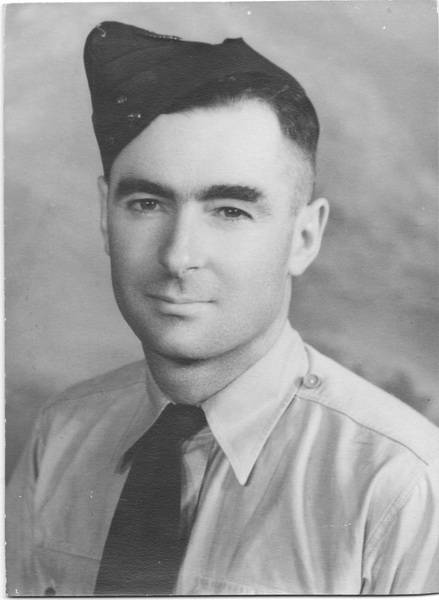
CATHCART, Hector
| Service Number: | 49928 |
|---|---|
| Enlisted: | 19 January 1942 |
| Last Rank: | Sergeant |
| Last Unit: | HQ North Eastern Area Command (RAAF) |
| Born: | Sea Lake, Victoria, Australia, 8 January 1909 |
| Home Town: | Middle Park, Port Phillip, Victoria |
| Schooling: | Not yet discovered |
| Occupation: | Not yet discovered |
| Died: | Victoria, Australia, 27 December 2002, aged 93 years, cause of death not yet discovered |
| Cemetery: |
Kerang Cemetery, Victoria, Australia PLOT- Lawn Row F # 30 |
| Memorials: |
World War 2 Service
| 19 Jan 1942: | Enlisted Royal Australian Air Force, Sergeant, 49928 | |
|---|---|---|
| 5 Oct 1945: | Discharged Royal Australian Air Force, Sergeant, 49928, HQ North Eastern Area Command (RAAF) |
Life in the RAAF
In 2001, when he was 92, Hector Cathcart wrote his recollection of his time with the RAAF.
Sue and Julie. Often you have asked me to write of my experiences in the war, but I have always dodged it as I did not do anything in the fighting line. When I did enlist, it was not at the very onset of war. Mona and I were alone in a flat, and I did not like to leave her, but having no children, I decided it was my job to do so. So, when I enlisted, it was not too early in the war. I was working at Goldsborough Mort in a Bourke Street store; eventually, I was made the one in charge of one of their show floors. At this time, men or women who were something of importance to a firm could be stopped from enlisting – to cut a long story short, I told them I was a labourer and was accepted immediately as an aircraft hand first class - the lowest rank in the RAAF – I even forget where I reported, but I ended up at Laverton air force base. Here, with a lot of others, I was trained to march like a soldier should, etc. It was at Laverton that I experienced the time I told you of many times when you were kids. That story is true except for the slipping part [?] After the initial training, we were all sent to various places to see where we were wanted. I think we had to apply for jobs and then went into training to see if we were suitable. I applied for the Meteorological Bureau and was sent to, I forget where, but before settling at a station, we were trained to do the job. My task was to decode messages sent out in a series of numbers from every weather station in Australia and some from New Guinea. After a lot of training in various places, Laverton, Shepparton, Mallala, SA – I forget the others – I was posted to Cairns, a beautiful town on the north coast of Queensland, where I stayed for well over a year. It was here that I had a taste of something a bit different from sitting at a desk all day or night.
The Naval officer in charge of an island watching for Jap subs and in charge of a contingent of young chaps complained that the forecasts they received were not secure enough, as they had to sail to Cairns for provisions. They asked for one of us to go out with them and report on the trip. Somehow it did not appeal to the rest of the staff, so I overtured to go. This Island was about 17 miles down the coast from Cairns. As we were sailing along, I noticed that the sailors were very young – cadets, I suppose. They were all down in the hold and could not see where they were going; no wonder they were scared.
I was up with the skipper and could see the big waves ahead. I was up alongside the skipper, and believe it or not, I enjoyed it as I had complete faith in the craft and its skipper, but I could imagine the fear it would instil into the minds of these boys. I believe I was twice as old as some of them, being well over 30 at the time. This had a nice ending for me as our officer called me one day and told me that the Naval officer had given me a good recommendation. It was only a few weeks later that I received my Corporal stripes and then my Sergeant stripes. After leaving Cairns, I was posted to a place called Higgins Field – nothing but a landing strip and a few huts. It was a lonely place, and thankfully, the war ended not long after. This Higgins Field was nicknamed Jacky-Jacky by the Aboriginals because it was not far from the Jacky-Jacky River. One day, a mate and I got two rifles and went to see if we could shoot some crocs; luckily, we did not see any, as I do not know how we could handle the big rifles, so kids, you can say truthfully, "my father went "Shooting crocodiles on the Jacky-Jacky". I cannot recall anything after this. I must have flown back to Cairns, as I seem to remember going by train to Melbourne some of the way. Mona had left Manton's to rear little Sue, and the first I remember of Sue was walking along a street with her on a long lead with harness attached and her trying to pull us along.
Submitted 8 April 2026 by Sue McLean


Click images to start slideshow.