







CAMROUX, William Henry
| Service Number: | 2889 |
|---|---|
| Enlisted: | Not yet discovered |
| Last Rank: | Private |
| Last Unit: | 17th Infantry Battalion |
| Born: | Not yet discovered |
| Home Town: | Not yet discovered |
| Schooling: | Not yet discovered |
| Occupation: | Not yet discovered |
| Memorials: |
World War 1 Service
| 2 Nov 1915: | Involvement Private, 2889, 17th Infantry Battalion, --- :embarkation_roll: roll_number: '12' embarkation_place: Sydney embarkation_ship: HMAT Euripides embarkation_ship_number: A14 public_note: '' | |
|---|---|---|
| 2 Nov 1915: | Embarked Private, 2889, 17th Infantry Battalion, HMAT Euripides, Sydney |
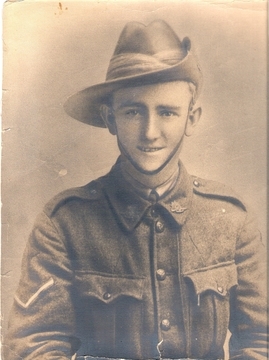
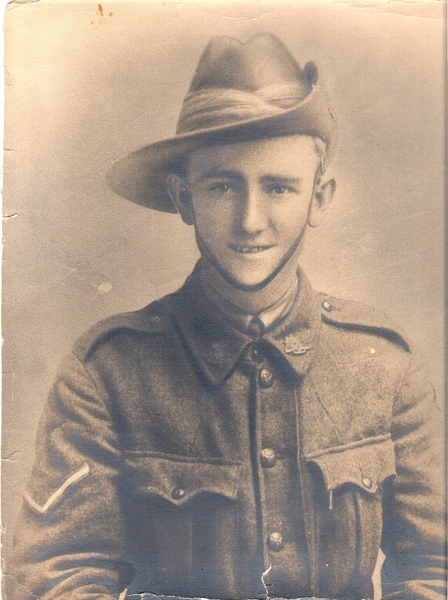
William Henry Camroux
Lance Corporal William Henry Camroux was born in Manly on 27th June, 1893.
He was the eldest child of Henry William and Rachael Ann (Orchard) Camroux,
and was of French and English heritage.
He was commemorated at the 2019 Villers-Bretonneux Anzac Day Service by Vice Admiral Michael Noonan.
William (also known as “Blue” because of his red hair) worked as a labourer and enlisted in the AIF “A Coy” 17th Battalion on 20th August 1915 at the age of 22. His younger brother Clarence also enlisted, and on 16th August 1915 at the age of 18, was posted to the 20th Battalion. He spent time in Egypt and the Western Front and returned to Australia in August 1917.
William left Australia on “Euripides” on 2nd November 1915 and spent time in Egypt before being deployed to the Somme in July 1916. On 22nd August, he saw a close friend, Clarrie, seriously wounded and so began a long correspondence between the two men, one at the front and the other in an English hospital.
In May 1917 William wrote of Bullecourt “well at 3.45 there was a rumble behind us and then our barrage hit his trench. It was the prettiest sight I’ve ever seen. That was our signal to advance. Then hell broke loose – machine guns, snipers and bombers got busy and we got it”. William was only a small man (5”4”) but on this day was carrying, like everybody else, battle order equipment, rifle & bayonet, a shovel or pick, 4 sandbags and a bag of 40 Mills bombs. He commented “some load to be getting along through a barrage with, isn’t it?”.
William spent time in many parts of the Somme (sometimes marching 20 miles a day), including Ypres of which he said “it, the town, is one mass of ruins. They will never build it up again”.
On 18th November, 2017, he was in the front line again at Flers and he writes “that’s where I found out what I was made of. We went through a barrage to get in, but that was nothing compared to what we experienced when we got there. We were wet and cold and the trench was full of mud, it was impossible to sleep so we just had to shiver and moan all night for the 4 nights we were in and to cap the lot “he” put a big H.E. on our ration dump and blew the lot up. We were living on biscuits with cocoa and milk spread on them the last two days”.
William was wounded twice but remained in the field. His daily rate of pay for the duration of the war was 4 shillings and sixpence.
On 3rd October 2018, he was gassed in the last Australian Infantry action of the war at the Battle of Montbrehain.
William embarked on the T.S. “Takada” in Plymouth, UK, and sailed for home on 25th December 1918. He disembarked in Woolloomooloo on 16th February and was welcomed home to Rozelle by his parents, two sisters and brother. He was formally discharged on 22nd June 1919.
On 12th June 1919, he commenced work at Cockatoo Island and then on 12th September of the same year left Sydney for the North Coast where he noted in his diary “Oct 14th: took over Plantation”. William was one of a number of returned soldiers who were resettled on the fertile lands of the North Coast around Murwillumbah and Mullumbimby.
On 29th October 1920, William telephoned Mr Jack Kunkler, the Soldiers Settlement Manager, and told him he was leaving the Plantation.
William relocated to Penrith and on 26th January 1924, married Pearl Honeman, whose family were 2nd Fleet descendants and were early pioneers of the Windsor/Rouse Hill district. William and Pearl had two children: Keith, 1925 and Betty, 1926.
Unfortunately William struggled with ill-health and “war demons” after returning home and on 31st August 1935, at the age of 42, was discovered dead in a street in Penrith having suffered a massive heart attack. His children were aged 11 and 9.
Submitted 20 April 2026 by Di Anstey
Click images to start slideshow.