








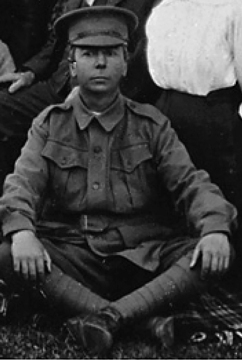
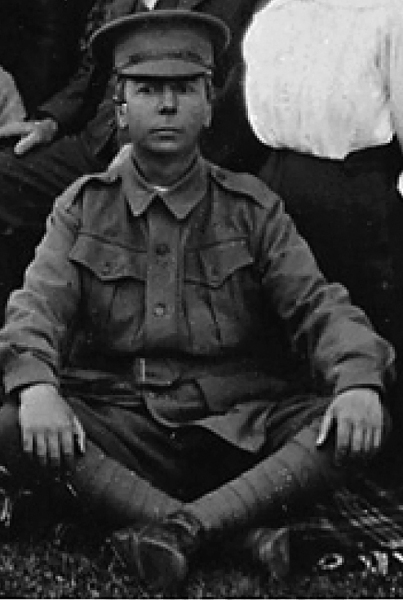
GOLDING, Herbert
| Service Number: | 564 |
|---|---|
| Enlisted: | Not yet discovered |
| Last Rank: | Private |
| Last Unit: | 23rd Infantry Battalion |
| Born: | Stoke Newington, London, June 1880 |
| Home Town: | Canterbury, Boroondara, Victoria |
| Schooling: | Not yet discovered |
| Occupation: | journalist |
| Died: | Died of wounds, France, 27 August 1916 |
| Cemetery: |
Contay British Cemetery, Contay, France |
| Memorials: | Australian War Memorial Roll of Honour, Balwyn War Memorial, Lancefield War Memorial |
World War 1 Service
| 10 May 1915: | Involvement Private, 564, 23rd Infantry Battalion, Battle for Pozières , --- :embarkation_roll: roll_number: '14' embarkation_place: Melbourne embarkation_ship: HMAT Euripides embarkation_ship_number: A14 public_note: '' | |
|---|---|---|
| 10 May 1915: | Embarked Private, 564, 23rd Infantry Battalion, HMAT Euripides, Melbourne |
Biography
Herbert (Bert) Golding was born in June 1880 in Stoke Newington, England. He was the eldest of nine children. His parents were his parents were Alfred and Kate (nee Littleton) Golding who were boot manufacturers in London. The family emigrated to Melbourne in 1882 and set up a successful boot manufacturing firm in Canterbury. Bert married Annie Florence James on November 10th, 1905, and they had two boys Herbert Victor (1908) and Donald James (1913). In 1913 Bert was a journalist who had worked on several newspapers in Victoria and South Australia, prior to his enlistment. He also served two years in the senior cadets while at school.
He enlisted on 12 February 1915 assigned as private to 23rd Battalion, C Company. His unit embarked from Melbourne, Victoria, on board HMAT A14 Euripides on 10 May 1915. Bert landed at Gallipoli and fought at Lone Pine, then was transferred to France where he was wounded by an artillery shell exploding nearby that caused a trench wall t collapse on him at Pozieres. He died of his wounds 27 August 1916 and is buried at Contay British Cemetery (Plot I, Row A, Grave No. 3), France.
Submitted 21 April 2026 by Michael Brd
Biography contributed by Michael Brd
Herbert (Bert) Golding was born in June 1880 in Stoke Newington, England. He was the eldest of nine children. His parents were his parents were Alfred and Kate (nee Littleton) Golding who were boot manufacturers in London. The family emigrated to Melbourne in 1882 and set up a successful boot manufacturing firm in Canterbury. Bert married Annie Florence James on November 10th, 1905, and they had two boys Herbert Victor (1908) and Donald James (1913). In 1913 Bert was a journalist who had worked on several newspapers in Victoria and South Australia, prior to his enlistment. He also served two years in the senior cadets while at school.
He enlisted on 12 February 1915 assigned as private to 23rd Battalion, C Company. His unit embarked from Melbourne, Victoria, on board HMAT A14 Euripides on 10 May 1915. Bert landed at Gallipoli and fought at Lone Pine, then was transferred to France where he was wounded by an artillery shell exploding nearby that caused a trench wall t collapse on him at Pozieres. He died of his wounds 27 August 1916 and is buried at Contay British Cemetery (Plot I, Row A, Grave No. 3), France.
https://trove.nla.gov.au/newspaper/article/75166348
The Reporter (Box Hill, Vic. : 1889 - 1925) Fri 13 Oct 1916
DEATH OF PRIVATE GOLDING.
News has been received by Mr. and Mrs. A. Golding, of Balwyn Road, Canterbury, that their son, Private Herbert Golding, died from wounds in France on August 27. He volunteered 18 months ago, and had served for 4½ months at Gallipoli. After a brief rest in Egypt, he was sent to France with the first batch of Australians. Prior to the outbreak of war the late Private Golding followed the profession of journalism, in which he displayed talents of a particularly high standard. For some time he was engaged on the reporting staff of this paper, and afterwards was on Adelaide and Mount Gambier papers. For a lengthy period he contributed to the columns of the "Bulletin" under the nom de plume of "Wusslean." Latterly he launched out into the proprietorship of newspapers, and shortly before enlisting owned "Lancefield Mercury." Deceased was well-known throughout this district, where he made numerous friends and admirers of his skill with the pen. His last contribution to "'The Reporter," from "somewhere in France," appeared on July 7. He leaves a widow and two young children, who are at present residing at Cheltenham, and with whom much sympathy is felt in their sad loss, together with his parents, who have been residents of Canterbury for over 30 years. His youngest brother, Private Stanley Golding, also sailed last week for the front.
Bert wrote for the paper:
https://trove.nla.gov.au/newspaper/article/75165803
The Reporter (Box Hill, Vic. : 1889 - 1925) Fri 7 Jul 1916
"SOMEWHERE IN FRANCE." Mr. H. Golding, formerly of the "Reporter" staff, who went to the front with the 6th Brigade 14 months ago and is one of the Anzacs, writes from "Somewhere in France" as follows:—
"Fritz is sending odd shrapnel shells over nearby just now. Yesterday afternoon I couldn't write. It was funny; they shortened up, the shells had been passing over, till they nearly got us, so we shifted out of the dugout. I sat down and began reading a book, and they burst a shell right in front and plastered me all over with dirt. So we wandered further and sat down, and there they hit the parapet and smashed up a traverse, so another shower of mud and pieces came on us. I got up in disdain and mooched away like the cat does when she doesn't want to be stroked. Last night the artillery on our left was going thicker than ever; it sounded like a battle. A howitzer has started on us. If it shortens up I'm going up the line to borrow a match! Well last night the 'straffing' moved up along the line till at ten o'clock it turned the corner and we were well in it. You should hear the shell that just fell. You hear it coming like an express train, and then it seems to charge into Cole's crockery shop. "This is Sunday, two or three days later. The interval represents a 'period of activity' during which it wasn't possible to write. Well, the argument spread along the line, and at 10 p.m. we were in bed and we got 'stand to,' and manned the parapets, while in two hours over 4000 shells were poured into the sector held by 'D' and 'C' companies — a line as long perhaps as from Canterbury Road to Hindson's top gate. Sometimes the records show a shell a second was bursting on us. Oh, Jerusalem, it was hot! We couldn't hear our own artillery (which generally half deafens us) for the bursting of the shells. I said 'This is like Mrs. Hemans' banyan tree, it turns your thoughts back to mother.' I didn't know our lieutenant was sitting just by. We call him 'Mother' because he looks after us so well. After a while waiting for the bump got monotonous, and we all made cigarettes and smoked them. 'They' kept on asking if we were alright, because we were in the direct line of fire. It was terrific, and a great relief when it stopped, but if the Germans thought it was to frighten us they failed, and if they had come over, thinking us de- moralised by the pounding, they would have fallen in, because we were all as fresh as paint. For the first half-hour you feel a bit 'off,' thinking you won't see home again. I believe the cowards sent gas over, and someone in authority sent up the S.O.S. signal in the air for our artillery. Fancy being in the front line, especially in such rotten trenches when they send up 'Save our souls.' Well, our artillery blew the gas away, but it meant shelling the Germans' lines, so they shelled ours. Of course you just brace yourself up for whatever is coming. None of us liked it, but we are absolutely steady. A little group of us sat under the parapet at the empty post Clive and I used to man and looked at one another. There are few of us old hands, but the reinforcements stood it well. The 24th were in reserve and were called up, and thinking we were being massacred they came as quickly as they could, very bravely, considering the Germans put a curtain fire behind us to isolate us while they pounded us. It has been found to act when the British use it on the enemy, but our boys won't be 'stood off' while their mates get pasted. Give them their due, with all their faults, Fritz meets good soldier stuff in the A.I.F. You know the British we relieved told us all along before we went in that while Bavarians or Saxons were there, at any rate while you let them alone, they'd keep quiet. But we did not think we're here to 'live and let live.' Those swine have no business here destroying these beautiful peaceful little towns and farms, and we're here to show them. So we shook them up all the time, and of course in the reprisals and being so daring got as many casualties each day as the last lot got in seven or ten weeks on their showing. The night we got pasted was to be our last night in for awhile. You see its so hot you only get a few days where it is hottest; the relief is most frequent. I would have liked —— to have heard the first time we sooled a new instrument of torture on to them. The night before we did leave a lot of us were sent back to the reserve trench to avoid the unpleasantness expected, and then we let fly with one of those trench mortars you read about in the 'World's Snooze,' but seldom see. It fires a round shell the size of the Colloseum at Rome, and lands like the collision of two comets and leaves a hole like the Valley Lake, besides lighting up right to Asia and Africa with its flash. The Prussians were 'in' on their side, so we played a few overarms from it on to their wicket. It was lovely, and must have made them sorry to be in France. They tried then and next day to hit it with artillery, and landed two or three howitzers that blew craters near my dugout. I know —— will be glad we made the Huns understand they are not welcome here, and chanced them doing their worst to us. Our trenches there won't be the quiet home they used to be. "To-day we are in a camp in huts among lovely beeches and elms and grass and wildflowers. Fancy being able to undress and wash after ten days forbidden to take even your boots off! I had a newspaper cutting while I was on the Peninsula that Gallipoli was the most terrible business of the war, and I didn't believe it. I do now. It is a picnic here, though we are in the most advanced part of the British-French line in a big salient or bay, out beyond the rest of the line. I am writing in a little cafe, with orchards all around, and the trees are in bloom and the cherries half formed. Shells go further on than this, but we are in peace comparatively. It is very beautiful, the real 'la belle Francais.' All along the roads and at corners are wayside shrines, and the Germans have put shells through most of them, but the Figure is seldom hit. By the convent garden walls pretty fruit trees and creepers flower, but a close look discloses old trenches and graves of German soldiers, and lots of little cemeteries of our own folk are here, grass and flower-grown. Certainly on this 'western' front the Germans are stopped, and have been for a long time, but it's a going to be a long and difficult job to shift them."
The circumstances surrounding his death were reported by a comrade who served with him at the time:
https://trove.nla.gov.au/newspaper/article/153609677
Camberwell and Hawthorn Advertiser (Vic. : 1914 - 1918) Sat 28 Oct 1916
HOW PRIVATE GOLDING WAS FATALLY WOUNDED.
The appended letter has been received by Mr. and Mrs. A. Holding, of Balwyn Road, Canterbury, with respect to the wounds sustained by their son, Private - Herbert Golding. Apparently the writer was not aware at the time that the wounds proved fatal: —
'Somewhere in France,' Aug. 31, 1916
Dear Mrs Golding — No doubt by the time this letter reaches you, you will have had full news of your son Bert's wounds, but I thought that I would write and let you know how he got them.
I was section corporal, and happened to be alongside him when the shell came in. We were in the front line of trench and Fritz landed a Jack Johnson right between us. I escaped alright, but Bert got buried in the fall of the trench, I came alongside him with a shovel and dug him out. He complained that his legs were broken, and I fancy his wrist was gone, but I don't think that he was hit with the shell. I got a stretcher right away, and we got him out alright, and must be well in hospital by now. My word, you have got a son you have real cause to be proud of. No words of mine could express our admiration of his wonderful behaviour, a cool, brave and determined soldier, not much muscle, but a heart like a lion. I have lost for a time one of my best friends. When I last saw him he was lighting his pipe and smiling away to himself, 'Anzac' written across his face.
A Jack Johnson couldn't kill him, and ten more couldn't break his heart. He was one of the few old boys left and was at all times the life of the company, cracking jokes, the best of them when we were right up against it. I don't think there is any cause to worry about him for he is in good hands and will get over it, and stands a good chance of being sent home for a rest, you will have him by the fireside for Xmas, of that I feel sure. I want you to give him a royal welcome, because there is no other man who deserves it better. He had a long run of it, and did excellent work. 1 will conclude by wishing him the best of good luck and a speedy recovery and return to his wife and kiddies. Will you please let his wife know about this. — yours sincerely (Signed) FRANK COLDSMlTH (Goldsmith?) (Corporal), No. 11 Platoon, 'C' Company, 23rd Battalion. ( 6th infantry brigade, 2nd Division AIF)
Click images to start slideshow.