







MERRIFIELD, George Bertram
| Service Number: | 1674 |
|---|---|
| Enlisted: | 31 December 1914 |
| Last Rank: | Private |
| Last Unit: | 57th Infantry Battalion |
| Born: | Castlemaine, Victoria, Australia, June 1892 |
| Home Town: | Hawksburn, Victoria |
| Schooling: | Not yet discovered |
| Occupation: | Labourer |
| Died: | Brisbane, Queensland, Australia, 5 April 1961, cause of death not yet discovered |
| Cemetery: |
Lutwyche Cemetery, Brisbane, Qld Anzac Portion 9 |
| Memorials: |
World War 1 Service
| 31 Dec 1914: | Enlisted AIF WW1, Private, 1674, 5th Infantry Battalion | |
|---|---|---|
| 19 Feb 1915: | Involvement Private, 1674, 5th Infantry Battalion, --- :embarkation_roll: roll_number: '8' embarkation_place: Melbourne embarkation_ship: HMAT Runic embarkation_ship_number: A54 public_note: '' | |
| 19 Feb 1915: | Embarked Private, 1674, 5th Infantry Battalion, HMAT Runic, Melbourne | |
| 1 Nov 1917: | Embarked AIF WW1, Private, 1674, 57th Infantry Battalion, 3rd MD, medically discharged |
Help us honour George Bertram Merrifield's service by contributing information, stories, and images so that they can be preserved for future generations.
Add my storyBiography contributed by Evan Evans
From Australian Remembrance Army
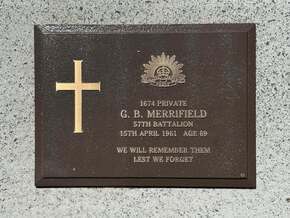
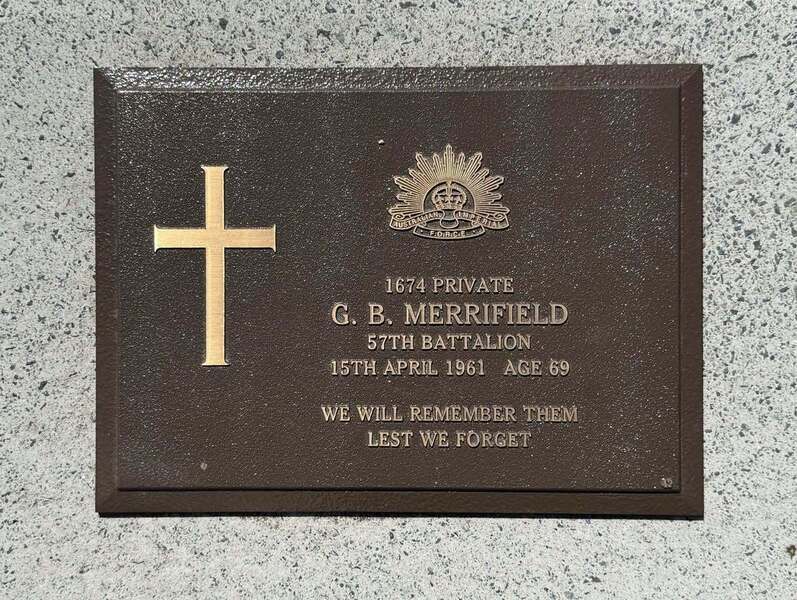
Australian World War One veteran Private George Bertram Merrifield (Service No. 1674), is one of the previously unmarked WWI veterans’ graves in Lutwyche Cemetery that has been accepted as an Official Commemoration by the Office of Australian War Graves.
We unveiled his plaque in Lutwyche Cemetery on 16 May 2026, along with a further 185 plaques on the previously unmarked graves of Australian World War One veterans:
See Australian Remembrance Army Facebook page
OAWG Official Commemoration: https://connect.dva.gov.au/.../viewCommemoration.html...
George Bertram Merrifield was born in 1892 at Castlemaine, Victoria, the son of Arthur John Merrifield and Alice Marion Merrifield, née Ochiltree. On 31 December 1914, at Victoria Barracks in Melbourne, he enlisted in the Australian Imperial Force. At the time of his enlistment, he worked as an agricultural labourer and was single. He embarked from Melbourne on 19 February 1915 aboard HMAT Runic.
After reaching the Middle East, Merrifield joined the 5th Battalion at Gallipoli. In June 1915, he became ill with dysentery and was admitted to hospital, passing through Lemnos and Mudros before being sent on to Malta. His records also refer to pneumonia and diarrhoea, with treatment connected to Lemnos, Mudros, Malta and the hospital ship Somali. In October 1915, Base Records in Melbourne advised his family that he was suffering from pneumonia but was improving. A further letter in December 1915 reported that he had dysentery following earlier pneumonia.
By early January 1916, Merrifield had rejoined his battalion at Tel-el-Kebir in Egypt. In March 1916, he was transferred from the 5th Battalion to the 57th Battalion during the major reorganisation of the AIF after Gallipoli. While in Egypt, he was again treated for medical problems, including sore and blistered feet, at places including Ismailia and Ferry Post. In June 1916, he embarked from Alexandria aboard H.T. Kalyan and disembarked at Marseilles to join the British Expeditionary Force. His service then moved to the Western Front in France with the 57th Battalion.
In France, Merrifield continued to experience periods of sickness and hospitalisation. He was sent to hospital sick in late 1916 and admitted with exhaustion in November. At the end of December 1916, he was admitted with mumps and passed through hospitals and depots including Rouen and Etaples. In March 1917, he was moved from France to England, reaching Weymouth through command depot channels. He was returned to Australia in July 1917.
Private George Bertram Merrifield died on 15 April 1961, aged 69, and was buried in Anzac Portion 9, Lutwyche Cemetery, Brisbane. His death was registered under the name William George Field.
In 1985, Mr George Robert Merrifield of Toowoomba lodged a Freedom of Information request seeking army postings and service medical records for Private G. B. Merrifield. He stated that George was his cousin and that the family was trying to establish where and when he had served, as very little was known about his army service.
In August 2024, more than sixty years after his death, we received notification that our application for an official war graves commemoration had been accepted for War Graves purposes.
His identity and dignity have now been restored.
Lest We Forget
Note:
Over the past six years we have submitted the service records and causes of death of hundreds of veterans to the Office of Australian War Graves for assessment for official commemoration. To date, more than 100 of these veterans interred at Lutwyche Cemetery have been accepted as Official Commemorations, and their graves are now being formally marked and will be maintained in perpetuity by the Office of Australian War Graves.
Many Australians are unaware that, unless specific eligibility criteria are met, returned service personnel are not automatically entitled to an official government-issued headstone or plaque at their place of interment. As a result, tens of thousands of Australian veterans lie in unmarked graves across the country.
Eligibility for official commemoration in Australia must satisfy one of the criteria outlined by:
• Commonwealth War Graves Commission (CWGC) – Criteria and qualifying service dates:
https://www.cwgc.org/.../what-are-commonwealth-war-graves/
• Department of Veterans’ Affairs (DVA) / Office of Australian War Graves (OAWG) – Additional war grave eligibility criteria:
https://www.dva.gov.au/.../commemo.../official-commemoration
Click images to start slideshow.