


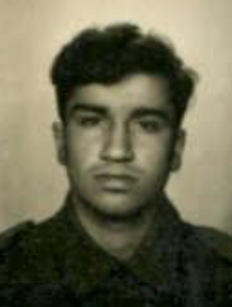
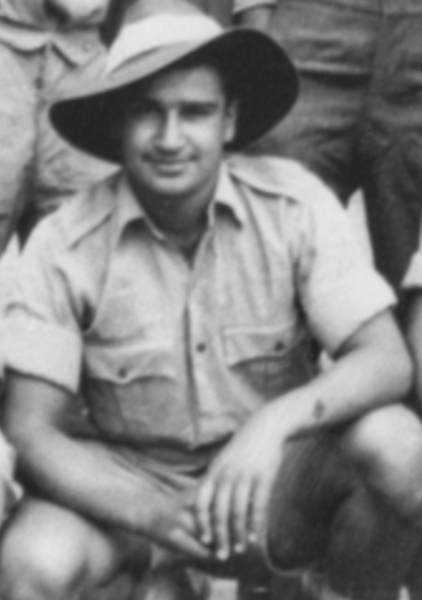
JACKOMOS, Alick
| Service Number: | VX71917 |
|---|---|
| Enlisted: | 13 January 1942, Caulfield, Vic. |
| Last Rank: | Private |
| Last Unit: | 2nd/14th Infantry Battalion |
| Born: | Carlton, Victoria, Australia, 25 December 1922 |
| Home Town: | Carlton, Melbourne, Victoria |
| Schooling: | Not yet discovered |
| Occupation: | Motor Mechanci |
| Died: | Cancer, St Vincent’s Private Hospital, Fitzroy, Melbourne, Victoria, Australia, 4 March 1999, aged 76 years |
| Cemetery: |
Melbourne General Cemetery, Carlton, Victoria MGC-PRES-Comp-NA-No-10 |
| Memorials: | Victorian Garden of Remembrance |
World War 2 Service
| 13 Jan 1942: | Enlisted Australian Military Forces (WW2) , Private, VX71917, 2nd/14th Infantry Battalion, Caulfield, Vic. | |
|---|---|---|
| 22 Jul 1946: | Discharged Australian Military Forces (WW2) , Private, VX71917, 2nd/14th Infantry Battalion |
Help us honour Alick Jackomos's service by contributing information, stories, and images so that they can be preserved for future generations.
Add my storyBiography contributed by Faithe Jones
Son of Andrew and Asimina JACKOMOS, 153 Eglin Street, Carlton, Vic.
Alick Jackomos, OAM, a Greek Australian, was a tireless worker for Aboriginal rights. He was one of the founders of the Aboriginal Advancement League and is the only non-Aboriginal to be made a member of the Advancement of Aboriginal and Torres Strait Islander people.
The son of Greek migrant parents, Alick Jackomos was born in Melbourne and grew up during the Great Depression. His parents owned a fish and chip shop and would give away meals to those in need, fostering in Alick a strong sense of community from an early age.
He had an active youth and learnt to box at the Exhibition Youth Club where he became friends with Aboriginal people in the area.
Alick had a keen sense of justice and at fifteen he rallied support for the Cummeragunja Walk Off – a protest against harsh conditions at the Cummeragunja Mission. He would later marry Yorta Yorta woman and activist Merle Morgan who grew up on the mission.
At age 17 he falsified his date of birth to join the army. Initially he was stationed at Morphett Creek in the Northern Territory where he was shocked by the living conditions of Aboriginal people in the region.
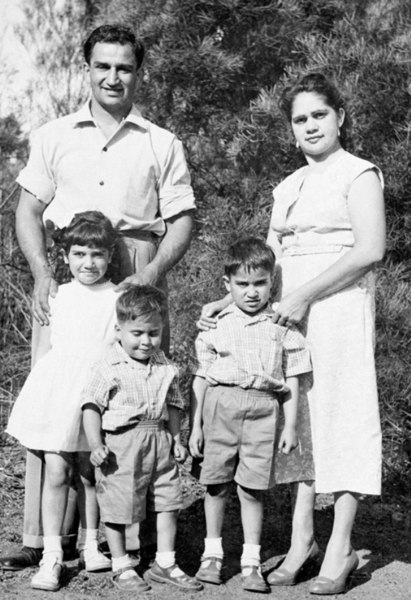
Family portrait of the Jackomos family, Alick and Merle with their three children Esmai, Michael and Andrew. AIATSIS Collection JACKOMOS.A04.BW-N03747_13a.
Following the Second World War, he joined a Jim Sharman’s travelling boxing troupe that performed at agricultural shows with other Sideshow Alley acts. These shows relied heavily on Aboriginal boxers and audiences, and Alick actively crossed cultural boundaries to associate with Aboriginal people when most of the population chose to shun them. Alick loved the lifestyle and for the next twenty years made lifelong friends.
In 1951 he married Merle and together they had three children, Esmai, Michael and Andrew.
Alick became Doug Nicholls’ apprentice in Aboriginal welfare and advocacy and throughout the 1960s he worked for the Federal Council for the Advancement of Aborigines and Torres Strait Islanders and the Australian Aborigines League (AAL). Despite being one of only two non-Aboriginal members, he was unanimously elected President of the AAL in 1963.
In the 1970s and 80s he joined the state and federal Department of Aboriginal Affairs working mainly in policy. Because of his strong ties to many Aboriginal communities, Alick was often a mediator between community members and the government and in 1971 he assisted in administering the land hand-back at Lake Tyers.
His commitment to the cause was, however, not without controversy. He was a non-Aboriginal man, with an Aboriginal family, living and moving in an Aboriginal world and working for Aboriginal rights.
Throughout his life Alick continued his grass roots community work delivering food and assisting Aboriginal parents to reunite with their children in foster care. An avid photographer, Alick collected a huge and remarkable photographic archive of Victorian Aboriginal people and compiled over a thousand intricate genealogies; some of this work was later used in land claim cases.
In 1985, he offered AIATSIS copies of his collection.
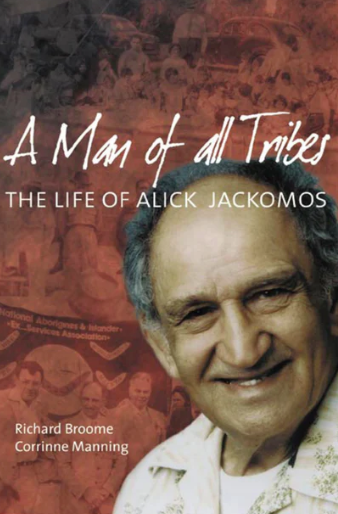
During his retirement Alick co-produced three books on Aboriginal history, Living Aboriginal History of Victoria, Forgotten Heroes and Sideshow Alley.
Universally acknowledged as a person of rare humanity, Alick was awarded an Order of Australia Medal in 1993 for his lifetime of work in Aboriginal affairs.
Click images to start slideshow.