






LEE, Rufus Augustus Richmond
| Service Number: | 913 |
|---|---|
| Enlisted: | Not yet discovered |
| Last Rank: | Private |
| Last Unit: | 17th Infantry Battalion |
| Born: | Kilgin, New South Wales, Australia, date not yet discovered |
| Home Town: | Lismore, Lismore Municipality, New South Wales |
| Schooling: | Not explicitly stated; however, he was a qualified Book-keeper prior to enlistment. |
| Occupation: | Book Keeper |
| Memorials: |
World War 1 Service
| 22 Dec 1914: | Involvement Private, 913, 17th Infantry Battalion, --- :embarkation_roll: roll_number: '11' embarkation_place: Melbourne embarkation_ship: HMAT Ceramic embarkation_ship_number: A40 public_note: '' | |
|---|---|---|
| 22 Dec 1914: | Embarked Private, 913, 17th Infantry Battalion, HMAT Ceramic, Melbourne |
Help us honour Rufus Augustus Richmond Lee's service by contributing information, stories, and images so that they can be preserved for future generations.
Add my storyBiography contributed by JASON LEE
ufus Augustus Richmond Lee was a young man of order and precision, qualities that likely defined him long before he stepped into a recruiter’s office. Growing up near the coastal river country of Kilgin and Lismore, he made his living as a book-keeper. In a world of ledgers and balance sheets, Rufus understood the value of accountability—a trait that would later become the backbone of his military contribution.
When the call for volunteers went out in 1914, Rufus didn't hesitate. At 22, he wasn't just looking for adventure; he was a member of the Lismore Rifle Club, suggesting a man who took civic duty and personal skill seriously. He joined because he was already prepared, trading his pens for a rifle and his ledger for an attestation paper, driven by a sense of quiet, disciplined patriotism.
His time as a frontline soldier with the 15th Battalion was short but harrowing. He was part of the desperate early days at Gallipoli, where the chaos of the cliffs was the polar opposite of the orderly life he had known. On May 4, 1915, a bullet through his left hand changed everything. For a book-keeper, a hand injury is more than a wound; it is a threat to one’s livelihood and identity. While the injury removed him from the trenches, it did not break his spirit or his utility.
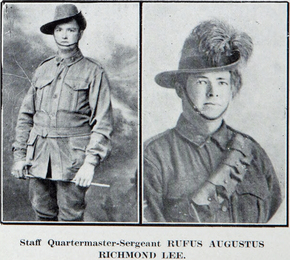
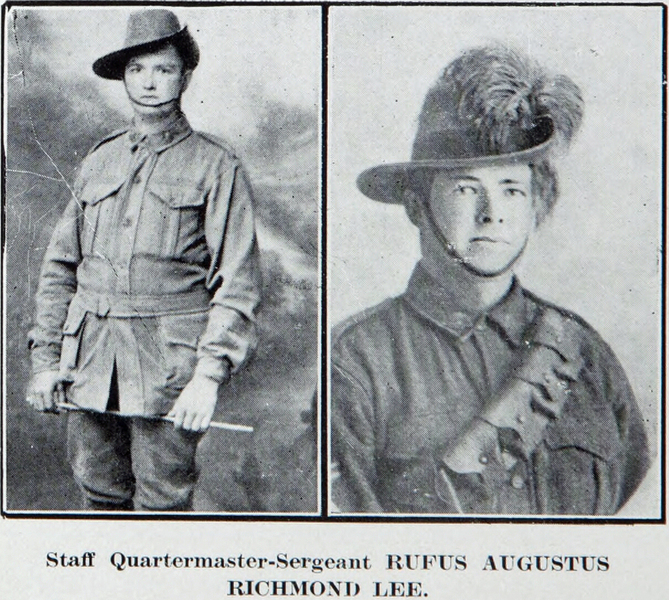
The Army recognized that Rufus was a man who could lead through organization. His transition from a wounded infantryman to an Extra Regimental Staff Quartermaster Sergeant (ER/SQMS) reveals a person who was deeply respected by his superiors. You don't reach that rank through seniority alone; you reach it because you are the person people rely on when things are falling apart. To his fellow soldiers, Rufus was likely the "fixer"—the man who ensured that despite the staggering scale of the war, the right supplies reached the right men. He was the human face of a massive, cold bureaucracy, bringing his hometown work ethic to the Headquarters of the Egyptian and British Expeditionary Forces.
What drove him was a commitment to the "unseen" work. While others sought glory on the field, Rufus found his purpose in the vital machinery of the war effort. He stayed in the service long after many others had returned home, remaining in Europe and Egypt until 1919 to assist with the monumental task of demobilization. This suggests a man who wouldn't leave a job half-finished—he stayed until the last ledger was closed and the last man was accounted for.
Returning to Australia in 1920, Rufus carried the invisible weight of the war and a permanent reminder in his scarred hand. Though he returned to a civilian life that often forgets the administrative heroes, his legacy is one of reliability. He was a man who saw the world at its most chaotic and spent his service trying to bring order to it, ensuring that his mates were fed, clothed, and equipped. He was a pillar of the community in Lismore—a man who understood that service isn't just about the moments of combat, but the years of steadfast dedication that follow.
Click images to start slideshow.