





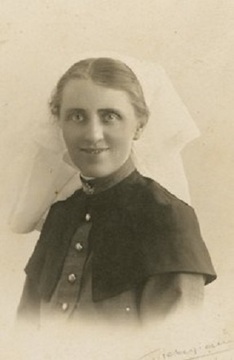
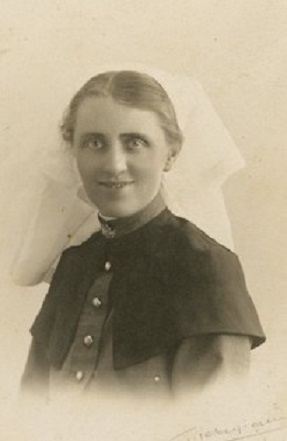
RICHMOND, Daisy Donaldson
| Service Number: | Nurse |
|---|---|
| Enlisted: | 21 November 1914 |
| Last Rank: | Sister |
| Last Unit: | 2nd Australian General Hospital (WW1) |
| Born: | Maitland, South Australia, 3 March 1883 |
| Home Town: | Goulburn, Goulburn Mulwaree, New South Wales |
| Schooling: | Not yet discovered |
| Occupation: | Nurse |
| Died: | St. Leonards, New South Wales, Australia, 3 December 1969, aged 86 years, cause of death not yet discovered |
| Cemetery: |
Northern Suburbs Memorial Gardens and Crematorium, NSW Cremated and Remains scattered |
| Memorials: |
World War 1 Service
| 21 Nov 1914: | Enlisted Australian Army Nursing Service (WW1), Staff Nurse, Nurse, 2nd Australian General Hospital (WW1) | |
|---|---|---|
| 28 Nov 1914: | Involvement 2nd Australian General Hospital (WW1), --- :embarkation_roll: roll_number: '23' embarkation_place: Sydney embarkation_ship: HMAT Kyarra embarkation_ship_number: A55 public_note: '' | |
| 1 Dec 1915: | Promoted Australian Army Nursing Service (WW1), Sister | |
| 29 Jun 1916: | Involvement Australian Army Nursing Service (WW1), Sister, Attached to 3rd A.G. Hospital in Cairo, Egypt until 10.7.1916. | |
| 21 Sep 1916: | Honoured Royal Red Cross (2nd Class), Awarded Royal Red Cross 2nd Class Date of Commonwealth of Australia Gazette: 21 September 1916 | |
| 10 Mar 1917: | Involvement Australian Army Nursing Service (WW1), Sister, Detached to 10th British Stationary Hospital for duty in France. | |
| 12 Jan 1919: | Involvement Australian Army Nursing Service (WW1), Sister, Attached to 1st AAH Harfield in London for duty | |
| 29 Sep 1919: | Embarked Australian Army Nursing Service (WW1), Sister, Returned to Australia via "Berrima". | |
| 7 Jan 1920: | Discharged Australian Army Nursing Service (WW1), Sister, Medals: 1914-15 Star, British War Medal and Victory Medal. | |
| 7 Jul 1921: | Honoured Mention in Dispatches, Mention in Dispatches certificate 5098 |
From Bush Nurse to Battlefield: The Life and Service of Daisy Richmond
Daisy Donaldson Richmond, Sister, AANS
In August 1914, when the Commonwealth’s first call went out for nurses to help the Australian war effort, trained volunteers were quick to answer. They were keen to ‘do their bit’ and go with the Australian Imperial Force (AIF) men sent abroad to the battlegrounds of World War One. By October, 300 civilian nurses nationwide had applied to join the Australian Army Nursing Service (AANS), part of the larger Australian Army Medical Corps (AAMC). Rigorous recruiting processes ensured a high standard among the successful candidates. Among them was Daisy Donaldson Richmond, a bush nurse from southwestern New South Wales, one of the select group of 161 women who were chosen nationwide that month for overseas service and immediate mobilisation. As she learned to be an army nurse, Daisy experienced a metamorphosis, mastering new medical techniques, managing increased responsibilities, and facing risks and fears not associated with her peacetime profession. Far from the wards of an Australian country hospital, Daisy became a decorated military Nursing Sister.
Daisy was born in Maitland, South Australia on 3 March 1883, the first child of Rev. Frederick and Matilda Richmond. She studied at Sydney Hospital, graduating after four years in medical and surgical nursing in January 1911, and was registered as a trained nurse on 3 March 1911. Daisy had worked as matron for the Bush Nursing Service at the Burrowa District Hospital for two years when she offered to join the AIF as a field nurse. On 21 November 1914, Daisy was assigned to serve with the 2nd Australian General Hospital (2AGH) unit. A devout Christian, Daisy felt an urgent need to enlist and start on her ‘sacred’ mission to mend men broken in fighting the ‘greatest war in history.’ Writing in her diary, she confessed her concern for the welfare of the Australian troops, ‘Dear brave fellows how one feels for them all so anxious to be of service to their country, so separated in the time of need from their loved ones.’ Daisy was 31 years old when she left Sydney on 28 November 1914 aboard HMAT “Kyarra” (No. 1 Hospital Ship) bound for Egypt.
There is no official record of Daisy’s early service with 2AGH at Mena House in Cairo where she nursed for three months from 20 January 1915. The first entry in Daisy’s service record reads, ‘20.4.1915 - Joined M.E.F. per “Guildford Castle”.’ She was to serve on a British hospital ship ferrying wounded and sick soldiers between the Gallipoli Peninsula and medical facilities on the Greek islands of Imbros and Lemnos, and further to Malta, Alexandria, and England. No further details of Daisy’s war work were logged until eleven months later. The next entry in Daisy’s service record reads, ‘19.3.1916 - “Demosthenes” - Returned to Australia in accordance with instructions from D.M.S. - Suez.’ However, Daisy’s letters and five-year war diary describe the evacuations of men from Gallipoli and an impression of the conditions under which she worked.
At dawn on 25 April 1915, Australian and New Zealand troops invaded the Gallipoli Peninsula at Gaba Tepe to seize the Turkish fortresses commanding the narrow strait of the Dardanelles at the same time as the British and French landed at Cape Helles. The troops secured a toehold on Turkish soil, for which they paid a heavy price. Inexcusably, the AAMC was unprepared to care for the 1400 Australian casualties evacuated throughout that evening, and the wounded men received only the crudest first aid. The Australian Parliament and the local press were quick to suggest that a low standard of medical practice was peculiar to the AAMC. The Australian public suspected the medical corps of treating its nurses poorly.
Daisy, on HMHS “Guildford Castle”, arrived at the Dardanelles on the morning of 26 April ‘as British, French and Russian battleships bombarded Turkish forts.’ With a lack of doctors, the nurses’ workload of wounded was heavy. Daisy suddenly found herself making significant decisions and acquired new responsibilities for triage, first aid, and pain management – usually a doctor’s domain – which stretched her knowledge and skill level. It was Daisy’s first duty on a ‘floating’ clearing station, and she thought her rushed efforts to care for the men just ‘a drop in the ocean of what should be done.’ Fifty years later, Daisy would recall nursing these soldiers: ‘It was terrible. Badly wounded men kept crawling in from the barges. At times we worked for thirty-six hours without stopping.’ The great weight of work that the sea transport nurses shouldered is evident from war records – only eighty of the AANS were spared to serve on fifteen of the thirty-five hospital ships that sailed to and from Gallipoli. Daisy, onboard HMHS “Neuralia” on 26 May 1915, wrote of her demanding work, saying she had 124 patients and, with one assistant, took until 2 am to dress the wounded. For her efforts, on 1 December 1915, Daisy was promoted to Nursing Sister.
The nurses on the hospital transports off the Gallipoli coast endured conditions that were akin to those at the front, and their lives were often in danger. Daisy experienced ‘the Turkish machine guns turn[ing] right on us,’ causing her to worry for her patients. She was on ship duty during the First Battle of Krithia and, the Anzac attack, throughout the August Offensives (Suvla Bay), and in the wake of the Battle of Lone Pine, the Charge at the Nek, and the torpedoing of HMT “Southland”. Recognition for Daisy’s ‘courage under fire’ came in honours lists. Daisy received ‘mentions in despatches’ twice and, on 2 May 1916, was awarded the Royal Red Cross (2nd Class) for ‘Distinguished Service in the Field.’
In January 1917, now detached from service with the No. 2 Sea Transport Section, Daisy returned to England and the 3rd Australian Auxiliary Hospital at Dartford. One month later, she reported for duty to the 2AGH at Wimereux in France. Regarded as ‘fragile’ first-aid workers at the war’s beginning, Australian military nurses, like Daisy, quickly proved their contribution was not merely competent but crucial to the war effort. At Gallipoli, lives were lost because medical treatment in the field had been crude. In France, more sophistication was required. On the Western Front, with casualties heavy, the posting of nurses became a matter of strategic importance. Generals informed medical officers of battle plans; their preparations required nurses to be close to the fighting to get the wounded medical attention fast. The entries for 1917 and 1918 in Daisy’s Service Record indicate this development in medical policy; for twenty months, she is regularly reassigned as battle lines moved, posted for duty in British and Australian CCSs, auxiliary, stationary, and general hospitals.
On 28 May 1917, Daisy reported to the 2CCS at Trois Arbres, a posting she had requested. The launch of the Messines offensive was set for 7 June, designed to force the German enemy to withdraw from the main battlefront of Vimy-Arras. Close by, the 2CCS, made ready for the impending attack. Daisy’s ward was ‘being fixed up just for chest cases.’ At 11 pm on 6 June, the Germans shelled the Wood with gas while the Allied troops were forming, causing hundreds of casualties. On 9 June, Daisy reported, ‘The wounded pour in today and about four hundred gas cases.’ Dealing with death, danger and devastation required much resilience, personal strength, and commitment and this is where Australian nurses, like Daisy, excelled.
Daisy did not feel diminished by the experience of war, as some perhaps were, but empowered, going on to take up responsible and influential posts within her profession at home. She did not marry. According to family folklore, her fiancé died in the war. Daisy lived her long life, as she had done before and throughout the war years, dedicated to the service of the Australian community, for which she was presented the Member of the Order of the British Empire award in 1964.
Submitted 29 June 2026 by Ross Richmond
Biography contributed by Sandra Barry
Reverend Frederick Richmond and Mary Matilda Richmond nee Donaldson were the parents of Sister Daisy Donaldson Richmond.
Remembered with Honour


Click images to start slideshow.