








KING, Leonard Charles
| Service Number: | 4824 |
|---|---|
| Enlisted: | 28 September 1915, Enlisted in Toowoomba |
| Last Rank: | Private |
| Last Unit: | 15th Infantry Battalion |
| Born: | Waimate, New Zealand, 19 June 1889 |
| Home Town: | Yuleba (Yeulba), Maranoa, Queensland |
| Schooling: | Not yet discovered |
| Occupation: | Labourer |
| Died: | Died of wounds, France, 4 February 1917, aged 27 years |
| Cemetery: |
Flesquieres Hill British Cemetery, France Plot IV, Row C, Grave No. 15. EVER REMEMBERED |
| Memorials: | Australian War Memorial Roll of Honour, Ballarat Australian Ex-Prisoners of War Memorial, Town of Roma and Shire of Bungil WW1 Honour Board, Yuleba Cenotaph |
World War 1 Service
| 28 Sep 1915: | Enlisted AIF WW1, Private, 4824, 15th Infantry Battalion, Enlisted in Toowoomba | |
|---|---|---|
| 28 Mar 1916: | Involvement Private, 4824, 15th Infantry Battalion, --- :embarkation_roll: roll_number: '11' embarkation_place: Brisbane embarkation_ship: HMAT Commonwealth embarkation_ship_number: A73 public_note: '' | |
| 28 Mar 1916: | Embarked Private, 4824, 15th Infantry Battalion, HMAT Commonwealth, Brisbane | |
| 2 Feb 1917: | Imprisoned Died of wounds 4 February 1917 whilst Prisoner of War. |
Help us honour Leonard Charles King's service by contributing information, stories, and images so that they can be preserved for future generations.
Add my storyBiography contributed by Stephen Brooks
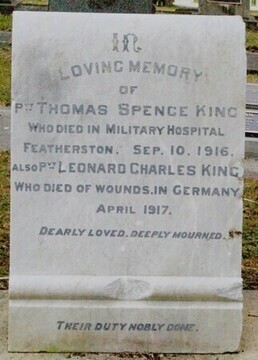
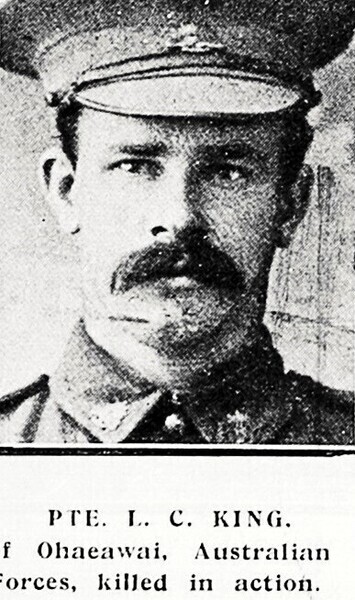
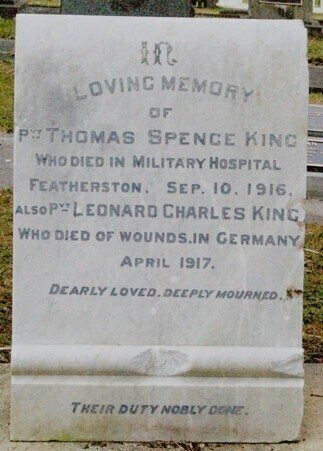
Leonard Charles King was the son of William John and Mary Eleanor King, of Ohaeawai, New Zealand. He had travelled to Australia in around 1909, and had been living in the Yuleba district of Queensland.
His younger brother, 31128 Pte. Thomas William Spence King, died when serving with a New Zealand Training Unit at Featherston, NZ, on 10 September 1916, aged 20.
Leonard Charles King joined the 15th Battalion in France during October 1916. At Gueudecourt on the Somme during February 1917, the Australians faced the harshest winter weather: “driving bitter winds, snow-frozen ground, and sharp frosts”
On 1 February, near Gueudecourt, the 15th Battalion attacked a section of the German front line known as Stormy Trench. The party consisted of 150 men and six officers, or one and half companies. The attack started at about 7.00 p.m. on a frontage of 500 metres. Although the enemy trenches were only 100 metres from the Australian lines, inadequate artillery support and poor overall planning caused the attack to fail. A German counter attack at 11 p.m. was beaten off. In the face of relentless German shelling of the captured trenches, and a stronger German counter attack at 4.30 a.m. the Battalion was forced to retire. Although 52 German soldiers were captured, the 15th Battalion’s casualties were 37 men killed, over 20 captured by the Germans and over 80 wounded.
King was one of the badly wounded men who was left in the trenches. He was captured by the Germans and died of a chest wound on 4 February 1917, at Ribemont in France. After the war his remains were reinterred in Flesquieres Hill British Cemetery.
Leonard’s father wrote to Base Records in 1920, “My wife and I beg to tender our sincere thanks to you and all members of the Australian Imperial Force in taking the trouble to inform us that our son L.C. King 4824 has received a decent burial and that his last resting place will be marked for all time. It has been a great comfort to us to feel that the Australian force has taken this matter in hand. Again thanking you, yours faithfully, W.J. King.”

Click images to start slideshow.