







TUNNEY, Charles Bede
| Service Numbers: | 2749, N103324 |
|---|---|
| Enlisted: | 28 April 1916 |
| Last Rank: | Private |
| Last Unit: | 55th Infantry Battalion |
| Born: | Young, New South Wales, Australia , 29 August 1898 |
| Home Town: | Monteagle, Young, New South Wales |
| Schooling: | Not yet discovered |
| Occupation: | Labourer |
| Died: | Eventide Nursing Home, Sandgate, Queensland, Australia , 2 December 1958, aged 60 years, cause of death not yet discovered |
| Cemetery: |
Lutwyche Cemetery, Brisbane, Qld Anzac Portion 9 |
| Memorials: | Young Town & Districts Tribute to Those who Volunteered Great War |
World War 1 Service
| 28 Apr 1916: | Enlisted AIF WW1, Private, 2749, 55th Infantry Battalion | |
|---|---|---|
| 7 Oct 1916: | Embarked Private, 2749, 55th Infantry Battalion, --- :embarkation_roll: roll_number: '19' embarkation_place: Sydney embarkation_ship: HMAT Ceramic embarkation_ship_number: A40 public_note: '' |
World War 2 Service
| 11 Feb 1941: | Enlisted Australian Military Forces (WW2) , Private, N103324 |
|---|
Help us honour Charles Bede Tunney's service by contributing information, stories, and images so that they can be preserved for future generations.
Add my storyBiography contributed by Evan Evans
From Australian Remembrance Army
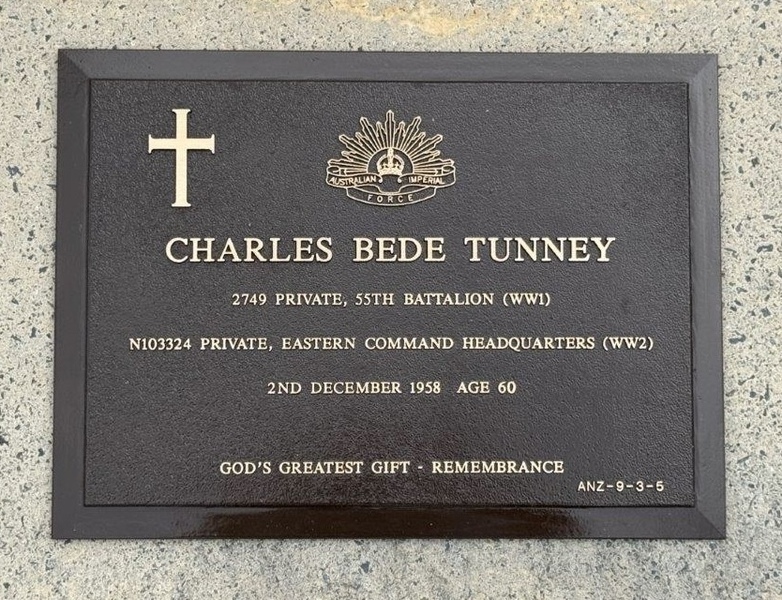
Private Charles Bede Tunney, an Australian World War One veteran who served during both World Wars, is among almost 800 previously unmarked WWI veterans’ graves in Lutwyche Cemetery we have now marked with plaques in recognition of their service for Australia.
We unveiled his plaque in Anzac Portion 9, Lutwyche Cemetery, Brisbane on 20 September 2025, along with a further 161 plaques on the previously unmarked graves of Australian World War One veterans:
See Australian Remembrance Army Facebook page
WWI service file:
2749, Private, 55th Battalion
WWII service file:
N103324, Private, Eastern Command Headquarters
Charles Bede Tunney was born on 29 August 1898 at Monteagle, near Young, New South Wales, the son of James Tunney and Ada Tunney (née Hardman). He enlisted in the Australian Imperial Force on 28 April 1916 at the age of 18 and embarked for overseas service on 7 October 1916. After training on Salisbury Plain in England, he was transferred to France, arriving on 18 December 1916. In the spring of 1917 he took part in the Allied offensive in the Bapaume sector, advancing with Australian forces following the German withdrawal.
On 2 April 1917, during a severe engagement at Diogenes, approximately eight kilometres from Bapaume, Tunney was seriously wounded when an enemy shell burst as the men were digging in, killing five soldiers and wounding four. His left elbow was shattered. He was evacuated to a base hospital and later treated in England. He left England for Australia on 7 April 1918, twelve months after being wounded, returning home after a voyage of approximately eight weeks. It was noted that his wounds had not yet fully healed and that further operations were anticipated.
In 1937, Tunney married Betty Meredyth in Sydney.
He re-enlisted for service during the Second World War, joining the Australian Military Forces on 10 February 1941 at the age of 42. At enlistment he was recorded as married, a military pensioner, and as having no children, and was residing in Paddington, New South Wales. His Second World War service was limited to home and administrative duties, including postings associated with Eastern Command Headquarters, and his records noted that his left arm was missing. He was discharged on 28 December 1942 as no longer required owing to medical classification.
The lasting consequences of his First World War injuries are recorded in a 1947 admission record from Eventide Nursing Home, Sandgate, Queensland, which notes his condition as “left arm off below the elbow” and records that he had no property and no money, reflecting the enduring physical and economic impact of his war service.
Private Charles Bede Tunney died on 2 December 1958, aged 60, and was buried in Anzac Portion 9, Lutwyche Cemetery, Brisbane. He had no known children.
After decades without recognition at his place of burial, his grave now bears a plaque commemorating his service to Australia — ensuring his name endures among those remembered for their duty and sacrifice. His identity and dignity have now been restored.
We have remembered him.
Lest We Forget.
Click images to start slideshow.