



BLACK, William John Gibb
| Service Number: | 882 |
|---|---|
| Enlisted: | Not yet discovered |
| Last Rank: | Driver |
| Last Unit: | 2nd Field Artillery Brigade |
| Born: | Raywood, Victoria, Australia, 1890 |
| Home Town: | Melton, Melton, Victoria |
| Schooling: | State School, Melton, Victoria, Australia |
| Occupation: | Chaff cutter |
| Died: | Killed in Action, Dickebusch, Belgium, 31 July 1917 |
| Cemetery: |
Dickebusch New Military Cemetery & Extension, Belgium Plot II, Row F, Grave No. 19 |
| Memorials: | Australian War Memorial Roll of Honour, Melton War Memorial |
World War 1 Service
| 20 Oct 1914: | Involvement Driver, 882, 2nd Field Artillery Brigade , Third Ypres, --- :embarkation_roll: roll_number: '3' embarkation_place: Melbourne embarkation_ship: HMAT Shropshire embarkation_ship_number: A9 public_note: '' | |
|---|---|---|
| 20 Oct 1914: | Embarked Driver, 882, 2nd Field Artillery Brigade , HMAT Shropshire, Melbourne |
Help us honour William John Gibb Black's service by contributing information, stories, and images so that they can be preserved for future generations.
Add my storyBiography contributed by Evan Evans
From Jérôme Hermans, Belgium
He survived deadly battles for more than two years on the frontline and died in an unlikely "kitchen" accident... Driver William John Gibb Black 882.
William John Gibb Black was born in 1890 in Raywood, Victoria to David Black (1851-1914) and Sarah Jane Dobbin (1862-1936).
He had five brothers: Richard Swale (1886-1945), David (1887-1938), Lawrence Benjamin (1892-1970), Harold Austin (1893-1956) and James Dobbin (1897-1951).
He studied at Melton Public School, a suburb of Melbourne where he lived with his parents.
After his studies, he continued to live with his parents and worked as a seasonal employee - harvester on local farms.
While he was destined to live a life of working in the fields of Australia and starting a family like so many other young men, the outbreak of war in remote Europe in the summer of 1914 upset his plans for the future.
William decided to answer the country's call and volunteer to serve in the Australian Imperial Force in the early weeks of the conflict.
This is how he presented at a recruitment office in Melbourne and signed his contract of commitment "for the duration of the war" on August 19, 1914.
He then underwent initial training in weapons handling and became familiar with the military structure and life under the flags before disembarking at Melbourne on 20 October 1914 aboard HMAT Shropshire, as a pilot in of the 2nd Field Artillery Brigade.
He landed in Egypt where he continued his training in weapons handling, the precautions to be taken when handling shells, the transport of ammunition and men on difficult ground and the rules of safety in the trenches.
He also underwent physical training preparing him for intense heat efforts, long walks and fatigue associated with incessant movements imposed by his function.
He had his first combat experience when he landed on the Gallipoli Peninsula and participated in the battles that would have allowed the British to deploy there.
However, facing tough Turkish resistance and in spite of violent fighting and severe casualties, they never managed to settle permanently on the island and decided to withdraw in December 1915.
William was among the men who survived without injury.
He then returned to the Egyptian camps during the first weeks of the year 1916 where he was stationed continuing training and training of new recruits while waiting for the reorganization of the Australian forces on the different still active fronts.
He resumed the sea on March 22, 1916 to the destination of the western front but in a first time, from the port of Marseilles.
The men disembarked about a week later and then began a long train crossing from South to North to the British back bases of the Havre.
William then benefited from a 15-day leave in England before taking back his place and joining the Somme front where extensive assaults were planned for the beginning of the summer of 1916.
He took part in many battles during the following months, among other things, the Battle of Pozières and in the Bapaume sector.
Despite the heavy loss, William walked away unharmed.
At the beginning of 1917, he was engaged in the pursuit of voluntary retreating Germans to the Hindenburg line as well as fighting in advanced villages.
He then joined a sector near the Franco-Belgian border because his battery took part in the fighting that began on 7th June 1917 after the explosions of huge mines under the German positions of Messines.
Despite the heavy losses suffered during this period, William survived once again without injury and moved to another sector of Ypres where the attacks of the late summer and winter of 1917, known today as the "Third Campaign of Ypres" were being prepared.
And it was in this sector, having survived so many mortal combat, that William would meet death.
While he was making moves with his colleagues on July 31, 1917, the men decided, on the coming evening, to stop and enjoy a hole, a ditch deep enough to light a small fire and try to heat their meal without the panache of smoke being easily spotted by the enemy.
Unfortunately, they were unaware that a deadly danger awaited them in the form of an explosive device, still intact, buried deep underground.
The heat of the fire lit above the engine caused it to explode as the men waited for their meal.
Although the machine was small in size, the damage was also much among men... Several are injured. and 3 died..
Amongst them... William...
He was 27.
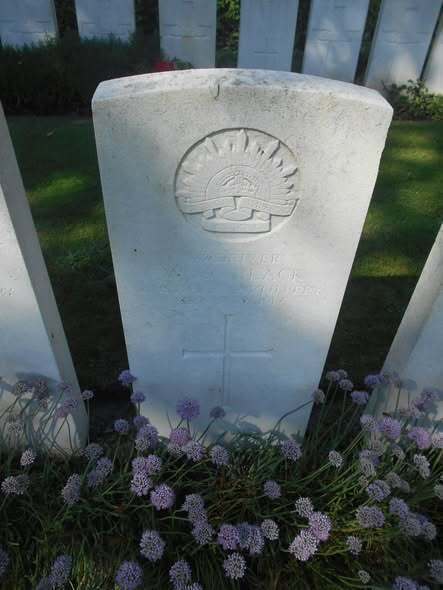
He rests in peace today at Dickebusch New Military Cemetery Extension.



Click images to start slideshow.