




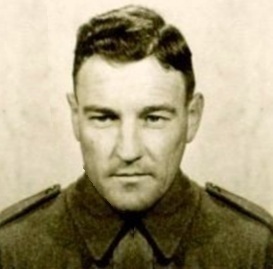
DALE, Harry Stanley
| Service Number: | VX24847 |
|---|---|
| Enlisted: | 17 June 1940 |
| Last Rank: | Private |
| Last Unit: | 2nd/9th Field Ambulance |
| Born: | Bendigo, Victoria, Australia, 15 June 1907 |
| Home Town: | South Yarra, Melbourne, Victoria |
| Schooling: | Not yet discovered |
| Occupation: | Hospital War Porter |
| Died: | Cancer, Strathmore, Victoria, Australia, 26 July 1969, aged 62 years |
| Cemetery: |
Fawkner Memorial Park Cemetery, Victoria 4th Ave Wall Niches (North Side), Wall 1, Section T, Niche 164 |
| Memorials: | Ballarat Australian Ex-Prisoners of War Memorial |
World War 2 Service
| 17 Jun 1940: | Enlisted Australian Military Forces (WW2) , Private, VX24847, 2nd/9th Field Ambulance | |
|---|---|---|
| 21 Nov 1945: | Discharged Australian Military Forces (WW2) , Private, VX24847, 2nd/9th Field Ambulance |
Fall of Singapore address
Bill Harry's son gave the address at the Fall of Singapore service at the Shrine of Remembrance in 2024
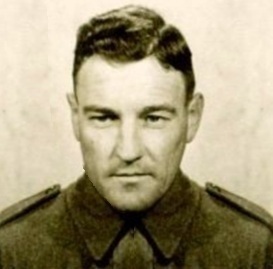
My father, Harry Stanley Dale VX24847, was a private with the 2/9th Field Ambulance unit, which was attached to the 8th Division 2nd A.I.F.
He was 33 years old when he enlisted at Prahan, making him one of the more mature age enlistments compared to the majority of those who enlisted in 1940. On his attestation form his occupation was listed as Hospital Ward Porter at the Alfred Hospital. With this occupation I assume, would have been behind him becoming attached to the 2/9th.
There first training camp was the Nagambie Road camp where the new recruits were placed in their companies, Harry was assigned to ‘B’ company. There were three other companies that formed the 2/9th, Headquarters company, ‘A’ company and Transport.
The unit then moved to a newly constructed Army base at Bonegilla.
This was the start of many bivouacs around N.E. Victoria and S.E. NSW during which there was much training in the treatment and evacuation of wounded troops, more advanced first aid, the use of Thomas splints, bandaging and application of shell dressings etc.
It was during their training at Bonegilla that a ceremony took place handing over a Red Cross flag and drum from the 10th Field Ambulance 1st A.I.F.
Today the flag is 108 years old and is still carried each year in the ANZAC Day March. It saw service in Northern France with the 10th Field Ambulance, between 1916 and 1918. It again saw service during the Malayan / Singapore campaign of 1941/42. Following the capitulation, it was retrieved from a rubbish heap at St Andrews Cathedral Singapore where it last flew, and handed in at Changi prison camp where it was hidden for the duration of the war. Unfortunately, the where abouts of the drum is not known.
The connection with the 10th Field Ambulance was a soldier by the name of Robert Webster. During the First World War, he was a captain with the 10th Field Ambulance and when World War two broke out he re-enlisted in 1940 with the rank of Major, and assigned to the 2/9th, where he was second in command. In 1941 he was promoted to Lieutenant Colonel. His men gave him the nick name ‘Rickety Kate.’
The 2/9th along with other 8th Division units embarked on the Queen Mary at Sydney on 2nd February 1941, and sailed on the 4th February.
They disembarked at the Singapore Naval Base on the 18th February, then entrained to the Malay Regiment Army camp at Port Dickson on the West coast of Malaya arriving on the 19th February.
Once settled in, the philosophy of the commanding officer Lieutenant Colonel Summons was, a field ambulance had to be as fit as, or fitter than any other unit in the division. Which put them on route marches and bivouacs through rubber plantations and supposably impenetrable jungle. Combined with the topical heat the fitness of the unit soon rose. When the C/O was happy with the fitness level, training then moved onto medical training.
In August 1941, Headquarters Company, and ‘A’ Company moved to Kota Tinggi, where they set up a Main Dressing Station, with Harry’s ‘B’ Company based at Mersing on the Northeast coast of Malaya, where they set up an Advanced Dressing Station, capable of accommodating 600 stretcher patients for a week or more in blast-proof shelters. A blast-proof dressing post and operating room were also provided for safe working during action.
During ‘B’ Companies time at Mersing Captain John Cade a psychiatrist was in command for a time, he was later prompted to Major. As a P.O.W. John Cade started up a mental health unit in Changi, where he observed his patients there had similar symptoms to those when he was in civilian life. He had a theory that it was chemistry changes to the brain, that causes the mental illness.
After the war he experimented with lithium as the chemical that may control the mental illness. The medical profession has acknowledged that John was the one who discovered the use of lithium as treatment for mental illness, now known as bi-polar, which is still used today. John was also instrumental in establishing a ‘Living Memorial’, the A.I.F. Malaya Nursing Scholarship. This is a two-year scholarship which gives a Malayan or Singaporean nurse additional training and qualifications in Australia, to take back with them. This scholarship is still active today.
On the 7th December 1941 Japanese soldiers landed at Kota Bharu and their planes bombed Kota Bharu, Patani, and Singapore. The war with Japan had begun.
With ‘B’ company still at Mersing on the 17th January 1942 they took over an ADS, whilst the MDS was still functional at Kota Tinggi. On the 21st January Japanese soldiers successfully landed at Endau, preparations were under way for withdrawals.
The 18th January saw enemy aircraft strafe the Mersing area, with a cluster of bombs falling close to the 2/9th’s Advanced Dressing Station, with the Red Cross Flag flying may have been the reason no direct hits were taken on the A.D.S.
On or about the 23rd January the 2/9th began an orderly withdrawal with the forces on the east coast performing “leap frog” manoeuvres, and like other units, moving at night.
On the 27th January 1942 the order was given for all units to withdraw to Singapore Island. The 2/9th were receiving up to eighty wounded a day, with Headquarters company moving to set up a 200-bed hospital at Hill 80 on Singapore Island. At Hill 80 the shelling and bombing was intense, the Red Cross Flag was laid across the top of the M.D.S. to signify a first aid post.
The remaining 2/9th units crossing onto Singapore Island on the nights of 30/31st January, then opened a MDS on the road running west from Bukit Panjang, with an ADS on the crossroad from Bukit Timah. During the first week of February the cases steadily increased.
Around the 12th February 1942 the 2/9th set up a M.D.S. in St Andrews Cathedral in the centre of Singapore, which accommodated approximately 200 wounded soldiers and civilians.
By the 19th February the strength of the 2/9th at Selarang Barracks were 15 officers and 229 other ranks and had established a 270 bed hospital. However, on the 6th March the Japanese ordered that all sick men to be concentrated in a central hospital in Roberts Barracks. To lessen the strain on the hospital which now housed approximately 2,600 patients the 2/9th maintained an outpatient service with special clinics attached. In August 1943 the A.I.F. section of the hospital moved back to the Selarang square.
On the 16th January 1946 ‘B’ company held a reunion at the Soldiers Memorial Hall in Richmond. I don’t know whether Harry attended, it was probable he did, for at the time he was living close by in Osborne Street South Yarra with Mum and Judy my older sister. With the reunion being a success, the former Commanding Officer Lieutenant Colonel Summons convened a meeting of representatives of all the companies to form an association. As a result, the first annual meeting and reunion of the 2/9th Field Ambulance Unit Association was held at the William Street Drill Hall on the 23rd April 1949.
With all the 2/9th veterans having passed away the relatives continue to uphold the associations motto:
“THE SHOW GOES ON”.
Submitted 23 February 2026 by Faye Dale

Click images to start slideshow.