







BLACKMAN, Thomas
| Service Number: | 3174 |
|---|---|
| Enlisted: | 11 December 1916 |
| Last Rank: | Private |
| Last Unit: | 41st Infantry Battalion |
| Born: | Gayndah, Queensland, Australia, January 1892 |
| Home Town: | Childers, Bundaberg, Queensland |
| Schooling: | Not yet discovered |
| Occupation: | Stockman |
| Died: | Repatriation Hospital, Greenslopes, Brisbane, Queensland, Australia, 21 February 1956, cause of death not yet discovered |
| Cemetery: |
Lutwyche Cemetery, Brisbane, Qld |
| Memorials: | Cherbourg Roll of Honour, Cherbourg War Memorial & Honour Roll |
World War 1 Service
| 11 Dec 1916: | Enlisted AIF WW1, Private, 3174, 41st Infantry Battalion | |
|---|---|---|
| 7 Feb 1917: | Involvement Private, 3174, 41st Infantry Battalion, --- :embarkation_roll: roll_number: '18' embarkation_place: Sydney embarkation_ship: HMAT Wiltshire embarkation_ship_number: A18 public_note: '' | |
| 7 Feb 1917: | Embarked Private, 3174, 41st Infantry Battalion, HMAT Wiltshire, Sydney | |
| 4 Apr 1919: | Discharged AIF WW1, Private, 3174, 41st Infantry Battalion, 1st MD |
Help us honour Thomas Blackman's service by contributing information, stories, and images so that they can be preserved for future generations.
Add my storyBiography contributed by Evan Evans
From Australian Remembrance Army
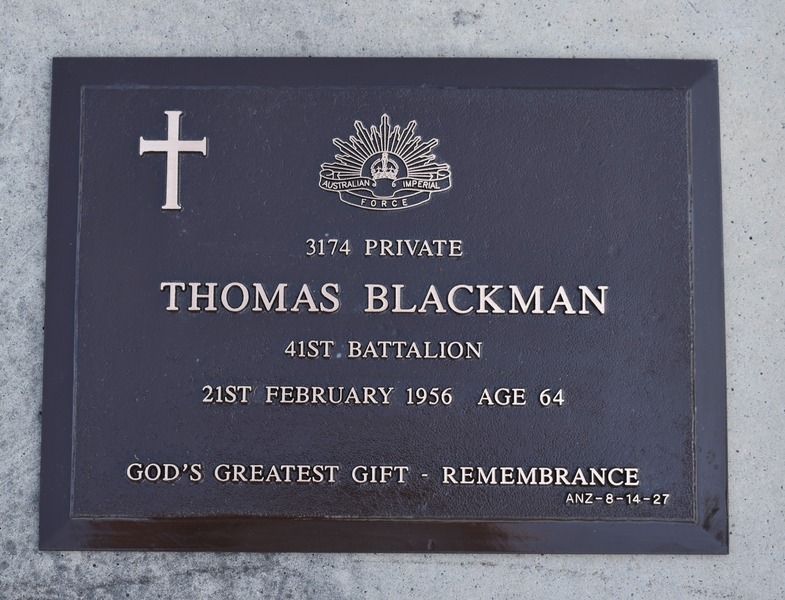
Private Thomas Blackman (Service No. 3174) was an Indigenous Australian World War One veteran whose previously unmarked grave in Lutwyche Cemetery has now been marked with a plaque honouring his service for Australia. We received grant funding for this grave plaque from the Australian Government under the Marking (First World War) Private Graves Grants Program.
On 23 September 2023, his plaque was unveiled in Lutwyche Cemetery, along with a further 300 plaques on the previously unmarked graves of Australian World War One veterans:
https://www.australianremembrancearmy.com/lutwyche...
WWI service record link:
https://recordsearch.naa.gov.au/.../Int.../ViewImage.aspx...
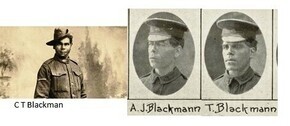
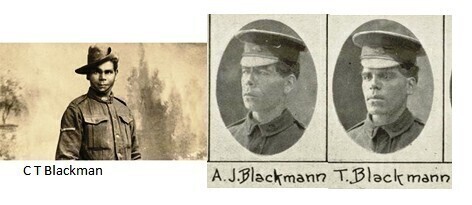
Thomas Blackman was one of three Indigenous brothers from Queensland who successfully defied official policy to join the Australian Imperial Force (AIF) between 1915 and early 1917 — a testament to their desire to serve their country despite official exclusion. All three were born in or around Gayndah, Queensland, to their mother, Emily Blackman (née Graham, later Dashong), who lived in Childers and served as their next of kin.
Their father, Thomas Blackman Senior, owned a 100-acre (40-hectare) property at Tiaro, a town on the Bruce Highway, 30 km south of Maryborough. The son of a white father and an Aboriginal mother, he died from cancer in 1898 at the age of 48, leaving no will. Within a few years, his wife Emily, an Aborigine, and their children were left destitute and living in a derelict house in Bundaberg. In September 1902, the children, including young Thomas, were removed from their mother’s care and sent to the government-run settlement at Barambah (now known as Cherbourg) in the South Burnett district of south-east Queensland.
Thomas (Tom) Blackman Junior was born in 1892. He enlisted in Bundaberg, Queensland, on 11 December 1916 in the 41st Infantry Battalion (7th Reinforcements), giving his address as Boompa, Queensland, and his age as 24 years and 11 months. His marital status was single and his occupation was stockman.
On 30 January 1917, an article was published in the Maryborough Chronicle:
http://nla.gov.au/nla.news-article151478945
“A meeting was held in the Queen’s Hotel on the evening of Wednesday to bid farewell to Alfred John Blackman and Thomas Blackman, two brothers who have volunteered to go to the front. Mr. Monty Parker occupied the chair, and there was a fair attendance. The Chairman pointed out that there were three brothers, Charlie Blackman, who had volunteered a year ago, and now the other two brothers were going, so that all the male members of the family would be doing their bit.”
The youngest, Charles Blackman (Service No. 2792), a labourer from Biggenden, was the first to enlist on 18 August 1915, becoming one of the earliest known Indigenous recruits. He served with the 9th Battalion on the Western Front from April 1916.
Thomas and Alfred Blackman embarked from Sydney, New South Wales, on board HMAT Wiltshire (A18) on 7 February 1917. His older brother, Alfred John Blackman (Service No. 3173), a labourer from Tiaro, also served in the 41st Battalion. Thomas joined his battalion in France in July 1917.
The family faced tragedy when Alfred Blackman died of wounds received in action in France on 8 October 1917. Thomas, who was fighting near his brother, suffered from shell shock and was listed as Absent Without Leave (AWOL) for a period following Alfred's death.
Charles Blackman returned on 12 April 1919 as a Lance Corporal, having been gassed and severely affected by shell shock. After his discharge, he worked for the Cardwell Shire Council and leased land in the Tully area, eventually changing his name by deed poll to Charles Thomas Graham in 1943. He died in Mossman Hall Mental Facility at Charters Towers on 12 August 1966.
Thomas returned to Australia on HMAT Argyllshire (A8) on 17 December 1918, arriving on 1 February 1919. He was discharged from the AIF on 4 April 1919. Sadly, his war service did not shield him from racial discrimination.
In 2009, a box of long-lost papers belonging to anthropologist Caroline Tennant-Kelly—who had passed away twenty years earlier—was discovered in the shed of an old friend. During the 1930s, Tennant-Kelly had conducted studies on the living conditions of Aboriginal people residing at Cherbourg. Among the notes and photographs from that time was a letter addressed to her by Thomas Blackman, dated 22 February 1935. He expressed his pain, disappointment, and sense of injustice, questioning what he had fought for if this was the "freedom" he had received:
"I'm writing to you referring to the treatment of half-caste soldiers. I'm a half-caste soldier myself. There were three of us went to the Great War out of my family. One was killed at war and two of us returned after the war was over. I always thought fighting for our King and country would make me a naturalised British subject and a man with freedom in the country but I have hardly had freedom since I returned from the war. I have no justice at all. I don't know if the King knows how his half-caste returned soldiers are treated in this country. I was brought to Cherbourg May 7th, 1934, and still find myself here. Is this the sort of freedom that I went to France and helped fight for? I say no. I want justice. I'm a man that is well liked wherever I worked. I was living at Maryborough and had my good home broken up by the Chief Protector of Aboriginals. It hurts me very much. I was locked up for seven days for being intoxicated and using bad language but it seems the Chief Protector wasn't satisfied with me taking my punishment but places me under the Act and put me to a settlement like a dog. I was brought to this settlement and find the Chief Protector hasn't got any accommodation for my wife. Another thing I find is that a half-caste soldier has got to get a permit from the Superintendent to go about the country. We helped to fight, same as white soldiers did. Think of all the half-caste soldiers that were killed at war. What thanks have the half-caste soldiers for going to war? We were good men at war but looked down on now the war is over."
Private Thomas Blackman died at the Repatriation Hospital, Greenslopes, Brisbane on 21 February 1956, aged 64, with pulmonary tuberculosis listed as the cause of death. He was buried three days later in Anzac Portion 8, Lutwyche Cemetery, Brisbane. His death certificate reveals that he was married at Barambah, aged 32, to Emily King, and that he had one living daughter.
Lest We Forget
Sources:
https://cherbourgmemory.org/profiles/thomas-blackman/
https://cherbourgmemory.org/
https://researchcentre.army.gov.au/.../case-study...
https://www.talesfromthegrave.org/.../how-a-collection-of...
https://www.couriermail.com.au/.../83194320b5d20e070105c7...
https://www.heraldscotland.com/.../17200108.remembering.../

Click images to start slideshow.