







PETERS, William Henry
| Service Number: | 2191 |
|---|---|
| Enlisted: | 3 June 1915, Brisbane, Queensland |
| Last Rank: | Corporal |
| Last Unit: | 25th Infantry Battalion |
| Born: | Esk, Queensland, Australia, 25 August 1894 |
| Home Town: | Esk, Somerset, Queensland |
| Schooling: | Esk State School, Queensland, Australia |
| Occupation: | Labourer |
| Died: | Killed in Action, France, 5 August 1916, aged 21 years |
| Cemetery: |
No known grave - "Known Unto God" |
| Memorials: | Australian War Memorial Roll of Honour, Esk War Memorial, Villers-Bretonneux Memorial |
World War 1 Service
| 3 Jun 1915: | Enlisted AIF WW1, Brisbane, Queensland | |
|---|---|---|
| 18 Sep 1915: | Involvement AIF WW1, Private, 2191, 25th Infantry Battalion, Battle for Pozières , --- :embarkation_roll: roll_number: '15' embarkation_place: Brisbane embarkation_ship: HMAT Armadale embarkation_ship_number: A26 public_note: '' | |
| 18 Sep 1915: | Embarked AIF WW1, Private, 2191, 25th Infantry Battalion, HMAT Armadale, Brisbane | |
| 5 Aug 1916: | Involvement AIF WW1, Corporal, 2191, 25th Infantry Battalion, Battle for Pozières , --- :awm_ww1_roll_of_honour_import: awm_service_number: 2191 awm_unit: 25 Battalion awm_rank: Corporal awm_died_date: 1916-08-05 |
Help us honour William Henry Peters's service by contributing information, stories, and images so that they can be preserved for future generations.
Add my storyBiography contributed by Ian Lang
# 2191 PETERS William Henry 25th Battalion
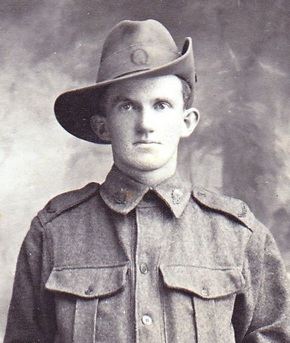
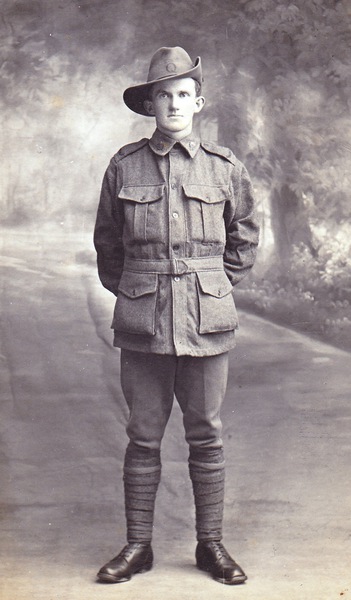
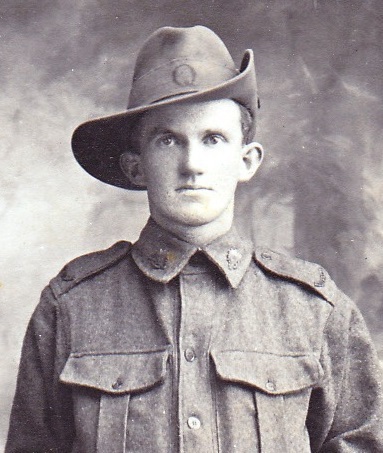
Will Peters was born at Esk on 25th August 1894. He was one of at least six children born to George and Hannah Peters at Esk. Will attended school at Esk State School before leaving to work at various jobs in the district. His sister, Elsie, when completing the Roll of Honour Circular stated Will’s occupation as stockman. Will took the train to Brisbane to enlist on 3rd May 1915.
Will informed the recruiting officer he was 20 years old and that both of his parents were deceased, naming Miss Elsie Peters, his eldest sister, as his next of kin. Will was accepted into the AIF and was placed into the 4th reinforcements of the 25th Battalion at Enoggera Camp where he was reunited with his elder brother, Wesley, who had enlisted some weeks previously. While the reinforcements were training at Enoggera, Will was promoted to Acting Lance Corporal and then Acting Sergeant. The reinforcements travelled by train from Alderley Station to Pinkenba Wharf where they embarked on the “Armidale” on 18th September 1915. The embarkation roll shows William and Wesley Peters with successive regimental numbers. Each had allocated 3/- of their daily pay of 5/- to be deducted. This payment may have been for Elsie Peters back in Esk.
By the time that the reinforcements arrived in Egypt, the British authorities were close to conceding that the Gallipoli Campaign had little chance of success. The existing AIF battalions on Gallipoli were to be gradually drawn down during November and December with the last draft of reinforcements for the 25th Battalion (2nd and 3rdreinforcements) landed to complete the withdrawal. The original 25th Battalion and the two drafts of reinforcements landed on the island of Mudros just before Christmas and landed back in Egypt in late January. Once men who were sick or those who had been unable to withstand the rigours of infantry fighting were sent to hospital or discharged from the battalion, their places were filled with the men from the 4th reinforcements. Will and Wesley were taken on strength by the 25th Battalion at Ismailia on 4th February 1916.
The AIF, once reorganised into 4 divisions, was go to France and the Western Front. The 25th battalion and the three other battalions of the 7th Brigade, 2nd Division, were already at full strength and they were among the first battalions to sail to France. The troops embarked at Alexandria on 14th March 1916 and disembarked at Marseilles five days later. Troop trains took the 25th north through the French countryside to the Armentieres sector of the Western Front
The 25th Battalion along with the other three battalions in the brigade spent several months in the Armentieres sector, which was often called the “Nursery sector” where newly arrived battalions could become acclimatised to trench warfare. The Australian troops enjoyed an almost idyllic period during the spring. There was very little fighting as the ground was too boggy. Hot meals came up from the battalion cookers each day and fresh water was piped into the front line and support trenches. On Gallipoli, men were restricted to less than a pint of water a day. Unlike previous postings, men could easily take advantage of a 12 hour pass to visit the local villages for refreshment where their pay was more than welcome; even if the arrival of the Australians brought about a rise in beer and wine prices. Meals of egg and chips were very popular. Many of the 25th Battalion men were from farming backgrounds and companies were designated to assist local farmers with the harvest, providing an opportunity to fraternise with the locals and to enjoy the smell of freshly mown hay. In June the battalion was moved further north to the Ypres salient in Belgium at Messines. This was a livelier sector of the front and the battalion had a more difficult time. Around that time, Will was permanently promoted to the rank of corporal.
On 1st July 1916, General Douglas Haig, Supreme Commander of British Forces in France launched a big offensive with the opening of the Battle of the Somme. The British battalions of Kitchener’s new army, mostly conscripts, suffered appalling losses; almost 60,000 casualties on the first day. The gains of the offensive were minimal but Haig was committed to pushing on. By the middle of July, three of the four Australian divisions in France and Belgium were moved south to the Somme where they would be thrust against the might of the German Armies. The primary objective was the high ridge on which nestled the village of Pozieres, halfway along the old Roman road between Albert and Bapaume. The 1st Australian Division successfully took the village on the 24th July. The 2nd Division, of which the 25thwas a part were charged with taking two lines of trenches and a blockhouse on the crest of the ridge above the village.
The 25th moved up into the jumping off trenches on the night of the 29th July and awaited the artillery bombardment that would cut the wire in front of the enemy positions. The 25th was in the centre of the assembled battalions as they charged uphill to their objective but the wire remained uncut and after severe losses the battalion withdrew.
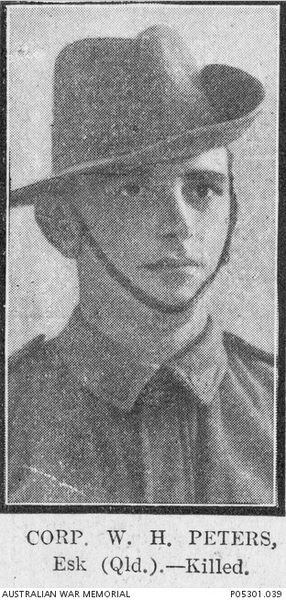
Five days later, with a slightly better plan, the 7th Brigade made another attempt and by the 5th August had taken the two lines of trenches and the blockhouse, but at tremendous cost. In the two attacks against the German lines, the 25thwhich had a nominal roll of about 900 suffered 650 casualties; of which 250 were killed. Another 70 would subsequently die of their wounds. Among the casualties were a number of men listed as Missing in Action; one of whom was Corporal William Peters.
Survivors of Pozieres described the German artillery which rained down on them in the trenches as the worst they experienced during the entire war. The Australian public were unprepared for the sheer size of the casualty lists that appeared in the daily newspapers and were unable to comprehend that a loved one could have disappeared without a trace. Most of the missing from Pozieres would eventually be declared Killed in Action by a Court of Inquiry but no trace of their remains was ever found.
Will Peters had named his sister Elsie as his sole beneficiary. She also took possession of Will’s testament, prayer book and letters. The Glenrock Lodge of the Independent Order of Oddfellows paid out a funeral benefit. According to the protocols of the time, Will’s medals, the 1914/15 Star, Empire Medal and Victory Medal were despatched to his eldest brother, George Peters. Wesley Peters was in a hospital in England while the Pozieres battle raged. Although seriously wounded later in the war, Wesley survived to marry an English bride and returned to Australia in 1920.
In 1938, some 20 years after the end of the First World War, the Australian Government constructed the Australian National Memorial at Villers Bretonneux. The memorial was dedicated by the newly crowned King George VI and records the names of over 10,000 Australian soldiers who lost their lives in France and have no known grave; William Peters among them.
On the site of the Pozieres windmill today is a commemorative stone which reads:
“The ruin of the Pozieres windmill which lies here was the centre of the struggle on this part of the Somme Battlefield in July and August 1916. It was captured by Australian troops who fell more thickly on this ridge than on any other battlefields of the war.”
Click images to start slideshow.