







THORNTON, William Edward
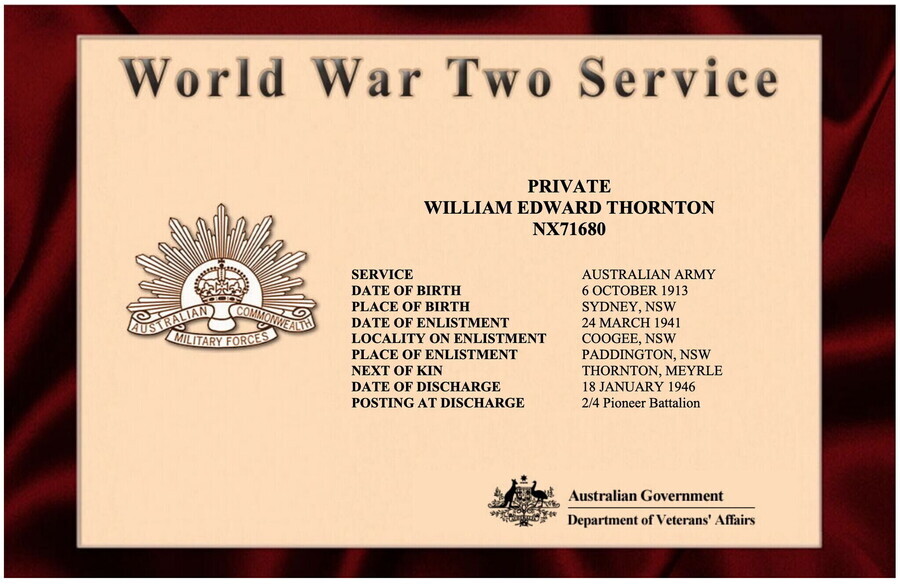
| Service Number: | NX71680 |
|---|---|
| Enlisted: | 24 March 1941 |
| Last Rank: | Private |
| Last Unit: | 2nd/4th Pioneer Battalion |
| Born: | Sydney, New South Wales, Australia, 6 October 1913 |
| Home Town: | Coogee, Randwick, New South Wales |
| Schooling: | Not yet discovered |
| Occupation: | Printer |
| Died: | Waverley, 6 August 1977, aged 63 years, cause of death not yet discovered |
| Cemetery: |
Eastern Suburbs Memorial Park, NSW |
| Memorials: |
World War 2 Service
| 24 Mar 1941: | Enlisted Australian Military Forces (WW2) , Private, NX71680, 2nd/4th Pioneer Battalion | |
|---|---|---|
| 18 Jan 1946: | Discharged Australian Military Forces (WW2) , Private, NX71680, 2nd/4th Pioneer Battalion |
Help us honour William Edward Thornton's service by contributing information, stories, and images so that they can be preserved for future generations.
Add my storyBiography contributed by Rod Hutchings
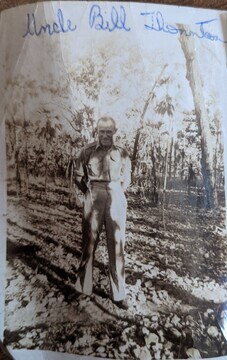
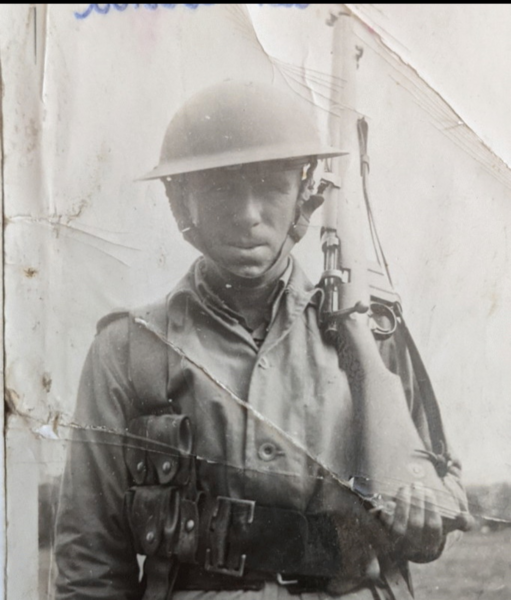
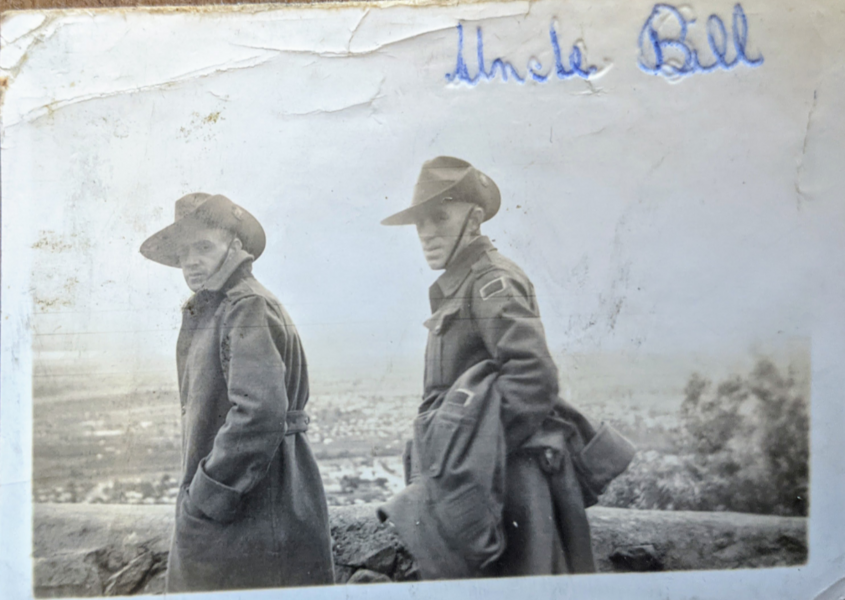
William Edward Thornton walked into the recruiting depot at Paddington on 24 March 1941. He was twenty-seven years old. He was a printer. He lived with his wife Meyrle at 5 Athol Street, Coogee, a short walk from the sea. Both his parents were dead.
Agnes had gone first, in August 1929, when William was fifteen. His father Robert followed fourteen months later, in October 1930. Two parents dead before William's eighteenth birthday. By the time he signed his enlistment papers he had been standing on his own feet for more than a decade. It shows in the small, steady choices the record preserves: the trade he learned, the woman he married in June 1938, the house close to the coast, the life he had rebuilt and was now preparing to leave.
Nothing in the file says why he joined. He was not conscripted. He was twenty-seven, married three years, working. The obvious reasons are the ones he never wrote down. Darwin had not yet been bombed. Japan had not yet entered the war. But a printer reads the papers more carefully than most, and by March 1941 the papers were grim.
He joined the 2/4th Pioneer Battalion. Pioneers were soldiers who also built. Trained as infantry, but tasked with the forward engineering work. They cleared mines, laid tracks, built bridges, maintained supply lines under fire. When the shooting started they fought. When it stopped they went back to the shovel and the axe. It was work that suited a man who already knew what it was to rebuild.
From Paddington he went to Canterbury, then to the 1st Training Battalion at Tamworth, then on 10 July 1941 he was taken on strength by the 2/4th Pioneers. By September he was in Darwin.
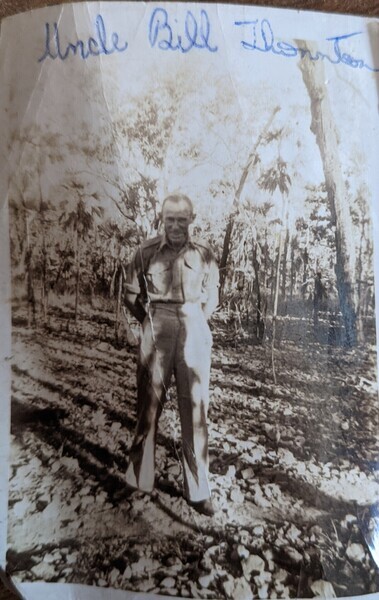
He was there for the whole of it. The first Japanese raid on 19 February 1942 killed more than two hundred people and sank eight ships in the harbour. The raids continued for most of the next two years. William stayed. He had embarked for Timor on 14 February 1942 with the rest of the battalion, but the operation was cancelled and the ship turned back. He disembarked in Darwin four days later, and the Top End became his war. Eighteen months of heat, dust, scrub, and the long nervous waiting between raids that wears on garrison men.
In June 1943 he was appointed Lance Corporal. The chevron came off his sleeve again on 7 January 1945, at his own request.
Soldiers who gave up rank voluntarily usually had one of two reasons. They disliked the paperwork that came with being a non-commissioned officer, or they wanted to be back among their mates without the distance a stripe put between them. Men who had served together since 1941, who had endured Darwin together, were about to go into their first major offensive. William chose to go in with them as a private soldier. The record does not say more. It does not need to.
Three months later the 2/4th Pioneers embarked from Cairns for Morotai, the staging island for the OBOE operations against Japanese-held Borneo. On 31 May 1945 William boarded LST 591, a Landing Ship Tank, bound for the north Borneo coast. The battalion went ashore at Brunei Bay on 10 June as part of the 9th Australian Division landings. They cleared roads, built bridges, worked the beaches, and fought when the work brought them to contact. The campaign ran until the Japanese surrender in August. William stayed on for the post-surrender rebuilding work and the slow job of getting the battalion home. He disembarked at Townsville on 29 December 1945 and was discharged on 18 January 1946.
One thousand seven hundred and sixty-two days of service. Six hundred and forty-three of those overseas.
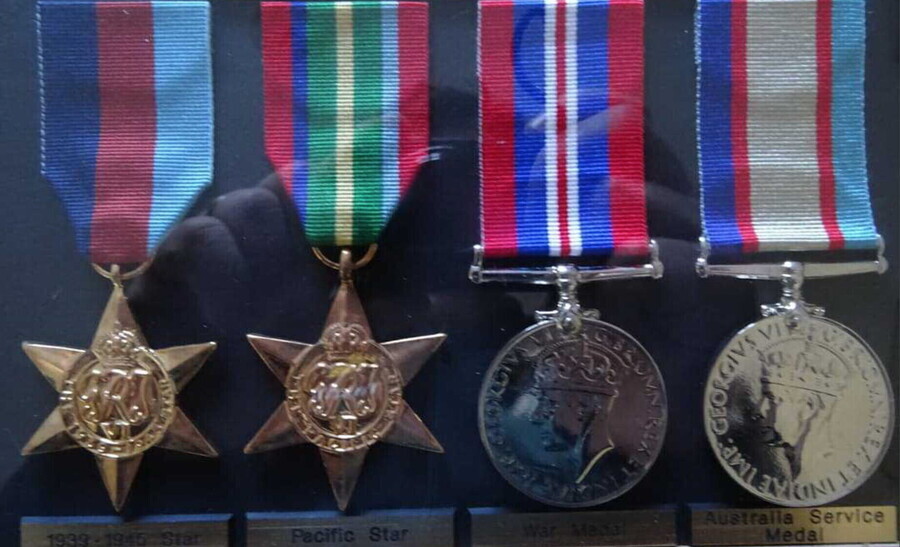
He came home to Meyrle and Coogee. He went back to the printing presses. He and Meyrle raised four children: Robert, Graham, Virginia, and Natasha. He was a quiet man by every indication the record permits. He did not apply for his campaign medals. The 1939-45 Star, the Pacific Star, the Defence Medal, the War Medal, the Australia Service Medal. All five were his on discharge. He never asked for them.
William died at Waverley on 6 August 1977, aged sixty-three. He is buried at Matraville.
In August 1992, fifteen years after William's death, Meyrle applied for his medals. She signed the postal receipt at her home in Bondi on 3 September. The medals came home in a small box, forty-six years after he did.
William was my great uncle. His older sister, Josephine Francis Thornton, born at Glen Ayre Private Hospital in Paddington on 7 December 1909, was my grandmother. She died at Matraville on 22 October 1957, and was buried there. Twenty years later her younger brother was buried there too.
Rod Hutchings
Click images to start slideshow.