






STANLEY, Wilfred Percible
| Service Number: | 2484 |
|---|---|
| Enlisted: | 10 January 1916 |
| Last Rank: | Trooper |
| Last Unit: | 2nd Light Horse Regiment |
| Born: | Roma, Queensland, Australia, 22 March 1888 |
| Home Town: | Toowoomba, Toowoomba, Queensland |
| Schooling: | Not yet discovered |
| Occupation: | Labourer |
| Died: | Brisbane, Queensland, Australia, 6 January 1957, aged 68 years, cause of death not yet discovered |
| Cemetery: |
Lutwyche Cemetery, Brisbane, Qld Anzac Portion 8 |
| Memorials: | Toowoomba Roll of Honour WW1 |
World War 1 Service
| 10 Jan 1916: | Enlisted AIF WW1, Private, 2484, 2nd Light Horse Regiment | |
|---|---|---|
| 5 May 1916: | Involvement Private, 2484, 2nd Light Horse Regiment, --- :embarkation_roll: roll_number: '1' embarkation_place: Sydney embarkation_ship: HMAT Karroo embarkation_ship_number: A10 public_note: '' | |
| 5 May 1916: | Embarked Private, 2484, 2nd Light Horse Regiment, HMAT Karroo, Sydney | |
| 21 Apr 1918: | Discharged AIF WW1, Trooper, 2484, 2nd Light Horse Regiment, 1st MD, medically discharged (wounding) |
Help us honour Wilfred Percible Stanley's service by contributing information, stories, and images so that they can be preserved for future generations.
Add my storyBiography contributed by Evan Evans
From Australian Remembrance Army
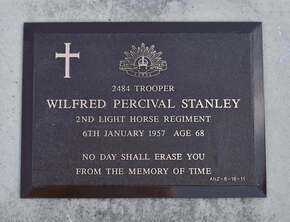
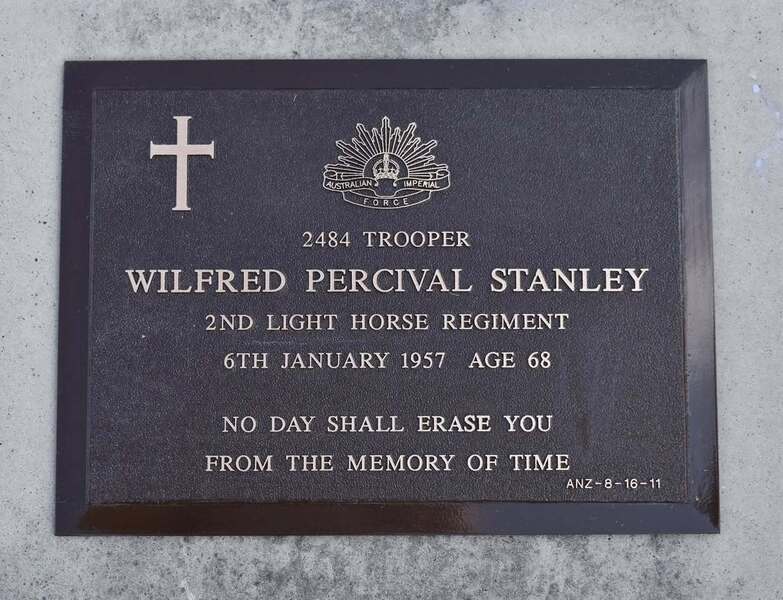
Australian World War One veteran Trooper Wilfred Percival Stanley (Service No. 2484), is among almost 800 previously unmarked WWI veterans’ graves in Lutwyche Cemetery we have now marked with plaques in recognition of their service for Australia.
We unveiled his plaque in Lutwyche Cemetery on 23 September 2023, along with a further 300 plaques on the previously unmarked graves of Australian World War One veterans:
See Australian Remembrance Army Facebook page
Wilfred Percival Stanley was born on 22 March 1888 in Roma, Queensland, to James Pembroke Stanley and Sarah Stanley (née Clarke).
Wilfred, recorded on his service record as Wilfred Percible Stanley, enlisted in the Australian Imperial Force at Toowoomba, Queensland, on 10 January 1916. He stated his occupation as labourer and nominated his mother, Mrs Sarah Jane Stanley, of Union Street, Toowoomba, Queensland, as his next of kin. On 5 May 1916, he embarked from Sydney aboard HMAT Karroo with the 17th Reinforcement, 2nd Light Horse Regiment.
After arriving overseas, Stanley was taken on strength with the 1st Light Horse Training Regiment at Tel el Kebir on 12 June 1916. He transferred to the 2nd Light Horse Regiment in August 1916 and served at Romani. In December 1916, he was hospitalised with D.A.H. — Disordered Action of the Heart — which was recorded as severe. D.A.H., often called “Soldier’s Heart” or “effort syndrome”, was a common First World War diagnosis for soldiers suffering symptoms such as palpitations, chest pain, dizziness, breathlessness and extreme fatigue, usually without clear evidence of organic heart disease. It was generally regarded as a functional condition associated with physical strain, exhaustion, stress and the effects of active service. Stanley was treated at several hospitals before convalescing at Abbassia and returning to duty in February 1917.
In July 1917, Stanley was again hospitalised, this time with debility, and was treated through several field and stationary hospitals before returning to Moascar. In August 1917, he attended the School of Instruction at Zeitoun, where he qualified as a 1st Class Hotchkiss Gunner.
On 3 November 1917, Stanley was wounded in action in Palestine. His records describe gunshot or shrapnel wounds to the left elbow/arm and right thigh. A bullet was removed from his right thigh, and the wound to his left elbow left him with restricted movement. The Medical Board assessed his disability at 40% and recommended his return to Australia for six months.
Stanley embarked from Suez for Australia aboard HMAT Ulysses on 15 February 1918 and disembarked in Australia on 20 March 1918. On 23 March 1918, the Toowoomba Chronicle reported that, during the desert fighting, he had been with a column responsible for a remarkable long-distance ride, and that his injury was serious enough for him to be sent home. The same article noted that, on his return, he had put on several stone in weight and had “filled out remarkably well”.
Stanley was discharged from the Australian Imperial Force on 21 April 1918.
Following his return to civilian life, he is recorded as living in western Queensland and working as a station hand.
Trooper Wilfred Percival Stanley died on 6 January 1957, aged 68, and was buried in Anzac Portion 8, Lutwyche Cemetery, Brisbane.
After decades without recognition at his place of burial, his grave now bears a plaque commemorating his service to Australia — ensuring his name endures among those remembered for their duty and sacrifice. His identity and dignity have now been restored.
We have remembered him.
Lest We Forget
Click images to start slideshow.