







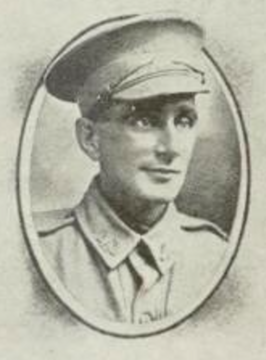
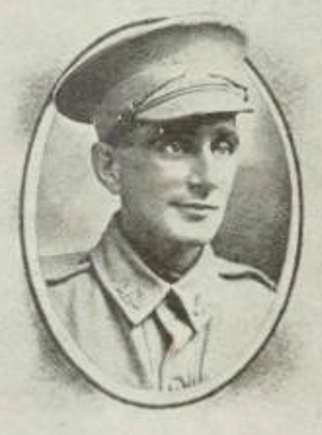
STYLES, Charles Henry
| Service Number: | 7322 |
|---|---|
| Enlisted: | 23 August 1915, Enlisted at Holdsworthy (now Holsworthy). Discharged due to illness on 10th October 1916. Re-enlisted by January 1917. |
| Last Rank: | Sapper |
| Last Unit: | 1st Infantry Battalion |
| Born: | Sydney, New South Wales, Australia, August 1889 |
| Home Town: | Redfern, City of Sydney, New South Wales |
| Schooling: | Not yet discovered |
| Occupation: | Tramway Permanent Way (Track) Worker |
| Died: | Illness, France, 26 June 1919 |
| Cemetery: |
No known grave - "Known Unto God" Villers-Bretonneux Memorial, Villers-Bretonneux, Picardie, France |
| Memorials: | Australian War Memorial Roll of Honour, Haymarket NSW Government Railway and Tramway Honour Board, Villers-Bretonneux Memorial |
World War 1 Service
| 23 Aug 1915: | Enlisted AIF WW1, Private, 7322, 1st Infantry Battalion, Enlisted at Holdsworthy (now Holsworthy). Discharged due to illness on 10th October 1916. Re-enlisted by January 1917. | |
|---|---|---|
| 10 Feb 1917: | Involvement Private, 7322, 1st Infantry Battalion, --- :embarkation_roll: roll_number: '7' embarkation_place: Sydney embarkation_ship: RMS Osterley embarkation_ship_number: '' public_note: '' | |
| 10 Feb 1917: | Embarked Private, 7322, 1st Infantry Battalion, RMS Osterley, Sydney | |
| 26 Jun 1919: | Involvement Sapper, 7322, --- :awm_ww1_roll_of_honour_import: awm_service_number: 7322 awm_unit: 6th Australian Broad Gauge Railway Operating Company awm_rank: Sapper awm_died_date: 1919-06-26 |
Help us honour Charles Henry Styles's service by contributing information, stories, and images so that they can be preserved for future generations.
Add my storyBiography contributed by John Oakes
Charles Henry Styles (7322) was born in Sydney about August 1889. He was a permanent way (track) worker for the trams.
Styles enlisted at Holdsworthy on 23rd August 1915 and gave his wife, Alice Annie Styles living in Erskineville as his next of kin. He also claimed military service with the Irish Rifles in Sydney and the Army Medical Corps. He was allotted to the 7th Reinforcements of the 19th Battalion. On 16th February 1916 he was taken on the strength of the 55th Battalion at Tel-el-Kebir (Egypt).
Six weeks later, on 5th April 1916, he was transferred to the 1st Field Ambulance and then the 2nd Australian Casualty Clearing Station, but with his ailment ‘N.Y.D.’ – not yet diagnosed. A fortnight later the medical situation had become clearer. Styles had post-diptheratic paralysis. He was transferred to the 15th Field Ambulance. Cerebral syphilis was added to the diagnosis. On 3rd May he was transferred to the 1st Australian Stationary Hospital at Ismalia with his condition now described as toxia strabismis. On 9th May he moved to the 3rd Australian General Hospital at Abbassia and then to the 1st Auxiliary Hospital on 19th May.
He was clearly very unwell and on 24th June 1916 embarked for Australia per HT ‘Port Sydney’. He reached Sydney on 22nd July. He was discharged from the AIF on 10th October. He was granted a pension of 15/- per fortnight from 11th October 1916.
Styles must have recovered well once he was back in Australia for by January 1917 he had re-enlisted. He was now allotted to the 24th Reinforcements to the 1st Battalion. He left Australia again on 10th February 1917 aboard RMS ‘Osterley’ as part of the 1st Battalion. The next day transferred to the 60th Railway Company, later known as the 6th Broad Gauge Railway Operating Company. This unit had been established for the specific purpose of operating the important supply railways behind the front and men with civilian railway skills were deliberately recruited.
‘Osterley’ reached Plymouth (England) on 11th April 1917. After some general training with the 1st Training Battalion, Styles proceeded overseas to France to reinforce the 60th Company, Australian Railway Operating Division at Bordon. On 14th September he was admitted to hospital with an injury to his index finger and this resulted in a series of admissions to different medical units before he returned to his unit on 5th October.
In May 1918 he was disciplined for:
‘Leaving his post as guard of engine 2766 without orders from his superior officer. AWL at Dosinghem as guard of engine 2766 absenting himself from 7.25 pm 14.5.18 to 4.50am 15.5.18, another man taking on his duty during that time. ‘
This offence incurred a penalty of seven days Field Punishment No. 2.
In August he had leave in England, but back in France in December he was admitted to hospital with Influenza. In February 1919 he was in hospital again, now with venereal disease. This took 23 days to clear. He remained in England, rather than return to the railway unit in France, and was in hospital again in April.
On 12th June 1919 he boarded HMAT ‘Themistocles’ for return to Australia. By this time he must have been very ill, for he was immediately admitted to the ship’s hospital with tuberculosis. He died of this disease on 26th June 1919 and was buried at sea the same day.
Charles Styles’ brother William Thomas Styles also died in the Great War, at Ypres, and was buried in the Menin Road Cemetery. Alice Styles requested that her husband’s details be added to his brother’s headstone since having been buried at sea he had no grave. This was agreed to by William’s next of kin, his uncle. The inscription read:
‘7322 C.H. Styles, B.G.R.O.C. Buried at sea 26/6/19 Thy Will be done’.
- based on the Australian War Memorial Honour Roll and notes for the Great Sydney Central Station Honour Board.
Click images to start slideshow.