







BEEMAN, Francis John Sydney
| Service Number: | 445436 |
|---|---|
| Enlisted: | 17 June 1944 |
| Last Rank: | Flight Sergeant |
| Last Unit: | No. 102 Squadron (RAF) |
| Born: | Redfern, New South Wales, Australia , 5 May 1926 |
| Home Town: | Ballina, Ballina, New South Wales |
| Schooling: | Manley, New South Wales, Australia |
| Occupation: | Artist |
| Memorials: |
World War 2 Service
| 17 Jun 1944: | Enlisted Royal Australian Air Force, Flight Sergeant, 445436, No. 102 Squadron (RAF) | |
|---|---|---|
| 18 Oct 1945: | Discharged Royal Australian Air Force, Flight Sergeant, 445436, No. 102 Squadron (RAF) |
Help us honour Francis John Sydney Beeman's service by contributing information, stories, and images so that they can be preserved for future generations.
Add my storyBiography contributed by David Beeman
He was twenty years old and had spent the previous eighteen months as an Air Gunner in a heavy bomber — a time with many hours to contemplate a potently perilous, perhaps short, future — and he resolved that if he survived, he would not waste the opportunities that came his way.
The Commonwealth Reconstruction Training Scheme gave John Beeman his chance. He had grown up in Manly, the youngest of eight children of an Anglican clergyman who had died when John was eight, leaving a household held together by a quietly determined mother. He had been a gifted student — ranked second in his entire year at fourteen, made class captain at fifteen — with an exceptional eye for spatial things: Technical Drawing, Woodwork, Geometry. He had always been drawn to making things visible.
Through the Rehabilitation Scheme, he enrolled at the Julian Ashton Art School in Sydney. The principal, Henry Gibbons, wrote of him to a colleague as "a Rehab. Trainee of some promise." That was an understatement. Five years later, John graduated with a credit in Drawing, Painting and Design, was already at work at the Australian Museum, and soon on his way to London to study at the Slade School of Fine Art and the Courtauld Institute of Art.
What followed was a career of quiet, far-reaching influence. At the Australian Museum he built the first dedicated Department of Art and Design in the institution's history, transforming the way scientific knowledge was presented to the public. A Supreme Court judge who wrote him a reference described him as "a man of great energy and initiative" whose galleries were "generally recognised to be of a standard equal to any in museums in other parts of the world."
Throughout all of it he continued to paint — large, richly glazed figurative works in the tradition of the Old Masters, close in observation and warm with humour. Critics compared them to Bruegel and William Dobell. In 2026, approaching his hundredth year, he is still at work in his studio most mornings.
The Air Gunner who resolved not to waste his chances has kept every one of them.

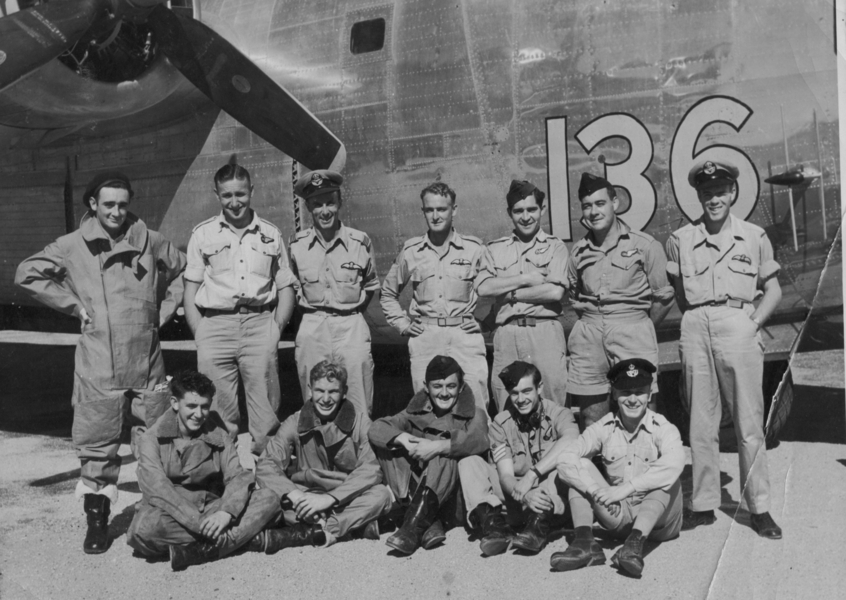
Click images to start slideshow.