




RICHARDSON, John William
| Service Number: | Commissioned Officer |
|---|---|
| Enlisted: | 24 February 1916, Sydney, New South Wales |
| Last Rank: | Captain |
| Last Unit: | 34th Infantry Battalion |
| Born: | Longueville, New South Wales, Australia, 11 July 1891 |
| Home Town: | Longueville, Lane Cove, New South Wales |
| Schooling: | Not yet discovered |
| Occupation: | Leather belt maker |
| Died: | Killed In Action, Passchendaele, Belgium, 12 October 1917, aged 26 years |
| Cemetery: |
No known grave - "Known Unto God" |
| Memorials: | Ypres (Menin Gate) Memorial |
World War 1 Service
| 24 Feb 1916: | Enlisted AIF WW1, Lieutenant, Commissioned Officer, 34th Infantry Battalion, Sydney, New South Wales | |
|---|---|---|
| 2 May 1916: | Embarked AIF WW1, Lieutenant, Commissioned Officer, 34th Infantry Battalion, --- :embarkation_roll: roll_number: '17' embarkation_place: Sydney embarkation_ship: HMAT Hororata embarkation_ship_number: A20 public_note: '' | |
| 29 Mar 1917: | Promoted AIF WW1, Captain, 34th Infantry Battalion | |
| 30 Jul 1917: | Involvement AIF WW1, Captain, Commissioned Officer, 34th Infantry Battalion, Third Ypres | |
| 12 Oct 1917: | Involvement AIF WW1, Captain, Commissioned Officer, 34th Infantry Battalion, 1st Passchendaele, --- :awm_ww1_roll_of_honour_import: awm_service_number: awm_unit: 34th Australian Infantry Battalion awm_rank: Captain awm_died_date: 1917-10-12 |
The sad story of Captain Jack Richardson
The sad story of Captain Jack Richardson
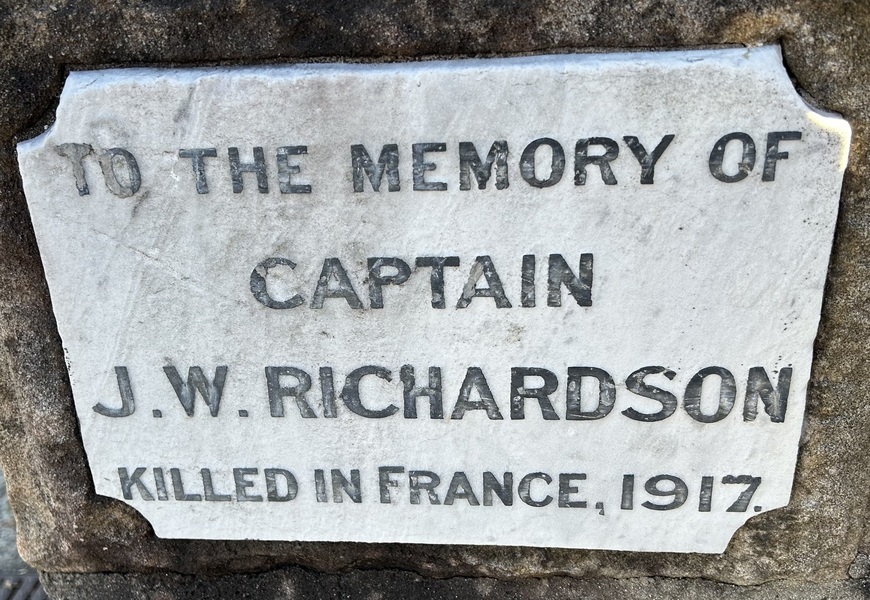
Fixed to a gatepost of the Kamilaroi Retirement Village at 155 Longueville Road, Lane Cove in Sydney is a plaque in memory of Captain J. W. Richardson, killed in France, 1917. In fact he was killed in action in Belgium on the first day of the battle of Passchendaele (sometimes called ‘Third Ypres’).
John William Richardson (Jack) was the eldest of eight siblings of a prominent Lane Cove (Sydney) family. His father, John senior, was a ‘quarryman’ and built the sandstone wall at the entrance to the Longueville Congregational Church, which today is the Kamilaroi Retirement Village.He fixed the memorial plaque to his son to the gatepost. The Lane Cove Council also acknowledged Jack’s war service by naming Richardson Street in his honour. And of course Jack’s name appears on the Canberra war memorial and on Menin Gate in Belgium. But like approximately half of Australians killed in acton at Passchendaele, his body was never recovered to be properly buried in a war cemetery.
The battle of Passchendaele in October 1917, Is considered by war historians as one of the most ferociously fought in the First World War. Unseasonable rain turned the battlefield into a `quagmire and it was difficult to retrieve the dead. Many wounded were left to die in the mud of no man’s land. The battle saw 60 Australian officers and 1322 other ranks killed. Jacks battalion, the 34th, lost 15 officers and 323 other ranks.
Jack was a Lane Cove boy, just 26 years old when he fell. He was the eldest of eight siblings. After finishing his schooling at Longueville Public School, he worked locally at Radke’s tannery and his profession is listed in the army records as ‘leather belt maker’. He joined the militia before the war and served as an NCO for four years until he was commissioned in June 1914. On the 24th February 1916, he joined the 34th battalion as lieutenant and travelled to France.
At Passchendaele and now promoted to the rank of captain, Jack probably blew the whistle at ‘zero hour’ (5.25am) on the 12th October which initiated the first allied attack at the start of the Battle of Passchendaele. He went ‘missing in action’ on that first day. An official army report states;
‘The above named officer was killed in action 12.10.17 near Passchendaele. After having gained the first objective in this terrible assault he reorganised his company and was assisting in the capture of the second objective when he was killed. On account of the Battalion having consolidated on a line in rear of where he was killed his body was left in no man’s land or in the German lines and it was impossible to conduct a burial. No burial took place and information of nature of wounds is unobtainable’. Later, conflicting eyewitness accounts state that he was ‘shot in the head’ and another stated that ‘he went too far right past our objective’.
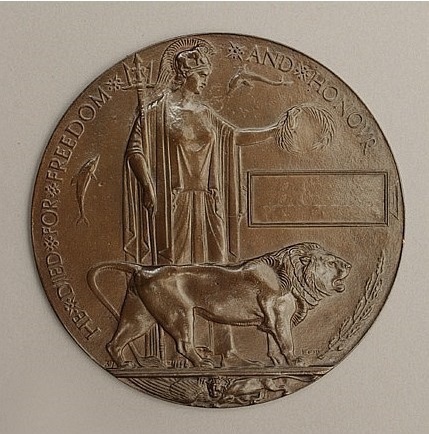
Jack’s parents were notified that their son was missing in action. They queried the army whether there might have been a mistake since there was another Richardson in the battalion. But in due course, some of Jack’s belongings were returned to the family in Sydney. And his identity disc was also later returned with the engraved rank of lieutenant. Again the family questioned whether it was their son’s disc, because his rank was captain. The army wrote back saying that he would have been wearing the disc issued to him prior to his promotion and adding; ‘As the disc was returned from Germany it is presumed that Captain Richardson was buried by German hands’.
There was no satisfactory ‘closure’ for the family for some time. That is where this story may well have ended except for a further remarkable set of circumstances.
Fighting the Australians on the German side was an 18 year old recently drafted soldier who was born in Sydney and grew up in Hunter’s Hill, just a few kilometres from Jack’s home in Lane Cove. He was Ekkehard Beinssen (Ekke), the son of a prominent German wool merchant based in Sydney. In 1912, the family decided to move to Germany so that Ekke, now twelve years old, could complete his education. Before he turned 18, he was drafted into the army and after some brief training, sent to the Western front at Passchendaele, aged 18 years and 3 months.
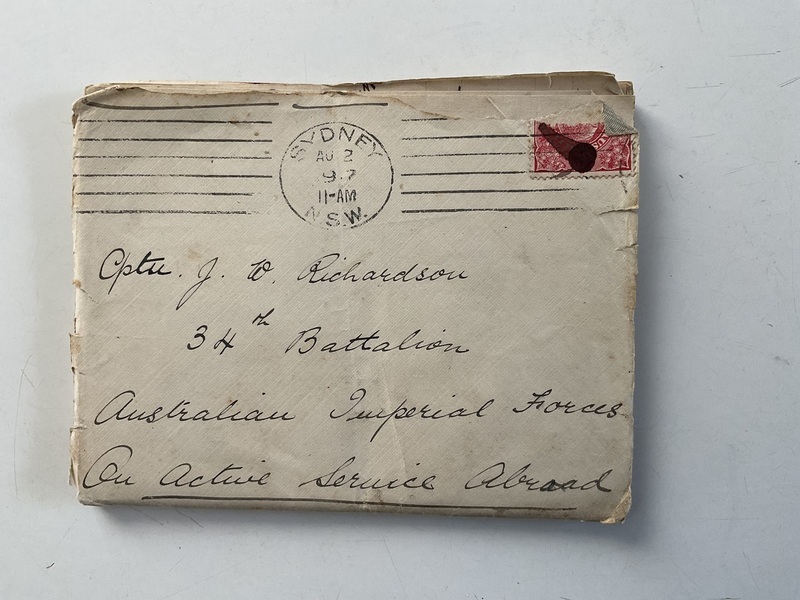
Ekke was a prolific letter writer and frequently reported his battlefield experiences to his family. In one letter he reported that he had come across the body of Captain Richardson. In his words (translated from German) he wrote;
‘I am surprised at myself that throughout the entire battle I wasn’t in the least nervous and my heart didn’t beat faster at all. That isn’t bravery but inherent indifference. The Tommies had already advanced when they saw us coming in extended line so that the counter-attack was completely and totally successful. They suffered huge losses and we also took several prisoners. They were all Australians opposite us and I have letters belonging to a fallen Captain from Sydney - Mr J.W.Richardson. I may also get his photos which somebody else has. A bit later, they took off his boots. I must say, there was a lot of looting. A pilot who came down was undressed down to his shirt when he had hardly hit the ground. I think it is really disgusting and of course I didn’t do it, though the enemy are also guilty. Perhaps I can write to the relatives of Mr. Richardson after the war. I am sending you the letters’.
What Ekke does not report is that he also took Jack’s identification disk and later gave it to a captured and wounded Australian soldier, with the message that Captain Richardson had been found dead by the Germans. That soldier was Samual Pittman from Merriwa in NSW. At hospital in Coblenz he handed the disk the the superintendent with the statement; ‘On the 14th October when I was taken prisoner a German Officer handed me Richardson’s matricule and informed me that Lieutenant Richardson had been found dead by the Germans’. This identification disc was eventually returned to the family via the Red Cross.
Ekke returned to Australia about ten years later, after completing a Doctorate of Economics and living in Germany, Persia, Saudi Arabia, New Guinea and the USA. He became a successful businessman in Sydney. In later years, he was an ardent passivist and spoke very little to his children about his war experiences. He never did contact the Richardson family and his children are still in possession of the letters.
Acknowledgements:
Silke Beinssen Hesse translated Ekke’s letters and made them available on the internet and to John Williams for his book ‘German Anzacs’. Professor Bill Gammage put further pieces of the story together in his article referenced below.
References:
German ANZACS and the First World War. John F. Williams. UNSW Press,1999.
An incident at Passchendaele. Bill Gammage. Overland, Issue 251, Winter 2023.
Submitted 7 January 2026 by Konrad Beinssen



Click images to start slideshow.