





63654
DUTHIE, James Archibald
| Service Number: | 5334 |
|---|---|
| Enlisted: | 29 May 1916, Adelaide, SA |
| Last Rank: | Private |
| Last Unit: | 27th Infantry Battalion |
| Born: | Ovingham, South Australia, 2 March 1896 |
| Home Town: | Kilkenny, Charles Sturt, South Australia |
| Schooling: | Not yet discovered |
| Occupation: | Dairy Farmer |
| Died: | South Australia, 21 October 1976, aged 80 years, cause of death not yet discovered |
| Cemetery: |
Centennial Park Cemetery, South Australia RSL Wall of Remembrance, Wall 111 Niche E014. |
| Memorials: |
World War 1 Service
| 29 May 1916: | Enlisted AIF WW1, Private, 5334, 27th Infantry Battalion, Adelaide, SA | |
|---|---|---|
| 12 Aug 1916: | Involvement Private, 5334, 27th Infantry Battalion, --- :embarkation_roll: roll_number: '15' embarkation_place: Adelaide embarkation_ship: HMAT Ballarat embarkation_ship_number: A70 public_note: '' | |
| 12 Aug 1916: | Embarked Private, 5334, 27th Infantry Battalion, HMAT Ballarat, Adelaide | |
| Date unknown: | Wounded 5334, 27th Infantry Battalion |
Dangerously Ill but Survived.
James Archibald, born in Kilkenny on the 2nd March 1896, was one of five sons of Amy Sheldon and William Henry Duthie. Scottish-born William arrived in Australia as a 12-year-old and became a dairyman. He had 27 years serving his community, represented West Ward, on the Yatala South Council including as Chairman. He also served on the Metropolitan Infectious Diseases Board in ’29.
While the family worked hard, there was still time for the many dairymen and their families to gather. In 1907 William suggested the formation of the Adelaide and Suburban Dairymen's Association. This was the beginning of an annual picnic which took place on the Jubilee Exhibition Oval on Thursday and was entirely successful. A procession left Victoria-Square at noon, and travelled via King William, Currie, Morphett, Hindley, and Rundle streets, then East and North terraces. Once at the oval, the large gathering of dairymen, their families and friends enjoyed sporting and other events, especially for the children.
James worked with his father as a dairy farmer on 10 acres at Yatala, a property acquired in 1909 From early years, William trod a fine line in terms of the water content of the milk he sold. He became a regular with Court appearances centring on the fat content, which varied according to the season, and also about the adding of skim milk to full cream. He received several fines, but also on balance, escaped without penalty in many other incidents. (His most expensive fine, and the heaviest imposed in S.A. totalling £108, was issued as James was en-route to England to serve in WWI.)
As were many young men, James was part of the Senior Cadets 77th Infantry for two years before transferring to the Citizens Forces in the 19th A.S.C until, aged 21 he enlisted on the 29th May 1916 to serve in WWI. He was allocated the number 5334 as part of the Mitcham 14/27th Battalion. The Register newspaper reported that he was one of 19 young men who enlisted on the same day and went into the Exhibition Camp.
James was paid the princely daily sum of 6/- (60 cents) of which 3/- was to go to his mother, Amy each week. He also nominated his mother as his next of kin.
By the 12th August James had embarked on the ‘Ballarat’ for overseas, arriving at Plymouth, England on the 30th September that year. He immediately marched into Rollerstone, a small village on the Salisbury Plains of Wiltshire, near the River Till. (Rollerstone, was established that year by the Royal Flying Corps as an observation balloon training area.)
From there James travelled to Folkestone and thence to Etaples in France, which had become one of several British Army bases. Those in charge were often known for not having served at the front and therefore held in low regard. They also developed a reputation for poor treatment of soldiers, including excessive sessions of marching across dunes ‘at the double’. By the 6th December James was serving in France with the 27th Battalion.
Less than three months later, on the 31st January, James was wounded in action with a penetrating gunshot wound to his back that also pierced his right lung. (A hernia is also mentioned.) Initially he was treated at Number 3 Stationary Hospital, Rouen but the severity of his injury categorised as ‘dangerously ill’ caused his transfer from Rouen for England six days later on the 25th February ’17. He sailed on the ‘St David’ in a serious condition. On arrival James was admitted to the 2nd Birmingham War Hospital, Northfield, West Midlands. His mother was informed of his condition with updates. A glimmer of hope was the note on the 24th March that ‘His progress is slow and he is still weak.’ An added, thoughtful comment was that ‘We hope this report will somewhat allay your great anxiety, and that your son may soon be sufficiently recovered to write you himself.’
A brief note from London on the 4th April was reassuring ‘Making satisfactory progress,’. The final note reported James was progressing favourably, adding ‘We feel sure you will be relieved to know your son is out of danger and no doubt you will shortly hear from him to this effect.’
As his condition improved James moved to The Depot at Weymouth. Back home local newspapers continued to publish news of the men serving overseas. In February, James was one of ten soldiers reported to be either dangerously or seriously wounded; 5334. Pte. J. A. DUTHIE, Kilkenny (dangerously). By March a total of all casualties made for sobering reading. It was the 276th casualty list containing 889 names, including:- Dead, 134, wounded, 370, missing, 4, ill, 354, injured, 25, prisoners of war, 2. James and two others, Lance-Corporal H. G. Barker, and T. Moore were on the Dangerously Ill list. The Advertiser reported that ‘Mr. and Mrs. Duthie, of Kilkenny, have received news that their son, Private J. A. Duthie, is in the Birmingham War Hospital.’
Eventually James had recovered sufficiently to return to Australia via the ‘Nestor’ to the Melbourne Victoria Barracks on the 22nd July. The September issue of the Register announced that ‘Homecoming Soldiers. Advice has been received by the military authorities that the undermentioned sick and wounded (comprising list No. 16) are due to arrive in Adelaide at an early date. All men not requiring immediate treatment at the hospital will be given leave and may proceed to their homes at the conclusion of the procession, without first attending at the hospital. The date and time of the arrival in Adelaide will be published so soon as possible. This included 5334.—Pte J. A. DUTHIE, 27th Bat.
On the 29th September, the Observer joyously reported that ‘More Soldiers Returned. Early on September 21 a vessel conveying more than 1,000 wounded and invalided soldiers arrived at the Outer Harbour. Shortly after 2 p.m. the men for the other States were brought to Adelaide by two special trains, and the 300 South Australians arrived at about 4 o'clock. They were met at the North Terrace Railway Station by a large crowd. On the platform were His Excellency the Governor-General (Sir Ronald Munro-Ferguson), attended by Capt. Clifford, A.D.C., and the State Governor (Sir Henry Galway), accompanied by Capt. d'Erlanger, A.D.C. As the train drew into the station the Mitcham Camp Band played "Home, Sweet Home."
‘The soldiers were driven in motor cars through the principal streets of the city, which were decorated with flags and lined with people, who showered fruit, sweets, and cigarettes into the cars. Later all of them were entertained in the Cheer-up Hut.’ In the list of named returnees was 5334.—Pte. J. A. DUTHIE, 27th Bat.
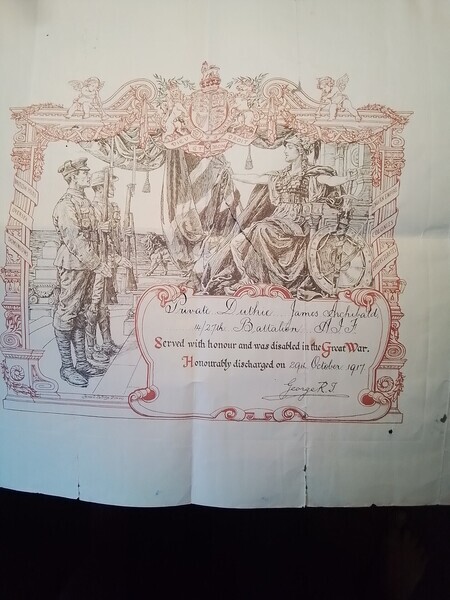
James was officially discharged on the 29th October, exactly 17th months after enlisting. (His record indicated this was 1 year 154 days, with 41 of those days served abroad.) As an invalid, James was then discharged from Keswick Barracks on the 17th November 1917. For his service, he was awarded the 1914/15 Star, the British War Medal and the Victory Medal. He was also issued with an elegantly coloured scroll, marking his Honourable Discharge where he ‘Served with Honour and was disabled in the Great War’.
James returned to dairying on the family property. He married Margaret Elizabeth with the two having a family of two sons, William Henry and James Packer.
James’s 60-year-old father died in February ’33, leaving a bequest of £21 to the Kilkenny Congregational Church and the remainder of his estate to the family. James continued to work the dairy, but unexpected challenges continued. In August ‘36, nine heifers valued at £40, were stolen from the Duthie family with the loss first noticed by their son, Kenneth who also worked on the property. It transpired that an ex-employee had taken some to the abattoirs and sold others, hoping to convince his wife he was still employed and earning money. He was prosecuted and fined. Subsequently, James advertised in February ’37 for a ‘lad or man, can milk, good wages and keep. Ring M7622 before 9 and after 12 o’clock. J.A. Duthie dairyman Kilkenny.’
Some of James’ father, William’s canny Scottish frugality was inherited by James as he tried to stretch milk production further. Unfortunately, in February ’37 he and Myrtle were each fined £5 with £2/1/ costs after pleading guilty to charges of having sold milk which did not comply with the standard fixed by the Food and Drugs Act.
Aged 80, James died on the 21st October 1976. His service is remembered at Centennial Park Cemetery on the Wall of Remembrance, Wall 111 Niche E014. Margaret Elizabeth lived to be 85 and died on the 11th November 1982. She also was buried in the Centennial Park Cemetery in the Services Family plot, Rose Bed 3, Position 87.
Researched by Kaye Lee with family information and photos by grandson Roger Duthy.
Submitted 5 May 2026 by Kaye Lee
Biography contributed by Faithe Jones
Son of William DUTHIE and Amy Sheldon nee MOONS


Click images to start slideshow.