


BYRNE, John Wall
| Service Number: | 462 |
|---|---|
| Enlisted: | 26 October 1914, 2 years Australian Light Horse, No. 2 Squadron 13th Regt |
| Last Rank: | Trooper |
| Last Unit: | 5th Light Horse Regiment (WW1) |
| Born: | Granville, New South Wales, Australia, 4 October 1891 |
| Home Town: | Brisbane, Queensland |
| Schooling: | Not yet discovered |
| Occupation: | Blacksmith |
| Died: | Brisbane, Queensland, Australia, 6 July 1951, aged 59 years, cause of death not yet discovered |
| Cemetery: |
Lutwyche Cemetery, Brisbane, Qld Anzac Portion 8 |
| Memorials: | Esk War Memorial |
World War 1 Service
| 26 Oct 1914: | Enlisted AIF WW1, Private, 462, 5th Light Horse Regiment (WW1), 2 years Australian Light Horse, No. 2 Squadron 13th Regt | |
|---|---|---|
| 21 Dec 1914: | Involvement Private, 462, 5th Light Horse Regiment (WW1), --- :embarkation_roll: roll_number: '2' embarkation_place: Sydney embarkation_ship: HMAT Persic embarkation_ship_number: A34 public_note: '' | |
| 21 Dec 1914: | Embarked Private, 462, 5th Light Horse Regiment (WW1), HMAT Persic, Sydney | |
| 26 Feb 1919: | Discharged AIF WW1, Trooper, 462, 5th Light Horse Regiment (WW1), 1st MD |
Help us honour John Wall Byrne's service by contributing information, stories, and images so that they can be preserved for future generations.
Add my storyBiography contributed by Evan Evans
From Australian Remembrance Army
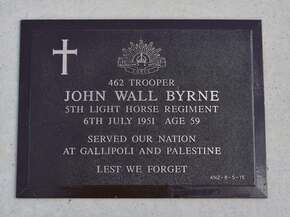
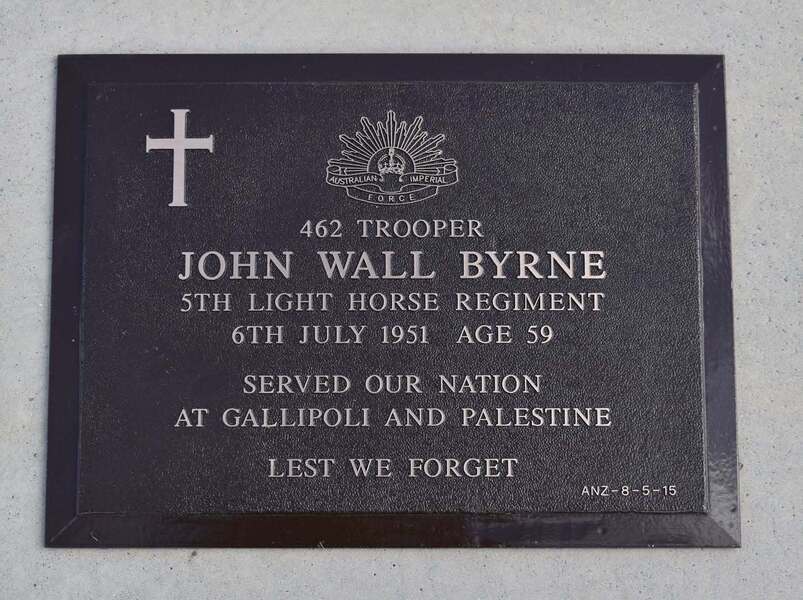
Trooper John Wall Byrne (Service No. 462), an Australian World War One veteran who served our nation at Gallipoli, is among almost 800 previously unmarked WWI veterans’ graves in Lutwyche Cemetery we have now marked with a plaque recognising their service for Australia.
We unveiled his plaque in Lutwyche Cemetery on 23 September 2023, along with a further 300 plaques on the previously unmarked graves of Australian World War One veterans:
See Australian Remembrance Army Facebook page
John Wall Byrne was born on 4 October 1891 at Granville, New South Wales, the son of Joseph Wall Byrne and Mary Ann McCullough. He trained as a blacksmith before enlisting in the Australian Imperial Force on 4 November 1914, at the age of 23. He embarked from Australia in December 1914 and served overseas for more than four years, first in Egypt and then at Gallipoli, where he landed on 16 May 1915. Following the evacuation of Gallipoli, Byrne continued active service with the Light Horse in Egypt and later in the Sinai and Palestine campaigns, taking part in the demanding mounted operations that characterised Australia’s Middle Eastern war effort.
During his service, Byrne’s trade skills were utilised when he was appointed a Shoeing Smith in June 1916, a role essential to the effectiveness of mounted units operating in desert conditions. His military record shows repeated periods of hospitalisation, including treatment for synovitis of the knee, reflecting the physical strain of prolonged active service.
Like many soldiers in continuously deployed units, his service history included several promotions and reductions in rank, including appointments as Lance-Corporal and Temporary Corporal, before later being reduced to the ranks. Despite these fluctuations, he remained on active service throughout the war and completed the full period of overseas duty.
Byrne returned to Australia in late 1918, embarking from Suez aboard the Port Darwin, and was formally discharged from the Australian Imperial Force on 26 February 1919.
In early 1919, he married Edith Emma Wells. The couple had two sons: Joseph William Byrne, born in 1920, and John Darcy Byrne, born in 1921. Their elder son, Joseph William Byrne, later served for Australia during the Second World War and died in November 1942 while on active service in Papua New Guinea, aged 22.
John Wall Byrne lived in Queensland in the years after the war and later developed carcinoma of the colon. He died in Brisbane on 6 July 1951 at the age of 59 and was buried in Anzac Portion 8 at Lutwyche Cemetery, Brisbane. His wife, Edith Emma Byrne, died in June 1977, and her ashes are interred at Mount Thompson Memorial Gardens and Crematorium, Holland Park, Brisbane.
After decades without recognition at his place of burial, his grave now bears a plaque commemorating his service to Australia — ensuring his name endures among those remembered for their duty and sacrifice. His identity and dignity have now been restored.
We have remembered him.
Lest We Forget.
Click images to start slideshow.