


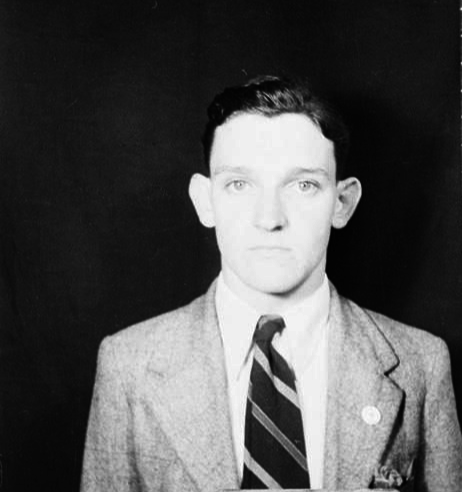
STAFFORD, Michael John
| Service Number: | 425907 |
|---|---|
| Enlisted: | 21 May 1942 |
| Last Rank: | Flying Officer |
| Last Unit: | Not yet discovered |
| Born: | Brisbane, Queensland, Australia, 19 July 1923 |
| Home Town: | Brisbane, Queensland |
| Schooling: | St Laurence's College, Brisbane, Queensland, Australia |
| Occupation: | Not yet discovered |
| Died: | Sydney, New South Wales, Australia, 6 August 2010, aged 87 years, cause of death not yet discovered |
| Cemetery: |
Toowong (Brisbane General) Cemetery, Queensland Plot Mon-22-21/#/22 |
| Memorials: |
World War 2 Service
| 21 May 1942: | Enlisted Royal Australian Air Force, Flying Officer, 425907 | |
|---|---|---|
| 8 Sep 1945: | Discharged Royal Australian Air Force, Flying Officer, 425907 |
Help us honour Michael John Stafford's service by contributing information, stories, and images so that they can be preserved for future generations.
Add my storyBiography contributed by John Dinnen
Shakespeare's King Henry declared "In peace, nothing so becomes a man as modest stillness and humility; but when the blast of war blows in out ears, then imitate the actions of the tiger; stiffen the sinews, summon up the blood, disguise fair nature with a hard-favor'd rage!"
Those well-chosen words are especially fitting when reflecting on the deeds of Lauries Old Boy, Michael John Stafford. Michael was a seasoned and decorated warrior of the skies over Europe during World War Two, yet few were to ever know of his wartime éscapades.
Born in Brisbane on 19th of December, 1923 Michael was a resident of Hansen Street, Moorooka. As with many young lads of Moorooka, Michael was a student at Lauries, he was a keen student, and his preferred co-curricular activities were swimming and cricket.
At the end of 1938 he made the decision to finish his formal education, and he immediately gained employment as a clerk with the state government.
This career path was short lived as World War Two was declared in 1939 and as soon as he turned 18 years of age Michael applied for admission to the Royal Australian Navy, sadly for him, he was considered medically unfit for service due to poor eyesight.
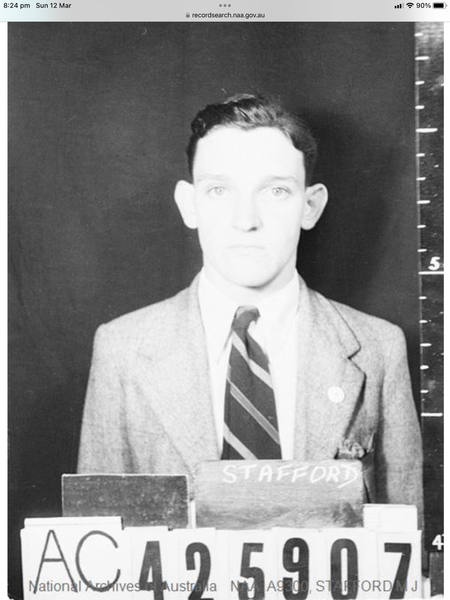
Not one to sit back and allow his peers to do the hard work for him, MIchael decided to have a crack at joining the Royal Australian Air Force. So on the 20th of May, 1942 he made his way to the Number 3 Recruiting Depot, in Creek Street, Brisbane. To his great surprise he was accepted as a RAAF Recruit, and after undertaking RAAF training at Kingaroy and Evans Head, he was assigned to train as a pilot, however due to recurring eyesight issues he was re-assigned to aircrew training, as a rear gunner.
Eventually, Michael embarked for the United Kingdom on the 27th of September,1943 arriving on the 3rd of November 1943.
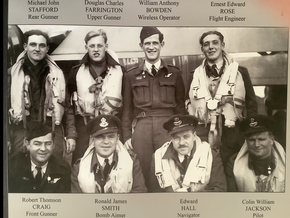
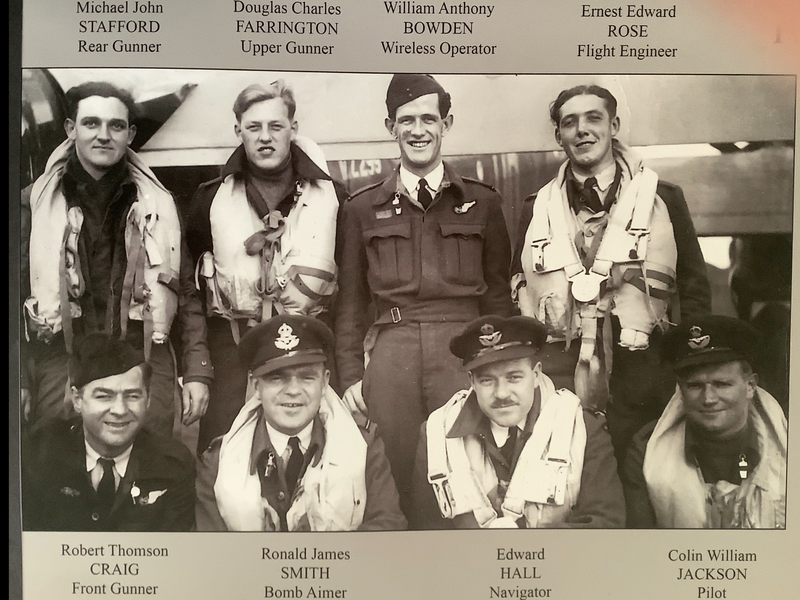
Immediately upon arrival in England he was assigned to RAAF Squadron 466 with the famous Bomber Command, based out of Driffield air base in Yorkshire and was tasked with Jackson crew, carrying out Bomber Special Duties.
Initially, Jackson crew consisted of seven aviators and spent many weeks training on the Halifax III heavy bomber. The training was arduous, yet swift as the situation necessitated.
There was one, recurring and startling sight cannot have escaped Michael's attention during his training, and that was the returning Halifax bombers being met by the Driifield airfield RAF fire brigade units, not for solely extinguishing on board fires, but often to remove the body of the deceased rear-gunner and to hose out his turret.
It is estimated that approximately 20,000 Bomber Command gunners were killed in action and overall. In fact, Bomber Command lost more than 55,000 air crew KIA in the skies over Europe in World War 2, and about half of all crews were lost before they had achieved 10 missions.
Nevertheless, on 26 May, 1944 Jackson crew undertook their first of operational bombing raids, on this occasion to destroy the Axis infrastructure in the town of Trappes, just outside of Paris. This was the first of 49 (393.05 operational hours) successful bombing raids that Michael undertook with the Jackson crew over Germany and France.
The primary role of the Rear Gunner is defence of the aircraft through advising the pilot of the correct diversionary manoeuvres to defeat the favoured rear attack of the Luftwaffe
Messerschmidt fighters, and in the event of that tactic failing, his role was to engage the enemy with the four .303 machine guns at his disposal.
Instructions such as "Corkscrew port now" immediately preceded violent evasive manoeuvres and "arse-end Charlie'' had the worst of it with the steep dive and corkscrew turns that followed.
One such occasion is recorded during a nighttime bombing raid to Braunschweig (Brunswick), Germany on 15 October, 1944. Whilst enroute to Brunswick, the Jackson crew was attacked by a lone Messerschmidt night fighter which approached out of the black night sky, from the rear and below, the first sign of the attack came on the form of incoming bullets striking the aircraft.
Flight Sergeant Michael Stafford engaged the enemy by estimating its position based on an educated estimation of the bullet trajectory, and when it came into his field of vision, rapidly approaching from below and behind, he scored direct hits, ultimately forcing the fighter to turn away with smoke and flames issuing from its engine.
The night fighter then fell below the clouds and shortly afterwards Stafford and his mid-gunner witnessed a ball of flames as it crashed into the ground.
This action was mentioned in a news article in the Australian media and the commanding officer, H.W. Connolly said "Ït was a case of if you don't get the fighter, he will get you. So, the gunner must be ready to bring accurate fire upon the enemy in a split second, and at the same time, instruct the pilot what evasive action to take. It's a pretty grim school, combat experience, for the air gunner. He's dead right the first time, or he's dead.
The world of the rear gunner was solitary existence, and arguably the most challenging role in Bomber Command. Imagine spending up to ten hours confined in a tight cocoon in a gunner turret, so small that the rear gunner has to remove his parachute to fit within the space. The only contact with other crew was the crackling radio, which was competing with the sharp hiss of his oxygen supply, and the roar of the four Roll Royce Merlin prop engines situated to the fore, and either side of his turret, there was also the extreme cold, with temperatures reportedly reaching minus 40C degrees.
Then, there was the ever-present anti-aircraft (Ack-Ack) fire when crossing the French coast and German countryside, an experience which British aviator Tom Winghan described as follows: "You had to literally fly through a wall of flak. You were often getting chunks of metal come pinging into the aircraft, and sometimes you could smell the cordite in the aircraft."
These challenges, as well as the probability of a rear-attack by the deadly-efficient Messerschmidt fighters meant that any lapse of concentration could lead to the death of not just himself, but of his whole crew.
A fellow airman Roy MacDonald, in describing the life of a Bomber Command airman stated "It was a Jekyl and Hyde existence really, and it was funny to ride around on your bike among the fields and think, well, it's not many hours since we were in another completely different world. And probably thinking maybe just once or twice, about the friends who hadn't come back. ait was a schizophrenic life really. You had to have two caps, one to enjoy yourself and one to get serious."
Bomber Command lost more than 55,000 air crew KIA in the skies over Europe in World War 2, and about half of all crews were lost before they had achieved 10 missions.
The British Prime Minister, Winston Churchill, in his eloquent and forceful speech recognising these airmen (including many thousands of Australian and other Commonwealth airmen): "Never in the field of human conflict was so much owed by so many to so few. ... we must never forget that all the time, night after night, month after month, our bomber squadrons travel far into Germany, find their targets in the darkness by the highest navigational skill, aim their attacks, often under the heaviest fire, often with serious loss, with deliberate careful discrimination, and inflict shattering blows upon the whole of the technical and war-making structure of the Nazi power.
RAAF Rear Gunner Michael John Stafford 425907, SLOB, of Hansen Street, Moorooka, flew 49 sorties (393.05 hours) over Nazi occupied Europe and completed his second and final tour on the 22nd of March, 1945.
Such was the regard that he was held in by Bomber Command (RAAF) that he was then promoted to the rank of Flying Officer on the 11th of March, prior to his last sortie with 462 Squadron.
His Commanding Officer, Wing Commander Paull stated that Michael was a ""Keen and conscientious Officer. He is an above average gunner and is excellent at instructing junior Gunners of the Squadron. He a very pleasant personality."
On the 20th of June, 1945 Michael arrived in Sydney, his war duties completed, and he returned home this time to new family home in Verney Road, Graceville to live a life of modest humility, and put the war behind him.
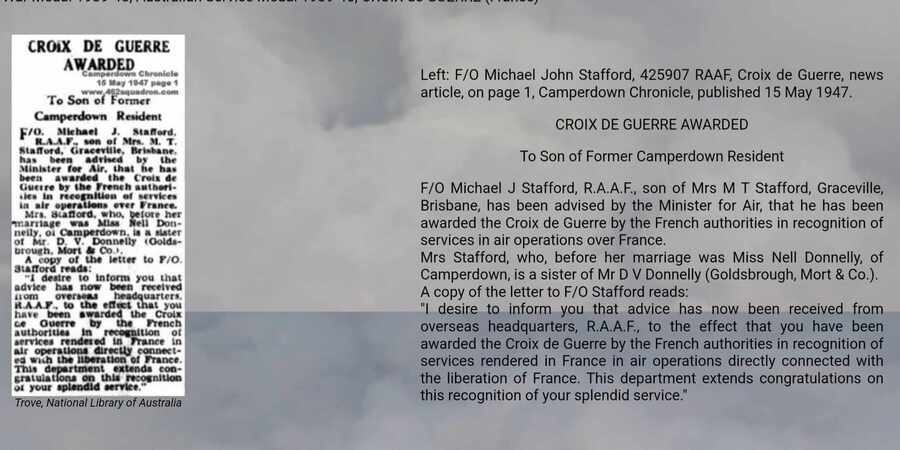
But the war was not finished with Michael, unbeknown to him, his name was being mentioned in the halls of the French Ministry of Defence. In July, 1945 Flying Officer Michael John Stafford was awarded the prestigious French military decoration Le Croix de Guerre in recognition of his acts of gallantry on the defence of France.
Mark Weate was an old friend of Michael, Weate stated "Michael was a very modest man, so all he told us was the Croix de Guerre was initially awarded to Colonel Jackson, who insisted that the award rightfully belonged to Michael."
Mark had no knowledge of Jackson's reasons, but the general assumption was that Jackson atributed the success and ultimately the survival of his crew Michael's work defending the Jackson Halifax.
Of the 13,000 or so Australian's who served in Bomber Command, Michael was one of only forty to receive the Croix de Guerre.
Michael remained a member of the RAAF Reserve at the rank of Flying Officer until the 1st of May, 1965 when he resigned his position due to residing in London.
On the 6th of August, 2010 Michael died after suffering a short illness whilst resident in Sydney his funeral was held at St. Canice's Catholic Church and he is interred in the Stafford family plot (Mon-22-21/#/22) at the Toowong Cemetery, with his parents Michael and Ellen, as well as brother, Peter. Michael was never married and had no children but was a much-loved Brother, Uncle and Great Uncle.
He was a friend to many who regarded it "an honour and privilege to have known him."
Rest in peace, SLOB RAAF Flying Officer Michael John Stafford, a man of modest stillness and humility.
Submitted by John Dinnen, St Laurence's Old Boys Association.
Click images to start slideshow.