







PATERSON, Thomas Russell
| Service Number: | 2815 |
|---|---|
| Enlisted: | 4 August 1915, QRVBRS Edinburgh 4 years |
| Last Rank: | Private |
| Last Unit: | 25th Infantry Battalion |
| Born: | Coatbridge, Scotland, 4 October 1886 |
| Home Town: | South Brisbane, Brisbane, Queensland |
| Schooling: | Not yet discovered |
| Occupation: | Storeman |
| Died: | Arteriosclerosis, Eventide Nursing Home at Sandgate, Queensland, Australia, 2 December 1960, aged 74 years |
| Cemetery: |
Lutwyche Cemetery, Brisbane, Qld Anzac Portion 9, |
| Memorials: |
World War 1 Service
| 4 Aug 1915: | Enlisted AIF WW1, Private, 2815, 25th Infantry Battalion, QRVBRS Edinburgh 4 years | |
|---|---|---|
| 21 Oct 1915: | Involvement Private, 2815, 25th Infantry Battalion, --- :embarkation_roll: roll_number: '15' embarkation_place: Brisbane embarkation_ship: HMAT Seang Bee embarkation_ship_number: A48 public_note: '' | |
| 21 Oct 1915: | Embarked Private, 2815, 25th Infantry Battalion, HMAT Seang Bee, Brisbane |
Help us honour Thomas Russell Paterson's service by contributing information, stories, and images so that they can be preserved for future generations.
Add my storyBiography contributed by Evan Evans
From Australian Remembrance Army
Over the past six years we have submitted the service records and causes of death of several hundred veterans to the Office of Australian War Graves for assessment for Official Commemoration. To date, more than 100 of these veterans interred at Lutwyche Cemetery have been accepted as Official Commemorations, and their graves are now being formally marked and will be maintained in perpetuity by the Office of Australian War Graves.
Australian World War One veteran Corporal Thomas Russell Paterson (Service No. 2815), is one of the previously unmarked WWI veterans’ graves in Lutwyche Cemetery that has been accepted as an Official Commemoration by the Office of Australian War Graves.
See Australian Remembrance Army Facebook page
OAWG Official Commemoration: https://connect.dva.gov.au/.../viewCommemoration.html...
Thomas Russell Paterson (also known as Thomas Rupert Paterson) was born on 4 October 1886 at Coatbridge, Scotland, the son of Joseph Paterson and Helen Paterson (née Cleland). He later emigrated to Australia and enlisted in the Australian Imperial Force at Brisbane on 24 August 1915, aged 26 years. At enlistment he stated his occupation as a storeman and nominated his mother, then residing in Edinburgh, Scotland, as his next of kin. On 21 October 1915 he embarked from Brisbane aboard HMAT Seang Bee for overseas service.
Following a period of training in England, Paterson proceeded to France in December 1915 and joined the 9th Battalion on the Western Front. In July 1916 the battalion participated in the attack at Fromelles, one of the costliest engagements for Australian forces during the war. In the aftermath of the fighting, he was reported missing on 23 July 1916 and was subsequently presumed killed in action. In fact, he had survived, having sustained a gunshot wound to the arm and had become separated from his unit during the action.
He continued in service but experienced ongoing ill health. In March 1917 he was evacuated to England suffering from trench fever and trench feet. He later returned to France in July 1917 and rejoined the 9th Battalion in August 1917. Over the following year he was admitted to hospital on several occasions, reflecting the cumulative effects of active service.
Paterson returned to Australia in January 1920 and was discharged from the Australian Imperial Force in April 1920.
In the decades after his service, Paterson he is recorded as living in Brisbane and working as a storeman, but his later years were marked by declining health. He suffered from senile dementia and spent time under care at the Brisbane Mental Hospital at Goodna before being admitted to Eventide Nursing Home at Sandgate, Brisbane.
Corporal Thomas Russell Paterson died in Brisbane on 2 December 1960 at the age of 74 and was buried three days later in Anzac Portion 9, Lutwyche Cemetery, Brisbane. Arteriosclerosis was recorded as the cause of death. Shortly after his death, an application was made to have his death accepted as war-related; however, this was considered by the Repatriation authorities and ultimately rejected.
In July 2024, we received notification that the Office of Australian War Graves had accepted our application for an Official War Graves Commemoration.
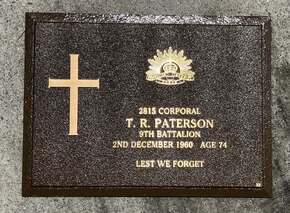
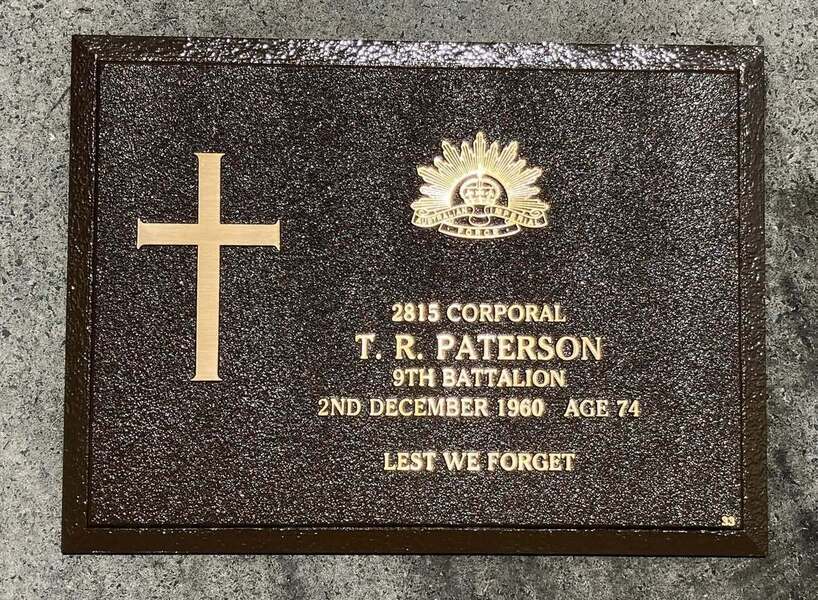
After decades in an unmarked grave, his final resting place now bears a plaque commemorating his service to Australia, ensuring his name endures among those remembered for their duty and sacrifice. His identity and dignity have now been restored.
Lest We Forget
Click images to start slideshow.