


DOYLE, William Andrew
| Service Number: | N102191 |
|---|---|
| Enlisted: | 7 February 1941 |
| Last Rank: | Private |
| Last Unit: | Not yet discovered |
| Born: | Parramatta, New South Wales, Australia, 22 October 1882 |
| Home Town: | Not yet discovered |
| Schooling: | Not yet discovered |
| Occupation: | Not yet discovered |
| Died: | Parramatta, New South Wales, Australia, 2 October 1949, aged 66 years, cause of death not yet discovered |
| Cemetery: |
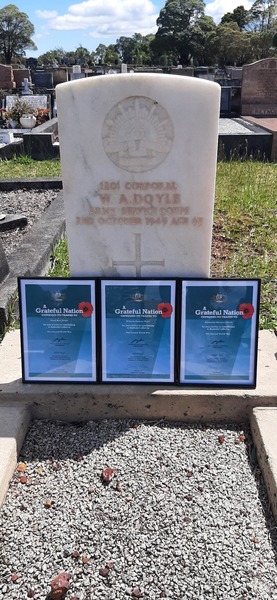
Woronora General Cemetery, New South Wales Roman Catholic Monumental Section 3B 0289 |
| Memorials: |
World War 2 Service
| 7 Feb 1941: | Enlisted Australian Military Forces (WW2) , Private, N102191 | |
|---|---|---|
| 27 Aug 1943: | Discharged Australian Military Forces (WW2) , Private, N102191, 5 Auxiliary Horse Transport Company |
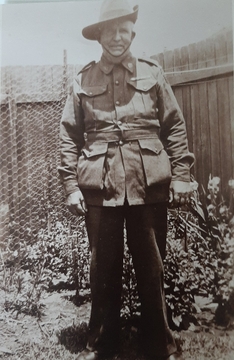
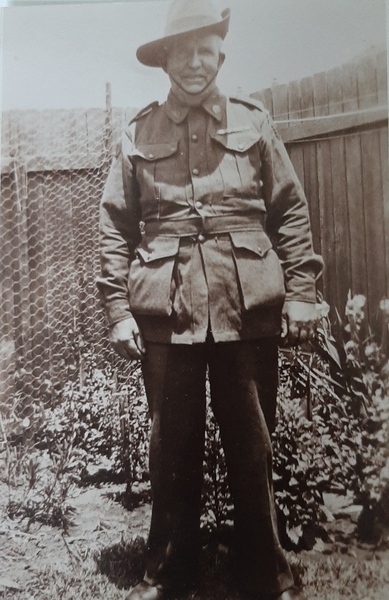
WILLIAM ANDREW DOYLE, WW1 Service No 1201 Corporal, Artificer, WW2 Service No N102191 Wheeler, My Grand Father.
WILLIAM ANDREW DOYLE, WW1 Service No 1201 Corporal, Artificer,
WW2 Service No N102191 Wheeler, My Grand Father.
Before World War one he was part of The Australian Army Reserve. It was a collective name given to the reserve units of the Australian Army. Since the Federation of Australia in 1901, the reserve military force has been known by many names, including the Citizens Forces, the Citizen Military Forces, the Militia was the unofficially Australian Military Forces he was in the Australian Rifles for two years. He married Anna Christina Frus on 18th of July 1906, he enlisted on 19th Sept 1914 at Marrickville N.S.W at 32 years old and he had four children between them. He embarked on 21th Dec 1914 from Sydney for England in convoy number 2 on the H.M.A.T. A39 Port Macquarie arriving Fremantle on 31 Dec 1914, Colombo Sri Lanka on 13 Jan 1915, Adan Yemen on 23 Jan 1015 and finally Port Said Egypt on 31 Jan 1915 with the Australian and New Zealand Army Corps (ANZAC), Australian brigade original intentions of going to England having been changed, he landed at Alexandria Port Said Egypt then to Tel El Kebir then Maadi Cairo which was a training centre for the Australian and New Zealand Army Corps Over the years at war he travelled 4000Kms by Boat.
His company with the best part of the Thirteenth Battalion, left Alexandria on April 13th for Lemnos Island, where all the transport boats and battleships were congregated ready to move out to make the Gallipoli landings in the Dardanelles. On the 22nd April his supply section, about twenty men and officers, were transferred from the Ascot to the Australia along with the rest of the 4th Brigade, under the command of then Colonel John Monash, the 13th Battalion took part in the Landing at Anzac Cove, arriving late on 25th April 1915. For the first four months, between May and August, they undertook defensive operations as the Anzacs attempted to establish themselves on the narrow beachhead that had been captured on the peninsula. On 8th August 1915 an attempt was made to break out from this position and the battalion took part in a costly, and only partially successful, attack on Hill 971. Later in the month, on 27th August, they were involved in another attack, this time on Hill 60, during which they suffered further casualties. After this the 13th Battalion was mainly used in a defensive role until the final evacuation in December 1915
One chap wrote he joined the Army Service Corps because he could not get into the Light Horse and was fond of horses, so as a driver. now they have left all their horses and all the work in that line is done by Indians with mules, so the A.S.C. chaps are just a sort of cross between wharf labourers and storekeepers, as their work all lies down at the base, and consists of unloading ships and loading up pack mules or mule carts.
After leaving ANZAC Cove he returned to Cairo where the 4th Division began forming at Tel El Kebir in February 1916. In addition to three infantry brigades, the new division included various support troops, including the 4th Field Company, 4th Field Ambulance and 7th Army Service Corps Company, which had previously served at Gallipoli.
There were delays in assembling the divisional artillery as I ANZAC Corps, which was to proceed to France first, received priority for personnel and artillery pieces. Consequently, the division could not depart for France before June 1916. In the meantime, the 4th Division undertook defensive duties along the Suez Canal, around Serapeum, to defend against a possible Ottoman attack. The division's stay at Armentieres was brief and it soon accompanied the 1st and 2nd Divisions to the Somme sector where the British had launched an offensive in July. In August 1916, it relieved the 2nd Division on the Pozieres heights, arriving in time to fight off a determined German counterattack. The attack fell largely on a small number of battalions, with the South Australian 48th Battalion losing nearly 600 men killed or wounded; the New South Welshman of the 45th Battalion were called upon to help a neighbouring British unit capture a position dubbed "Munster Alley", during which they lost 345 men. Meanwhile, an attack on the 14th Battalion was repulsed after an individual effort by Lieutenant Albert Jacka, who had previously received the Victoria Cross for actions at Gallipoli.
Following this, the division was brought back up to two thirds strength, and after relieving the 2nd Division, launched an attack to the north of Mouquet Farm. After a rest, the division returned to Mouquet Farm in late August and early September; the division's losses during these two periods amounted to over 7,000 killed or wounded. After a rest around Ypres, the division undertook a third tour of the front at Flers in the final months of 1916.
In March 1918 he arrived in Weymouth England where over 120,000 Australian and New Zealand troops passed through Weymouth in Spring & Summer, Weymouth Esplanade would be full of Anzac soldiers in wheelchairs, being wheeled along by their more able mates.
Returning to Australia on the SS Dunvegan Castle landing in Sydney on the 14th of June 1918 and discharged 14th Sept 1918, Height 5ft 8in (176.7 cm), Weight 11 stone 2 lbs (71.1kg) eyes blue, hair dark brown. Anna passed away on the 6th of August 1935 in the Mater Hospital Newcastle. He married Marion Emma Gooding in 1938
On the 7th of February 1941 at an age of 58, He joined the Army this time the 2 A.I.F. 8th Garrison Battalion, then transferred to the 5th Australian Auxiliary Horse Transport it was raised in New South Wales and throughout the war was responsible for coastal defence in and around the Newcastle region. Thus, on 11th December 1941 8th Garrison Battalion was allocated to the Newcastle Covering Force. Garrison Battalions were part of the Australian 'Army Reserve' within the CMF Militia structure for Homeland Defence with the role of manning fixed defences and vulnerable points. The personnel were Class B men, those between 48 and 55 who had seen war service before September 1939, therefore mostly WW1 veterans. 5th February 1943 He was appointed Special Group II (wheeler), 19th of July 1943 he was taken to 17th Camp Hospital and found with Hypertension and on the 26th of July 1943 at an Medical Board meeting he was classed Medical unfit of duty “Class D” he was discharged on the 25th August 1943 as a Private II., He and Marion lived at 10 Merley St Woronora and on the 2rd of October 1949 he passed away at a age of 66 years
Medals awarded:
WW1 1914-1915 Star, British War Medal, Victory Medal, Anzac Commemorative Medallion,
WW2: War Medal 1939-1945, Australia Service Medal 1939-1945
Submitted 18 May 2024 by Anthony Doyle
FREDERICK MORRIS DOYLE, N73539 and NX16727, Sapper / Gunner. Father
FREDERICK MORRIS DOYLE, N73539 and NX16727, Sapper / Gunner. Father
During the Second World War, Australia’s land fighting force was essentially composed of two separate armies. Frederick spent from the 2nd of April 1940 to 12th August 1942 in the Citizen Military Forces (CMF or Militia). He had to re-sign and was then part of the 2nd Australian Imperial Force (AIF) from the 13th of August 1942 to 5th of December 1945. Frederick enlisted on the 2nd of April 1940 at North Battery, Fort Scratchley, Newcastle and within two months had been posted to Darwin (8th of June 1940). To get there, On 16th of May 1940 he was sent on the SS Montoro which travelled via Brisbane, Townsville, Port Moresby, Thursday Island and then Darwin.
Frederick was assigned to the 7th Fortress Company and on the 2nd of August 1940 he was transferred to the 37th Fortress Company his duties where to assist the Artillery’s Heavy Anti-Aircraft Battery’s as a Search Light operator.
After completing specialist engine hand group III and Switch Boards II courses he was appointed to L.H.LC. On the 23rd of December 1940. Frederick was admitted to Darwin Military Hospital and then discharged no reason was given. On the 6th of February 1941, he was appointed Specialist Group II Instrument Operator Switchman. Frederick had a medical hearing on 5th of February 1942 to discuss his health as he was suffering from meningitis, Dengue fever, Tinea of the feet, Prickly Heat and Singapore Ear. Frederick’s father had a change of address from Ferny Valley Cardiff NSW to Carinya Rest Home, Campbell Hill, West Maitland and then on the 25th of May 1942. Frederick marched out of Field Engineers school Darwin.
The Australian mainland, domestic airspace, offshore islands, and coastal shipping were attacked at least 97 times by aircraft from the Imperial Japanese Navy Air Force and Imperial Japanese Army Air Force.
These attacks came in various forms; from large-scale raids by medium bombers, to torpedo attacks on ships, and to strafing runs by fighters. On the 18th of August 1942 Frederick was transferred from Darwin to Sydney Heavy Artillery North Battery North Head for training to become a Gunner and was put on a charge of A.W.L. He received two days C.B (confined to barracks). This is where Michael James Foley must have introduced Theresa Catherine Foley his sister to Frederick Morris (Paddy) Doyle. They were married on the 19th of June 1943 at St Francis of Assisi's Paddington.
On the 15th of July 1943 Fredrick reported an injury to his left elbow/wrist, while working on gun number one. No one was to blame, and he was on duty, so a court of enquiry was not held. Between 16th August 1943 to 22nd August 1943, he was admitted to hospital with influenza. The 2nd of March 1944 he was admitted with appendicitis. He was moved around three hospitals in just over a month. These included 57 Camp Hospital Manly No113 Mil Hospital Concord, and then Bonnie Brae Ingleburn. By the 15th of April 1944 he was released. On the 30th of November 1944 he left Sydney for Canungra Queensland (L.H.Q. Training Centre) for a 4-month Jungle Training Course before leaving Brisbane for Morotai Island on the 23rd of May 1945. Frederick travelled in convoy B.G.530 A with the USAT Louis Pasteur, USAT Sea Ray and USAT Sea Barb and about 2 days from Morotai the Corvette escort ARARAT arrived named after a city in Victoria. Islands and bays sights spotted on the way Milne Bay, Goodenough, Langemak Bay, Finschhafen, Hollandia, Biak Island, Halmahera and on arriving at Morotai other Australian ships where H.M.A.S Bundaberg, H.M.A.S Rockhampton and the H.M.A.S Cootamundra, he joined the 2/3rd Composite Anti-Aircraft Regiment and was with them between 25th May 1945 to 21st December 1945, at the end of world war 2 he returned to Sydney and was discharged.
It was announced on the 8th of June 1991 in the Queen’s Birthday Honours that he would receive an Order of Australia for service to Veterans Posthumously.
Medals Awarded: Order of Australia (Service to Veterans), 1939-1945 Star, Pacific
Submitted 5 May 2024 by Anthony Doyle
Click images to start slideshow.