







KEDDA, William Thomas Caldwell
| Service Number: | 2269a |
|---|---|
| Enlisted: | 6 March 1917, Embarked Melbourne aboard HMAT Shropshire |
| Last Rank: | Private |
| Last Unit: | 2nd Infantry Battalion |
| Born: | Glasgow, Scotland, December 1895 |
| Home Town: | Bulimba, Brisbane, Queensland |
| Schooling: | Not yet discovered |
| Occupation: | Railway Porter |
| Died: | Coronary occlusion, Brisbane, Queensland, Australia, 17 February 1963 |
| Cemetery: |
Lutwyche Cemetery, Brisbane, Qld Monumental Portion 13 |
| Memorials: |
World War 1 Service
| 6 Mar 1917: | Enlisted AIF WW1, Private, 2269a, Reinforcements WW1, Embarked Melbourne aboard HMAT Shropshire | |
|---|---|---|
| 11 May 1917: | Embarked AIF WW1, Private, Light Trench Mortar Batteries | |
| 7 Jun 1919: | Discharged AIF WW1, Private, 2nd Infantry Battalion |
Help us honour William Thomas Caldwell Kedda's service by contributing information, stories, and images so that they can be preserved for future generations.
Add my storyBiography contributed by Evan Evans
From Australian Remembrance Army
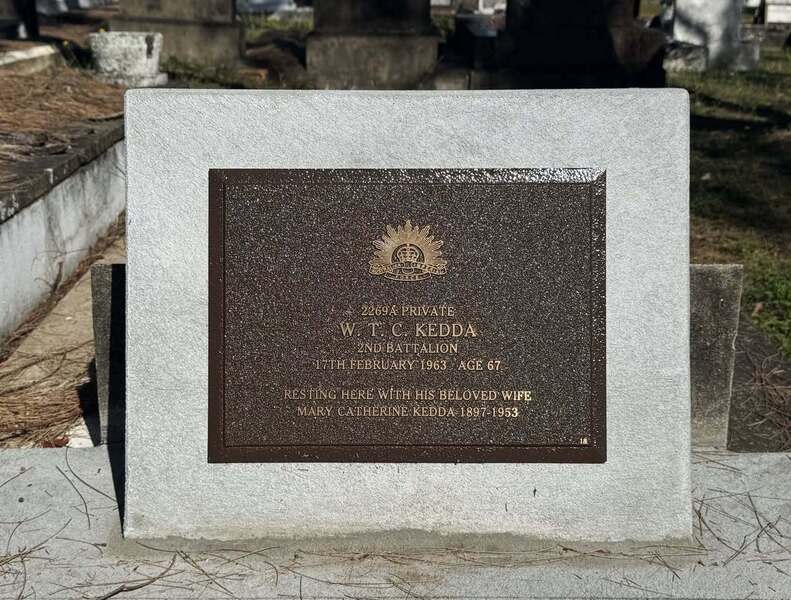
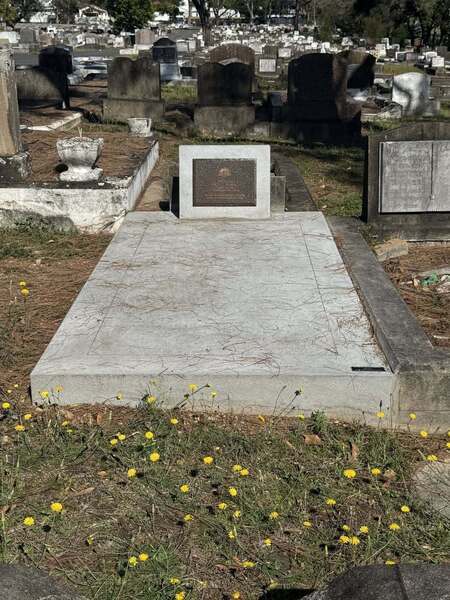
Private William Thomas Caldwell Kedda (Service No. 2269A), an Australian World War One veteran, is among over 100 previously unmarked WWI veterans’ graves in Lutwyche Cemetery that have been accepted as Official Commemorations by the Office of Australian War Graves.
WWI service file:
See Australian Remembrance Army Facebook page
William Thomas Caldwell Kedda was born in 1895 in Glasgow, Scotland, and in 1914 made his home in Queensland, where he worked as a railway porter. At 21 years of age, he enlisted in the Australian Imperial Force on 6 March 1917 in Brisbane and embarked from Melbourne on 11 May 1917 aboard HMAT Shropshire. He underwent further training in England before proceeding to France in April 1918 as reinforcements during the final year of the First World War.
During his overseas service, Kedda experienced several periods of illness and injury. He was hospitalised in England with influenza in October 1917 and later, while serving abroad, suffered injuries including a sprained ankle and other wounds that required medical treatment and evacuation through military hospitals. Despite these setbacks, he returned to duty and remained attached to Australian Imperial Force units during the closing stages of the war. He rejoined Australian formations in early 1919 before ultimately returning home. His service left him with ongoing physical difficulties, particularly affecting his ankles, which continued to trouble him in the years after the war and resulted in repeated medical assessments and treatment under repatriation provisions.
Following his return to civilian life, William resumed work with the railways as a shunter and guard and established his family in Brisbane. On 26 October 1922, he married Mary Catherine (also recorded as Kathleen) Sullivan in Brisbane.
Private William Thomas Caldwell Kedda died from coronary occlusion on 17 February 1963, aged 67, and was buried in Monumental Portion 13, Lutwyche Cemetery, Brisbane. He was laid to rest with his wife, Mary Catherine, who had predeceased him in 1953. In 2024, sixty-one years after his death, we received notification that the Office of Australian War Graves had accepted our application for an Official War Graves Commemoration.
After decades in an unmarked grave, his final resting place now bears a plaque commemorating his service to Australia — ensuring his name endures among those remembered for their duty and sacrifice. His identity and dignity have now been restored.
“2269A PRIVATE
W. T. C. KEDDA
2ND BATTALION
17TH FEBRUARY 1963 AGE 67
RESTING HERE WITH HIS BELOVED WIFE
MARY CATHERINE KEDDA 1897-1953”
Lest We Forget
A note from the Australian Remembrance Army regarding the remarking of previously unmarked WWI veterans’ graves:
Many Australians are unaware that, unless specific eligibility criteria are met, returned service personnel are not automatically entitled to an official government-issued headstone or plaque at their place of interment. As a result, tens of thousands of Australian veterans lie in unmarked graves across the country.
War graves, and their protection, are important because they teach future generations about the consequences of conflict.
Eligibility for official commemoration in Australia must satisfy one of the criteria outlined by:
• Commonwealth War Graves Commission (CWGC) – Criteria and qualifying service dates:
https://www.cwgc.org/.../what-are-commonwealth-war-graves/
• Department of Veterans’ Affairs (DVA) / Office of Australian War Graves (OAWG) – Additional war grave eligibility criteria:
https://www.dva.gov.au/.../commemo.../official-commemoration


Click images to start slideshow.