





LENNON, Ernest George
| Service Number: | 2600 |
|---|---|
| Enlisted: | 25 October 1915 |
| Last Rank: | Lance Corporal |
| Last Unit: | 41st Infantry Battalion |
| Born: | Rockhampton, Queensland, Australia, August 1888 |
| Home Town: | Rockhampton, Rockhampton, Queensland |
| Schooling: | Not yet discovered |
| Occupation: | Stockman |
| Died: | Broncho-pneumonia, uraemia, and dementia arteriosclerotic, Brisbane General Hospital, Queensland, Australia, 26 November 1952 |
| Cemetery: |
Lutwyche Cemetery, Brisbane, Qld Anzac Portion 8 |
| Memorials: |
World War 1 Service
| 25 Oct 1915: | Enlisted AIF WW1, Private, 2600, 41st Infantry Battalion | |
|---|---|---|
| 17 Nov 1916: | Involvement Private, 2600, 41st Infantry Battalion, --- :embarkation_roll: roll_number: '18' embarkation_place: Brisbane embarkation_ship: HMAT Kyarra embarkation_ship_number: A55 public_note: '' | |
| 17 Nov 1916: | Embarked Private, 2600, 41st Infantry Battalion, HMAT Kyarra, Brisbane | |
| 31 Mar 1919: | Discharged AIF WW1, Lance Corporal, 2600, 41st Infantry Battalion, 1st MD |
Help us honour Ernest George Lennon's service by contributing information, stories, and images so that they can be preserved for future generations.
Add my storyBiography contributed by Evan Evans
From Australian Remembrance Army
Australian World War One veteran Lance Corporal Ernest George Lennon Australian Remembrance Army (Service No. 2600), is among almost 800 previously unmarked WWI veterans’ graves in Lutwyche Cemetery we have now marked with plaques in recognition of their service for Australia.
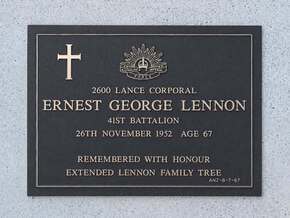
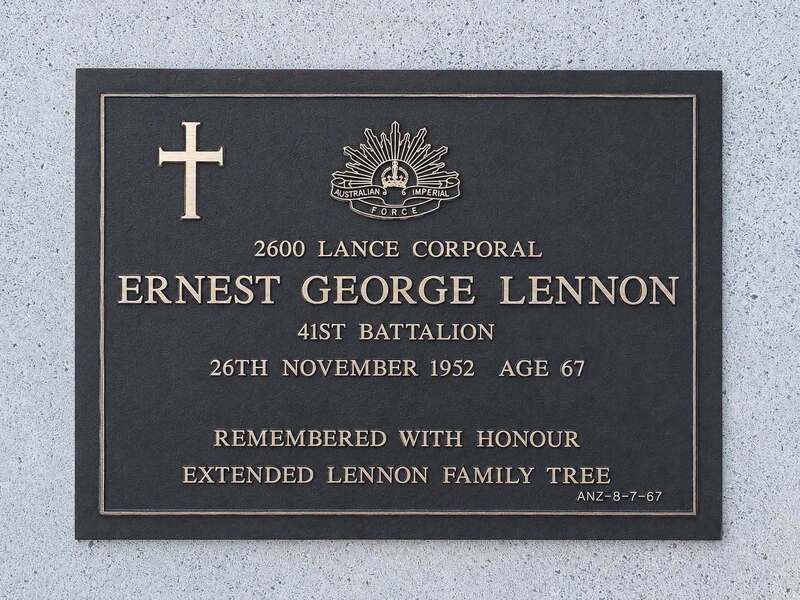
We unveiled his plaque in Lutwyche Cemetery on 16 May 2026, along with a further 185 plaques on the previously unmarked graves of Australian World War One veterans:
See Australian Remembrance Army Facebook page
Ernest George Lennon was born at Rockhampton, Queensland, in 1888, the son of Edward Lennon and Frances Lennon, née Rohan. He enlisted at Townsville on 25 October 1916, aged 27, stating that he was single and worked as a stockman. His mother, Mrs F. Lennon of Quay Street, Rockhampton, was named as his next of kin. Ernest embarked from Brisbane on HMAT Kyarra on 17 November 1916.
Ernest served in England and France, with his record showing repeated illness and hospitalisation. On 11 May 1917 he was sent sick to hospital in England, and on 24 May marched in to the 11th Training Battalion from hospital. On 18 August 1917 he was again sent to hospital with influenza and was admitted to the 24th General Hospital at Boulogne on 24 August. He was sent to the 1st Convalescent Depot on 1 September, still suffering from influenza, and on 4 November was admitted to the 3rd Rest Camp.
On 30 December 1917 Ernest was sent to hospital with a septic leg, rejoining his battalion on 12 January 1918. Further illness followed in March, when he was treated for conjunctivitis, and in April, when he was hospitalised with synovitis of the right knee. He went before the 3rd Medical Board at Etaples on 19 May 1918, then marched in to the Infantry Base Depot at Rouelles on 24 May. He returned to the front and rejoined his battalion on 1 June, but was again sent to hospital with influenza on 22 August. On 1 September 1918 he was invalided to England and admitted to Graylingwell War Hospital at Chichester, before being transferred to the 3rd Auxiliary Hospital and then to the Command Depot at Weymouth.
His service ended with his return to Australia aboard H.M.T. Somali on 27 January 1919. He was discharged at Brisbane on 31 March 1919. His discharge was recorded as due to shell shock, and his physical condition at the time of discharge was assessed as 20 per cent incapacity.
After the war Ernest remained connected with the repatriation system. His returned soldier record shows applications for employment through 1919 and 1920, and applications for assistance lodged in April and May 1919.
Lance Corporal Ernest George Lennon died at Brisbane General Hospital on 26 November 1952, aged 68, and was buried in Anzac Portion 8, Lutwyche Cemetery, Brisbane.
His death certificate recorded broncho-pneumonia, uraemia, and dementia arteriosclerotic as causes of death, with hyperpiesia, malnutrition, and senility also noted.
Ernest was unmarried and had no known children.
After more than seven decades without recognition at his place of burial, his grave now bears a plaque commemorating his service to Australia — ensuring his name endures among those remembered for their duty and sacrifice.
His identity and dignity have now been restored.
We have remembered him.
Lest We Forget
Click images to start slideshow.