


7941
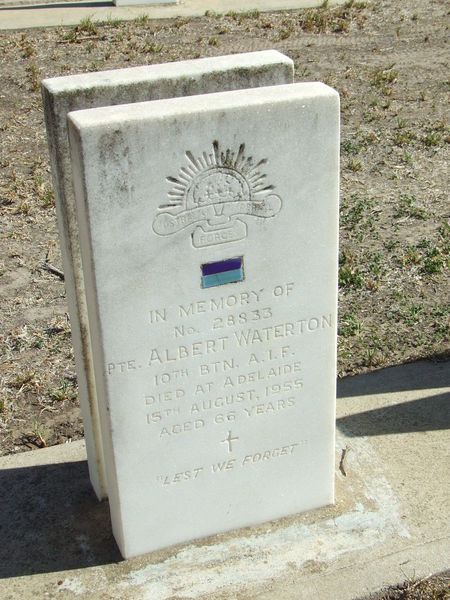
WATERTON, Albert
| Service Number: | 1088 |
|---|---|
| Enlisted: | Not yet discovered |
| Last Rank: | Corporal |
| Last Unit: | 10th Infantry Battalion |
| Born: | Wolverhampton, England, date not yet discovered |
| Home Town: | Not yet discovered |
| Schooling: | Not yet discovered |
| Occupation: | Railway emp |
| Died: | Circumstances of death not yet discovered |
| Cemetery: |
West Terrace Cemetery (AIF Section) Section: KO, Road: 16, Site No: 68 |
| Memorials: |
World War 1 Service
| 20 Oct 1914: | Involvement Private, 1088, 10th Infantry Battalion, --- :embarkation_roll: roll_number: '10' embarkation_place: Adelaide embarkation_ship: HMAT Ascanius embarkation_ship_number: A11 public_note: '' | |
|---|---|---|
| 20 Oct 1914: | Embarked Private, 1088, 10th Infantry Battalion, HMAT Ascanius, Adelaide | |
| 11 Nov 1918: | Involvement Corporal, 1088, 10th Infantry Battalion |
Help us honour Albert Waterton's service by contributing information, stories, and images so that they can be preserved for future generations.
Add my storyBiography contributed by St Ignatius' College
Albert Waterton was born in approximately September 1889 at Wolverhampton England. He enlisted in the Australian Imperial Force on September 14th 1914 and was assigned to the 10th Battalion as Private No. 1088. His enlistment records described him as five feet five and a half inches tall, weighing 140 pounds (approximately 63.5kg), with brown hair and brown eyes, and was a member of the Church of England. Waterton’s next of kin was his mother Emma Waterton, with him being unmarried. Prior to the war Waterton had worked as a waiter. on the 20th of October 1914 Waterton’s unit embarked from Adelaide South Australia on board the Transport A11 Ascanius to war.
He served with the 1st Reinforcement of the 10th battalion as a private and was later deployed to Gallipoli on April 25th 1915. The landing of Gallipoli had occurred in the wrong location causing a chaotic landing and had resulted in 2000 casualties of the original 16,000 men. At Gallipoli Waterton was punished with seven days of field punishment on the 15th of June. This punishment forced the soldier to do work with heavy loads on his back or get strapped to a cross for multiple days. In Waterton's case after the punishment there was no longer any record of crimes or any sort of misconduct. While serving in Gallipoli in September 1915, Waterton became severely ill and was admitted to the 1st Australian Field Ambulance with gastroenteritis. His condition worsened and he was later diagnosed with dysentery. This diagnosis led to his evacuation from Gallipoli to Mudros and then to Malta where he resided in St John’s Hospital. Waterton was then admitted with gastroenteritis during his stay in Malta.
After being evacuated from Gallipoli, the battalion was then transferred to Egypt to train. After the doubling of the AIF and formation of new battlions they were then sent to France to help in the battle of Somme where Waterton was injured and sent to Harefield Hospital to recover (no date of transfer was recorded).
Waterton was then discharged from Harefield Hospital at Perham Downs on August 8th from there he was released from Furlough Class A (paid leave due to reasons such as medical leave). On the 9th of August Waterton was transferred to the 3rd training battalion from the No.1 commanding depot. After his transfer Waterton had embarked to France once again from Perham downs on the 8th of September.
On the 16th of September 1916 Waterton became sick and was admitted to a hospital in Etaples. During his stay he was falsely diagnosed with Malaria at the hospital. On September 1916 Waterton embarked back to England from Le Havre via the HS (Hospital ship) Mabero From there he was accurately admitted with Malaria on the 20th of September 1916 at the London General Hospital at Wandsworth. After recovering there he was deemed unfit for battle and sent to training.
On October 10th Waterton was ordered to report back to headquarters at Tidworth. He was then sent to embark to France on the SS Onward on the 19th of November or help in the Battle of Somme, where he had previously been transferred due to sickness. Upon arrival in France, he was transferred to reinforce Ex-England, on the 29th he was pegged to join a unit although not specified in the records Waterton had probably been assigned to a different unit. Afterwards on the 28th of January Waterton was diagnosed sick once again with their being no specific diagnosis of his illness.
On February 3rd Waterton was sent to join the 10th Battalion as reinforcement, on the same day as his transfer Waterton was admitted to hospital with inflammation of connective tissue in the toe. This usually meant an infection, trench foot or poor hygiene around the toe. Due to this he was brought onto ambulance train 16, once again Waterton was then transferred back to England and transferred to the Convalescent Hospital. Waterton was then granted another Furlough Class A from the 5th of March to the 20th. On the 21st he was deemed fit for training however unfit for active duty. After succeeding in training Waterton was marched out to the 16th Brigade in Wareham and soon after transferred to the 70th Battalion and removed from the 10th Battalion.
On September 16th, 1917, Waterton was transferred to the First battalion on special order 1801 from Sutton Veny. Waterton was also promoted to Corporal on March 14th, 1918; however, he was reverted to private shortly after on the 30th of June. During this time, he had also transferred to the 15th Battalion and became a permanent cadre of No.1 Company. From here to the end of the war Waterton’s battalion had participated in minor battles and he conceived minor injuries and illnesses with most of the records not specifying the place or illness.
On the 10th of October 1918 Waterton had embarked back to Australia from Taranto returning as a private of the 10th Battalion. From there Waterton was awarded all three medals of Pip, Squeak and Wilfred which are also known as “the 1914 Star Medal”, “the British War Medal” and finally “the Victory Medal”.
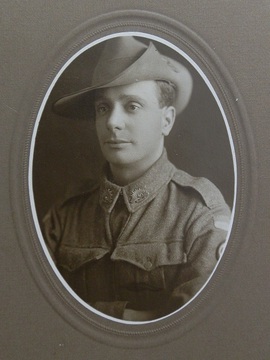
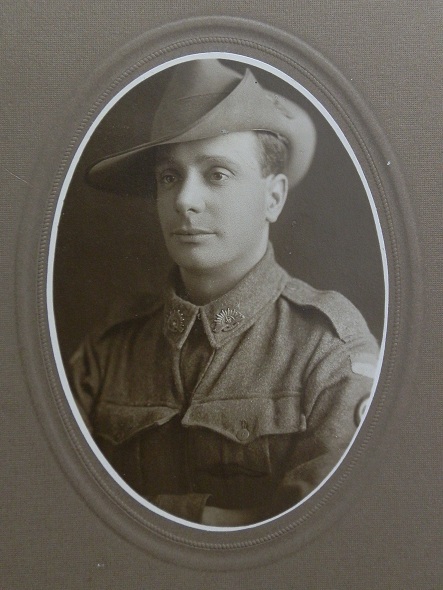
Click images to start slideshow.