



ROSS, Thomas Henry
| Service Number: | 5085 |
|---|---|
| Enlisted: | 28 January 1916 |
| Last Rank: | Private |
| Last Unit: | 23rd Infantry Battalion |
| Born: | Talbot, Victoria, Australia, 1881 |
| Home Town: | Footscray, Maribyrnong, Victoria |
| Schooling: | Prince Alfred Primary School, Talbot, Victoria, Australia |
| Occupation: | Blacksmith |
| Died: | Bronchopneumonia, Acute myeloid leukaemia, Pulmonary tubercoulosis, Heidelberg, Victoria, Australia, 21 July 1970 |
| Cemetery: |
Altona Memorial Park, Victoria Commemorative plaque where his ashes are. |
| Memorials: | Footscray Town Hall Roll of Honour |
World War 1 Service
| 28 Jan 1916: | Enlisted AIF WW1, Private, 5085, 23rd Infantry Battalion | |
|---|---|---|
| 19 Jul 1916: | Involvement Private, 5085, 23rd Infantry Battalion, --- :embarkation_roll: roll_number: '14' embarkation_place: Melbourne embarkation_ship: HMAT Armadale embarkation_ship_number: A26 public_note: '' | |
| 19 Jul 1916: | Embarked Private, 5085, 23rd Infantry Battalion, HMAT Armadale, Melbourne | |
| 17 Mar 1917: | Involvement AIF WW1, Private, 5085, 23rd Infantry Battalion, Breaching the Hindenburg Line - Cambrai / St Quentin Canal, Bapaume, 1917. Wounded in action 20 March. GSW Left Shoulder | |
| 20 Mar 1917: | Wounded AIF WW1, Private, 5085, 23rd Infantry Battalion, Wounded in action 20 Mar 1917. GSW Left Shoulder. Returned to unit in France 09 Jan 1918 | |
| 21 Mar 1918: | Involvement AIF WW1, Private, 5085, 23rd Infantry Battalion, German Spring Offensive 1918, D Company 23rd Battalion AIF | |
| 4 Jul 1918: | Involvement AIF WW1, Private, 5085, 23rd Infantry Battalion, Le Hamel - Blueprint for Victory, D Company 23 Infantry Battalion AIF | |
| 8 Aug 1918: | Involvement AIF WW1, Private, 5085, 23rd Infantry Battalion, The Battle of Amiens, D Company 23rd Battalion AIF | |
| 1 Sep 1918: | Involvement AIF WW1, Private, 5085, 23rd Infantry Battalion, Mont St Quentin / Peronne, D Company 23rd Infantry Battalion AIF | |
| 3 Oct 1918: | Involvement AIF WW1, Private, 5085, 23rd Infantry Battalion, Montbrehain, D Company 23rd Battalion. The 23rd Battalion was not directly involved in the fighting at Montbrehain. However, it was involved in fighting in the preceding days. The 23rd Battalion was withdrawn from the front line on the night of October 5th, marking the end of its participation in the war. | |
| 2 Mar 1919: | Wounded AIF WW1, Private, 5085, 23rd Infantry Battalion, Admitted to hospital with Influenza (Spanish Flu Epidemic) | |
| 10 May 1919: | Embarked AIF WW1, Private, 5085, 23rd Infantry Battalion, Discharge from Hospital to Hospital Ship Karoola. Arrive 21 Jun 1919 | |
| 12 Apr 1920: | Discharged AIF WW1, Private, 5085, 23rd Infantry Battalion |
Help us honour Thomas Henry Ross's service by contributing information, stories, and images so that they can be preserved for future generations.
Add my storyBiography contributed by Gordon Ross
Prior to WW1 Harry (as he was known), a blacksmith, had two children, Henry and Dorris, to his wife Adelaide, where they lived at Rupert St in Footscray.
Suffering the effects of wounds recieved and influenza Harry returned fromthe War and was unable to continue his trade as a blacksmith. As a consequence he was placed on a TPI pension. Two more children, Cliff and Norris joined the family some years after his return.
In WW II Henry served in the RAAF whilst, Cliff served in the second AIF. Norris joined the RAN shortly after WWII.
Harry continued to live at Rupert St, with Adelaide and his son Cliff. Cliff married in 1958 and the growing family continued to live at Rupert St until 1960.
The house at Rupert St, had fallen into disrepair and did not have the capacity to house the growing family. Cliff secured a house in Altona North with a War Service Home Loan and the family, Harry, Adelaide, Cliff, his wife Valma and three children moved to the new house. Three more children arrived after the move, requiring an additional bedroom to be added to the three bedroom house.
Adelaide suffered from diabetes for many years with Harry taking on the responsibility for preparing her insulin and carrying out the injections. At the same time he suffered from tuberculosis, believed to have been contracted whilst in the trenches in France.
His own health issues as well as the strain of caring for Adelaide, led him to what we now know to be self medicating. In his later years he was an alchoholic and frequented 'Millers Inn' in North Altona on a daily basis.
With all his problems he remained committed to Adelaide and was a wonderful companion to his grandchildren. In 1970, six weeks after Adeliade passed away, he also passed away, having lost the will power to live.
Shortly before he passed a migrant family from Greece moved into the house across the road. Their grasp of English was limited. He sat in the front yard and he spoke to his own grandchildren. "Look there are some little Greek boys now living across the road. You should go over there and play with them. Perhaps you can learn to speek Greek from them. Who knows, one day you might meet a nice Greek girl or go to Greece".
In a period where there was much distrust of migrants and rejection of foreign arrivals, this man, who in his lifetime he had suffered the horrors of the worst of humanity was still encouraging his grandchildren to reject racism and reach out to new arrivals.
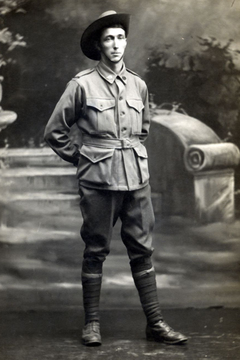
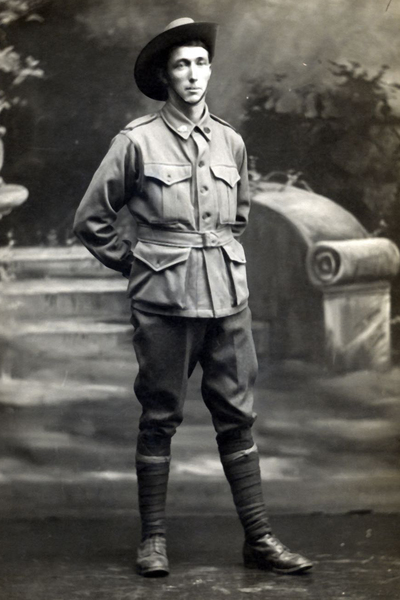
Click images to start slideshow.