








3705
DAVEY, Arthur George
| Service Number: | 3813 |
|---|---|
| Enlisted: | 29 June 1915, Melbourne, Victoria |
| Last Rank: | Private |
| Last Unit: | 23rd Infantry Battalion |
| Born: | Norwood, South Australia, 9 January 1891 |
| Home Town: | Melbourne, Melbourne, Victoria |
| Schooling: | Not yet discovered |
| Occupation: | Plumber |
| Died: | Greenslopes Repatriation Hospital, Queensland, Australia, 21 July 1962, aged 71 years, cause of death not yet discovered |
| Cemetery: |
Lutwyche Cemetery, Brisbane, Qld Anzac Portion 9, Lutwyche Cemetery, Brisbane. |
| Memorials: |
World War 1 Service
| 29 Jun 1915: | Enlisted AIF WW1, Melbourne, Victoria | |
|---|---|---|
| 8 Feb 1916: | Involvement AIF WW1, Private, 3813, 23rd Infantry Battalion, --- :embarkation_roll: roll_number: '14' embarkation_place: Melbourne embarkation_ship: HMAT Warilda embarkation_ship_number: A69 public_note: '' | |
| 8 Feb 1916: | Embarked AIF WW1, Private, 3813, 23rd Infantry Battalion, HMAT Warilda, Melbourne | |
| 1 Jul 1918: | Discharged AIF WW1, Private, 3813, 23rd Infantry Battalion, 4th MD, wounded |
Help us honour Arthur George Davey's service by contributing information, stories, and images so that they can be preserved for future generations.
Add my storyBiography
Arthur was one of four brothers who enlisted and served in WW1, from Adelaide. Three of the brothers were awarded the Military Medal, and one, Phillip, the Vicoria Cross as well. All except Arthur served in the 10th Battalion. Oldest brother Arthur was living in Melbourne when he enlisted (23rd Battalion) - he was repatriated to Australia in May 1918 having been twice wounded. Brother Claude, in the 10th Battalion, had been awarded the Military Medal in early 1917 before being killed at Bullecourt in May 1917. Another brother, Richard, similarly serving in the 10th Battalion was also awarded the MM for action at Le Barque in February 1917. Youngest brother Joseph who enlisted early in 1915 into the 27th Battalion and embarked with them in May 1915, finished his war in the 10th Battalion returning to Australia in May 1918.
Biography contributed by Evan Evans
From Australian Remembrance Army
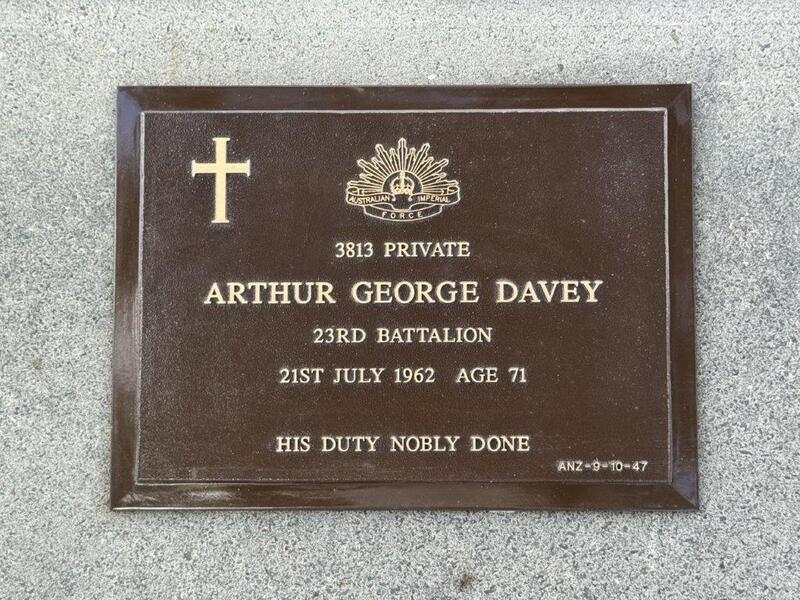
Private Arthur George Davey (Service No. 3813), an Australian World War One veteran, is among almost 800 previously unmarked WWI veterans’ graves in Lutwyche Cemetery we have now marked with a plaque in recognition of their service for Australia.
We unveiled his plaque in Lutwyche Cemetery on 20 September 2025, along with a further 161 plaques on the previously unmarked graves of Australian World War One veterans:
See Australian Remembrance Army Facebook page
Arthur George Davey was born in 1891 at Norwood, South Australia, the eldest of five brothers from an Adelaide family whose wartime service became widely recognised. All five brothers enlisted and served in the Australian Imperial Force during the First World War. Three were awarded the Military Medal, one brother, Philip Davey, received the Victoria Cross, and two brothers, Claude and Richard, were killed in action.
Arthur was living in Melbourne when he enlisted, unlike most of his brothers who served in the 10th Battalion. On 8 February 1916, he embarked for overseas service with the 23rd Infantry Battalion, departing Melbourne aboard HMAT Warilda. During active service he was wounded twice, requiring hospitalisation and removal from front-line duty. In May 1918, he was repatriated to Australia and later discharged from the AIF.
After the war, Arthur Davey’s life became increasingly unstable. By the late 1930s he had been an inmate of Kenmore Mental Hospital, and over subsequent decades he was in and out of mental hospitals across south-east Queensland, including Kenmore, Brisbane, and Toowoomba Mental Hospitals. His mental illness was chronic and required repeated periods of institutional care.
The personal consequences were severe. His marriage broke down and he was later recorded as divorced. By 1942, while he was seriously ill in hospital, authorities were unable to locate his wife, prompting a formal request to Army Base Records to attempt to trace her whereabouts. The lack of contact underscores the extent of his social isolation by this time.
In later years, Arthur Davey had no significant income or assets and relied on Commonwealth assistance. His affairs were eventually managed under medical supervision, with involvement of the Public Curator of Queensland, reflecting official recognition that he was unable to manage his own affairs independently.
Arthur George Davey’s life reflects the long and often hidden cost of war. While his family’s wartime service was marked by exceptional gallantry and sacrifice, his own post-war years were shaped by injury, recurrent mental illness, marital breakdown, institutionalisation, and isolation—outcomes that unfolded quietly long after the war had ended.
Private Arthur George Davey died at the Greenslopes Repatriation Hospital, Brisbane on 21 July 1962, aged 71, and he was buried three days later in Anzac Portion 9, Lutwyche Cemetery, Brisbane.
After decades without recognition at his place of burial, his grave now bears a plaque commemorating his service to Australia — ensuring his name endures among those remembered for their duty and sacrifice. His identity and dignity have now been restored.
We have remembered him.
Lest We Forget.



Click images to start slideshow.