






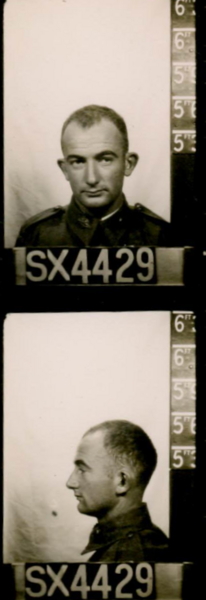
TUMMEL, John Le Helmke
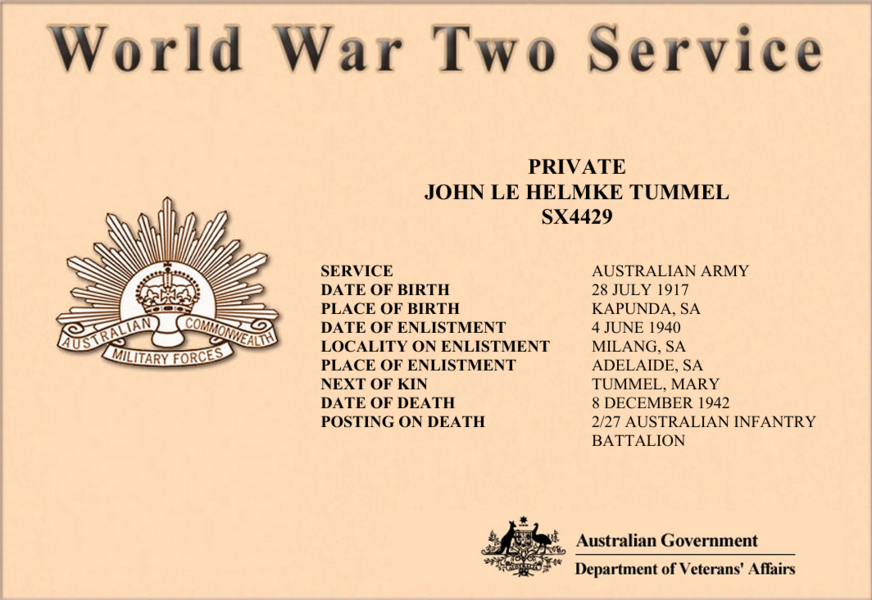
| Service Number: | SX4429 |
|---|---|
| Enlisted: | 4 June 1940, Adelaide, SA |
| Last Rank: | Private |
| Last Unit: | 2nd/27th Infantry Battalion |
| Born: | Kapunda, South Australia, Australia, 28 July 1917 |
| Home Town: | Milang, Alexandrina, South Australia |
| Schooling: | Paskerville School, York Peninsula & Roseworthy Agricultural College, South Australia. |
| Occupation: | Labourer (Farming) |
| Died: | Killed in Action, Papua , 8 December 1942, aged 25 years |
| Cemetery: |
Port Moresby (Bomana) War Cemetery, Papua New Guinea CWGC Grave No: Section B. Plot 5. Row E. Grave 17. Inscription: "FOR GOD AND COUNTRY". |
| Memorials: | Adelaide WW2 Wall of Remembrance, Australian War Memorial Roll of Honour, Milang Memorial Gates, Milang Soldiers' Memorial Gardens & Anzac Park, Rostrevor College WW2 Memorial Plaques, Tanunda War Memorial |
World War 2 Service
| 4 Jun 1940: | Enlisted Adelaide, SA | |
|---|---|---|
| 4 Jun 1940: | Enlisted Private, SX4429, Adelaide, South Australia | |
| 8 Dec 1942: | Involvement Australian Military Forces (WW2) , Private, 2nd/27th Infantry Battalion |
Help us honour John Le Helmke Tummel's service by contributing information, stories, and images so that they can be preserved for future generations.
Add my storyBiography contributed by Elizabeth Allen
Son of Leslie Helmke TUMMEL and Agnes May McNAMARA
He married Mary Eileen nee BAGLEY
Pte. J. H. Tummell, who originally went to Milang from Tanunda (where his parents reside), was also employed at Milang by Mr. Bagley. He was some little time back married to Miss
Mary Bagley. The news of his death was received with deep regret.
Referring to the paragraph in our last issue regarding the death of Pte. J. H. Tummell, we incorrectly stated that the late soldier had been in the employ of Mr. Bagley, whereas we
should have mentioned the name of Mr. L. H. Landseer, of Milang. Pte. Tummell was married to Mr. Bagley's daughter (Mary) over two years ago.
Biography contributed
Private John Le Helmke Tummel was 25 when he fell at Gona in Papua, helping to win a battle he did not live to see finished.
He left behind a young wife in Milang, a farming future in the Barossa, and a legacy that should not fade into footnotes.
His story is a clear reminder that the opportunities we enjoy today were bought by people who never got to see the future they were fighting for.
John grew up in Tanunda in South Australia's Barossa Valley, the elder son of Leslie and Agnes Tummel, in a community built on vineyards, hard work, and tight family ties.
He studied at Rostrevor College and then earned his Roseworthy Diploma of Agriculture in 1937, ranking ninth in his year and joining the next generation of leaders of the land.
In September 1940 he married Mary Eileen Bagley at St Barnabas's Church in Strathalbyn, uniting two prominent rural families from Tanunda and Milang.
Only weeks later he was in uniform with the 2/27th Battalion, a South Australian battalion raised at Woodside and bound for the Middle East.
He fought in the Syria–Lebanon campaign in 1941, including actions at Adlun, the Litani, Sidon, and Damour, where his battalion proved itself in some of the toughest mountain and urban fighting of the war.
By the time he sailed home in early 1942, he was not a fresh graduate anymore.
He was an experienced combat soldier.
In March 1942 he returned briefly to South Australia with the 7th Division.
That short leave was almost certainly the last time Mary saw her husband.
By August 1942 he was in Papua, thrown into the Kokoda campaign just as Australian forces were being pushed back toward Port Moresby.
At Mission Ridge in early September, the 2/27th held under repeated attacks, fighting at close quarters and using more than 1,200 grenades in forty-eight hours.
When the Japanese cut the track behind them, his battalion was ordered off the Kokoda Track and into the jungle, beginning a brutal starvation trek that lasted nearly two weeks.
They carried their wounded, lived on scraps, battled disease, and eventually emerged at Jawarere on 22 September, emaciated but still a formed unit.
Two months later, still recovering from that ordeal, John marched with the 2/27th into the Gona beachhead.
On 8 December 1942 his battalion attacked through swamps and kunai grass toward heavily fortified Japanese positions, with limited artillery support and no guarantee of success.
In that final assault, John was killed in action.
Hours later, the famous signal "Gona's Gone" confirmed the beachhead had fallen.
He died on the day the tide turned.
He helped secure one of the first decisive land victories against the Japanese, and never came home to the Barossa or the shores of Lake Alexandrina.
Today, his name is etched in multiple places of memory.
→ On the memorial gates and garden at Milang, the town that claimed him as a son-in-law who never returned.
→ On the Roseworthy Agricultural College Honour Roll, among graduates whose potential on the land was lost to the war.
→ On the Rostrevor College Honour Board, in the long line of old scholars who served and fell.
→ On Panel 55 of the Roll of Honour at the Australian War Memorial in Canberra.
→ At Bomana War Cemetery near Port Moresby, in Section B5, Row E, Grave 17, among Australian soldiers who share his story of courage and cost.
His life had a clear trajectory before the war.
A respected education.
A specialist agriculture qualification.
A marriage linking two strong rural families.
A future leading and improving South Australian farms and vineyards.
That future was cut short on a swampy battlefield in Papua.
Remembering John is not only about honouring one soldier.
It is about honouring a whole generation of men and women whose education, leadership, and dreams were lost, and whose absence still shapes our communities today.
So when we talk about opportunity, security, and the lives we are building now, we should also talk about people like SX4429 Private John Le Helmke Tummel, who gave up all of theirs.
Lest we forget.
Australian Peacekeeper and Peacemaker Veterans Association


Click images to start slideshow.