






MANN, Alexander
| Service Number: | 1627 |
|---|---|
| Enlisted: | 3 August 1915 |
| Last Rank: | Gunner |
| Last Unit: | 11th Field Artillery Brigade |
| Born: | Drayton, Queensland, Australia, 10 February 1883 |
| Home Town: | Toowoomba, Toowoomba, Queensland |
| Schooling: | Not yet discovered |
| Occupation: | Cab driver |
| Died: | Brisbane, Queensland, Australia, 20 October 1958, aged 75 years, cause of death not yet discovered |
| Cemetery: |
Lutwyche Cemetery, Brisbane, Qld Anzac Portion 9 |
| Memorials: | Toowoomba Roll of Honour WW1 |
World War 1 Service
| 3 Aug 1915: | Enlisted AIF WW1, Private, 1627, 2nd Light Horse Regiment | |
|---|---|---|
| 30 Nov 1915: | Involvement Private, 1627, 2nd Light Horse Regiment, --- :embarkation_roll: roll_number: '1' embarkation_place: Sydney embarkation_ship: HMAT Suffolk embarkation_ship_number: A23 public_note: '' | |
| 30 Nov 1915: | Embarked Private, 1627, 2nd Light Horse Regiment, HMAT Suffolk, Sydney | |
| 16 Jan 1918: | Discharged AIF WW1, Gunner, 1627, 11th Field Artillery Brigade , 1st MD, medically unfit (wounding) |
Help us honour Alexander Mann's service by contributing information, stories, and images so that they can be preserved for future generations.
Add my storyBiography contributed by Evan Evans
From Australian Remembrance Army
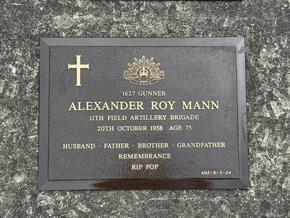
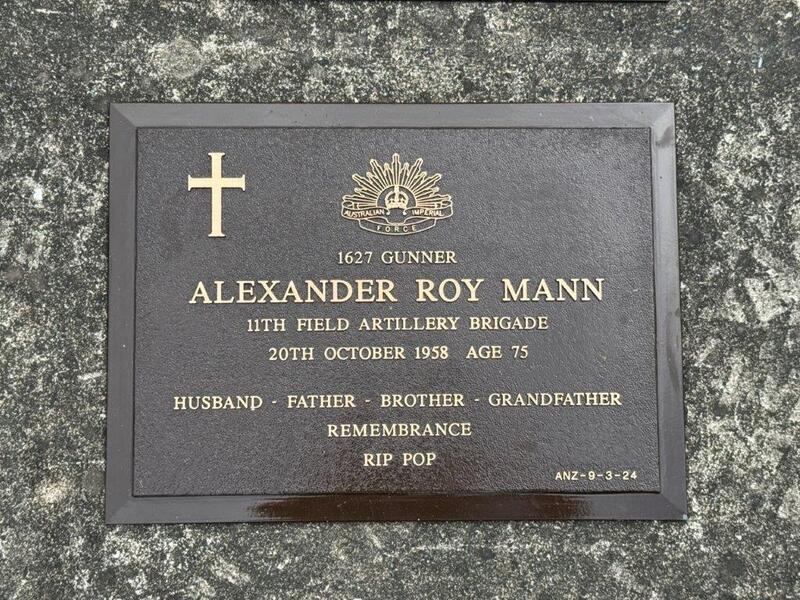
Australian World War One veteran Gunner Alexander Roy Mann (Service No. 1627), is among almost 800 previously unmarked WWI veterans’ graves in Lutwyche Cemetery we have now marked with a plaque recognising their service for Australia.
We unveiled his plaque in Lutwyche Cemetery on 20 September 2025, along with a further 161 plaques on the previously unmarked graves of Australian World War One veterans:
See Australian Remembrance Army Facebook page
Alexander Roy Mann was born on 10 February 1883 in Drayton, near Toowoomba, Queensland. He married Agnes Conley in February 1906 at age 23. Their first child, Thelma, was born in May 1906 and died two weeks later. Two daughters followed in 1909 and 1912, and a son was born in August 1914.
Alexander enlisted in the Australian Imperial Force on 21 August 1915 in Toowoomba, joining the 12th Light Horse Regiment reinforcements. On his attestation form, he gave his age as 32 and listed his occupation as cab driver. He noted he was married with three children under sixteen.
He embarked from Australia on 22 October 1915 and, on 1 March 1916, was taken on strength of the 1st Light Horse Reserve Regiment in Heliopolis, Egypt. On 16 April 1916 he transferred to the 4th Divisional Artillery at Serapeum, was mustered into the 11th Field Artillery Brigade, and was soon posted to the 41st Battery as a gunner.
On 1 June 1916 he proceeded from Alexandria to join the British Expeditionary Force, disembarking at Marseilles on 10 June for service on the Western Front. He was admitted sick in December 1916 but returned to duty shortly after.
On 25 September 1917 he was wounded in action in France, suffering shrapnel wounds to his right leg and thigh. He was treated at several hospitals, including the 10th Casualty Clearing Station, the 2nd Canadian General Hospital, and the 2nd General Hospital, before being evacuated to England on 5 October 1917.
He was admitted to the 1st Southern General Hospital on 7 October and later transferred to the 3rd Australian Auxiliary Hospital on 16 January 1918. He was discharged to the No. 3 Command Depot at Hurdcott and later to No. 2 Command Depot at Weymouth.
Medically unfit for further service, Mann returned to Australia on 19 April 1918 aboard H.T. Marathon and disembarked in mid-June 1918. He was subsequently discharged from the AIF.
He and Agnes welcomed twin daughters in 1919. The family continued living in Toowoomba, where he resumed cab driving. Agnes died in 1923 at age 43. Alexander remained in Toowoomba until 1943, after which he is recorded as living in Brisbane.
Gunner Alexander Roy Mann died on 20 October 1958 aged 75, and was buried in Anzac Portion 9, Lutwyche Cemetery, Brisbane.
After decades without recognition at his place of burial, his grave now bears a plaque commemorating his service to Australia — ensuring his name endures among those remembered for their duty and sacrifice. His identity has now been restored.
We have remembered him.
Lest We Forget.
Click images to start slideshow.