








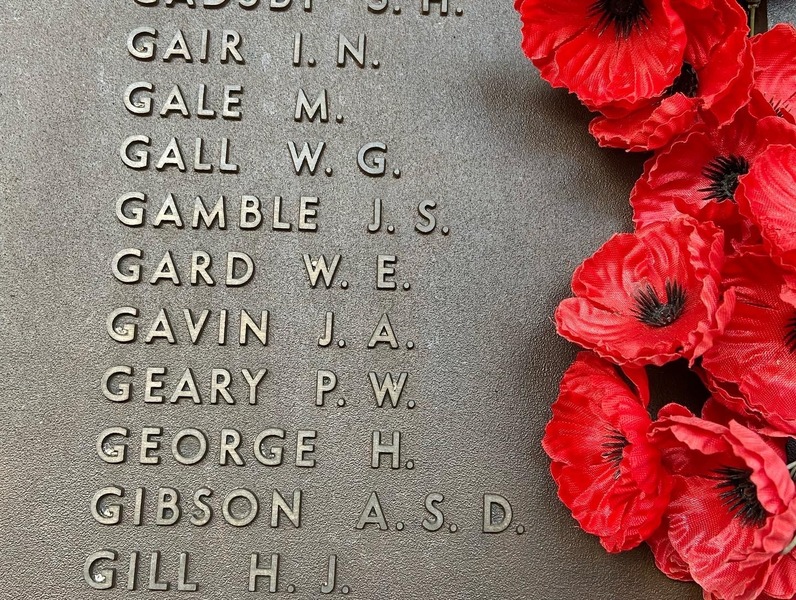
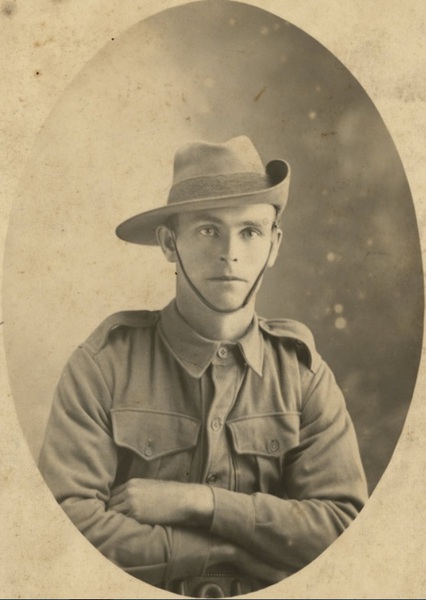
GAVIN, James Augustus
| Service Number: | 482 |
|---|---|
| Enlisted: | 9 July 1915, Enoggera, Queensland |
| Last Rank: | Lance Corporal |
| Last Unit: | 31st Infantry Battalion |
| Born: | Jondaryan, Queensland, Australia, 20 March 1886 |
| Home Town: | Toowoomba, Toowoomba, Queensland |
| Schooling: | State School, Queensland, Australia |
| Occupation: | Station Hand |
| Died: | Killed in Action, Fromelles, France, 19 July 1916, aged 30 years |
| Cemetery: |
Rue-Petillon Military Cemetery, Fleurbaix, Bethune, Nord Pas de Calais Plot I. Row K. Grave 39. Inscription: THOUGH NOTHING CAN THE LOSS REPLACE A DEAR ONE TAKEN FROM OUR SIDE |
| Memorials: | Australian War Memorial Roll of Honour, Crows Nest (Qld) War Memorial, Toowoomba War Memorial (Mothers' Memorial) |
World War 1 Service
| 9 Jul 1915: | Enlisted AIF WW1, 482, Depot Battalion (AIF), Enoggera, Queensland | |
|---|---|---|
| 9 Nov 1915: | Embarked AIF WW1, Private, 482, 31st Infantry Battalion, --- :embarkation_roll: roll_number: '16' embarkation_place: Melbourne embarkation_ship: HMAT Wandilla embarkation_ship_number: A62 public_note: '' | |
| 7 Dec 1915: | Embarked AIF WW1, Private, 482, 31st Infantry Battalion, Disembarked Suez, Egypt | |
| 29 Apr 1916: | Promoted AIF WW1, Lance Corporal, 31st Infantry Battalion, Appointed | |
| 16 Jun 1916: | Embarked AIF WW1, Lance Corporal, 482, 31st Infantry Battalion, Embarked Alexandria for B.E.F per H.M.T. "Hororata" | |
| 23 Jun 1916: | Embarked AIF WW1, Lance Corporal, 482, 31st Infantry Battalion, Disembarked Marseilles, France | |
| 19 Jul 1916: | Involvement AIF WW1, Lance Corporal, 482, 31st Infantry Battalion, Fromelles (Fleurbaix), Killed In Action | |
| 19 Jul 1916: | Involvement AIF WW1, Lance Corporal, 482, 31st Infantry Battalion, Fromelles (Fleurbaix), --- :awm_ww1_roll_of_honour_import: awm_service_number: 482 awm_unit: 31st Australian Infantry Battalion awm_rank: Lance Corporal awm_died_date: 1916-07-19 |
Help us honour James Augustus Gavin's service by contributing information, stories, and images so that they can be preserved for future generations.
Add my storyBiography contributed by Ian Lang
# 482 GAVIN James Augustus 31st Battalion
James Gavin was born at Jondaryan on 20th March 1886 to James and Mary Gavin. The family moved to Pechey near Crows Nest in time for young James to attend Pechey State School. He was the eldest of ten children born to James (snr) and Mary. When James was old enough, he left school to work on the family farm.
James travelled to Brisbane to enlist on 9th July 1915. Over the next 18 months, four of his brothers would also enlist. James stated his age as 29 and occupation as station hand. He presented as a well-built man, almost 6 feet tall and 12 ½ stone. James made his way to Enoggera Camp where he was placed briefly into a depot battalion before being allocated to “B” Company of the 31st Infantry Battalion.
The 31st Battalion was raised as part of the 8th Brigade of the 5th Division AIF. The 31st comprised two companies raised in Queensland and two companies from Victoria. The other three 8th Brigade battalions were from NSW, Victoria and a combined SA and WA battalion. With such a widespread recruitment, it was not possible for the constituent battalions to train and exercise as a complete brigade. The two Queensland companies of the 31st travelled to Broadmeadows camp outside Melbourne so that the 31st could at least train as a full battalion. On 9th November 1915, the bulk of the 31st under the command of Lt Col Toll embarked on the “Wandilla” at Port Melbourne and sailed to Fremantle where a convoy was being assembled for the crossing of the Indian Ocean. The 31st landed at Suez on 7thDecember and then travelled by train to Heliopolis, a Cairo suburb. Over the next month, the units that had been evacuated from Gallipoli in late 1915 returned to Egypt.
There were then a large number of Australian troops in Egypt; Gallipoli Veterans, reinforcements from Australia, and complete units like the 8th Brigade. A reorganization and expansion of the AIF effectively doubled the size of the AIF with new battalions being created from a core of experienced men. The 5th Division however, had arrived in Egypt complete without the addition of some experienced Gallipoli veterans. This lack of experience would be a telling factor in the division’s future. While reorganisation continued, the men of the 8th Brigade were despatched to the Canal Zone to meet an expected Turkish threat from the Sinai. On 29th April, while stationed at the Ferry Post on the Suez Canal, James was promoted to Lance Corporal.
Over the next three months, the AIF was gradually shipped to France and the “real” war on the Western Front. The 8thBrigade was one of the last units to leave Egypt on 16th June 1916; arriving in Marseilles on 23rd June. From the southern French port, the 31st and 30th Battalions boarded trains for the long journey to the northern sector of the front around the city of Armentieres. The battalions marched into billets at Morbecque on 26th June. This sector was referred to as the nursery sector where newly arrived troops could be slowly exposed to the rigours and routines of trench warfare. The ground was flat and boggy and any earthworks would quickly fill with water so the front line consisted of built-up earthen breastworks supported by wicker panels with the floor covered with wooden duck boards.
On 11th July, the 31st Battalion went into action for the first time on the Bois Grenier Line, relieving the 15th Battalion. The British command was pushing for more aggressive actions along the front rather than the small trench raids that had been the usual activity. One company of the 31st took part in a raid on 13th July with limited success and some casualties. The battalion was relieved on the 15th July and went into billets around the ruined village of Fleurbaix. Those three days constituted the sum total of exposure to offensive action for the 8th Brigade. The next action would not be so easy.
General Douglas Haig, Supreme British Commander in France, launched a huge summer offensive along the valley of the Somme River on 1st July 1916. Haig was trusting in the sheer weight of numbers of his army to drive the Germans back. History records that the British suffered 60,000 casualties on the first day. It was apparent that barbed wire and machine guns were more than a match for straight lines of soldiers marching with bayonets fixed towards heavily defended positions, yet Haig was committed to the fight. In an effort to delay German reinforcements in the northern sector of the front being repositioned to the Somme, Haig ordered a feint to be directed at the Germans manning Aubers Ridge in front of the village of Fromelles, south of Armentieres. The general given the task, Lt Gen Haking, had two divisions at his disposal with which to carry out a plan to take Aubers Ridge and divert German Forces. Haking had attempted a similar scheme in May using the 1st Division of the AIF, but without success. For the second attempt, the General had the British 61st Division and the Australian 5th Division, both only newly arrived at the front. He had originally planned to use the 1st Division as he had in May but the divisional commander “Hookey” Walker refused point blank to take part. Walker was lucky he was in the AIF; if he had been a British general, he would probably have been court martialled.
Haking began his plans for the assault to commence on 17th July. Part of the plan was to distribute to every soldier who was to take part a document outlining the timetable for the attack and to reiterate that the attack would only have limited objectives as it was a feint. The document ended with a plea that these plans were to be kept secret. The plan was discussed openly in the estaminets in the rear area where soldiers gathered to drink and this news naturally found its way to the enemy.
Haking postponed the attack for one day due to rain. He was concerned that the artillery he had from the 4th and 5thAustralian Divisions would not be able to register their shots in the inclement weather. Most of the gunners were inexperienced and some had never fired their 18 pounders due to a shortage of ammunition. The 6th Bavarian Division had been in possession of Aubers Ridge for more than a year and were well prepared for the British and Australian assault as they had easily repelled the previous assault back in May. The German front line breastworks consisted of a sandbag wall more than two metres high and more than 6 metres thick capable of withstanding all but the heaviest artillery, of which Haking had none.
At dawn on the 19th July, the four battalions of the 8th Brigade began to move into the front line trenches. In front of them lay dead flat marshy ground intersected by drainage channels. The Germans on the 25 metre high Aubers Ridge had a commanding view of the British and Australians moving up. They displayed a sign which read “Why so long, you are twenty-four hours late.” A Previous sign read “Advance Australia – If you can!” So much for secrecy! The much-maligned Australian artillery began to pour fire on the first German line but due to inexperience, many of the rounds dropped short, killing a number of Australians and wounding many more with friendly fire. The German artillery, which had twelve months to get their ranging right, added to the carnage. At 6:00pm, with two hours of daylight remaining, the whistles blew signalling the charge.
The 31st Battalion was positioned opposite a bulge or salient in the German line, occupied by a concrete gun emplacement marked on the maps as the Sugarloaf. The company commander of “B” Company, Captain Sharpe, had been wounded in the preliminary artillery barrage and Lieutenant Spreadborough assumed command of the company. Many of the 31st men were cut down before reaching the Sugarloaf. Those who made it to the first line of the German defences were some of the few 5th Division troops to have done so. All along the front, the advance was met with enfilading artillery and machine gun fire. Ammunition began to run low and the British 61st Division that was supposed to be protecting the 31st Battalion’s advance could not move forward, leaving the right flank of the 31st open. With ammunition critical and no more reserve troops available, a withdrawal was ordered by the 5th Division Commander, Maj Gen McCay. In places the withdrawal turned into a rout which resulted in more casualties as men ran for the shelter of the starting trenches. By the morning of the 20th July, it was all over.
For Australians, the battle fought on 19th and 20th July 1916 is referred to as Fromelles. The 5th Division sustained 5,533 casualties in that single night. For the 31st Battalion, the figures were just as sobering; 66 killed, 80 missing and 420 wounded, from a battalion strength of 900. One of those killed was James Gavin, aged 30. His body was carried back and buried in the Eaton Hall Cemetery with a chaplain in attendance.
James had named his sister, Mary, as the sole beneficiary of his will. She also received a parcel of James’ personal effects which included an identity disc, wallet, photos, wristwatch and a religious text. James’ mother was granted a pension of 30 shillings a fortnight. James’ four brothers who enlisted all survived the war and returned to Queensland.
In the 1920s, the Eaton Hall cemetery was reorganised and renamed Rue Petillon Cemetery. James’ parents chose the following inscription for his headstone: THOUGH NOTHING CAN THE LOSS REPLACE A DEAR ONE TAKEN FROM OUR SIDE.



Click images to start slideshow.