







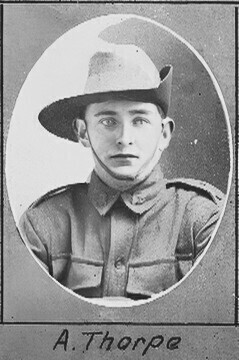
THORPE, Allan
| Service Number: | 2421 |
|---|---|
| Enlisted: | 6 May 1915 |
| Last Rank: | Lance Corporal |
| Last Unit: | 15th Infantry Battalion |
| Born: | Woodstock, New South Wales, Australia, 2 April 1889 |
| Home Town: | Cowra, Cowra, New South Wales |
| Schooling: | Not yet discovered |
| Occupation: | Labourer |
| Died: | Natural Causes, Brisbane, Queensland, Australia, 14 March 1967, aged 77 years |
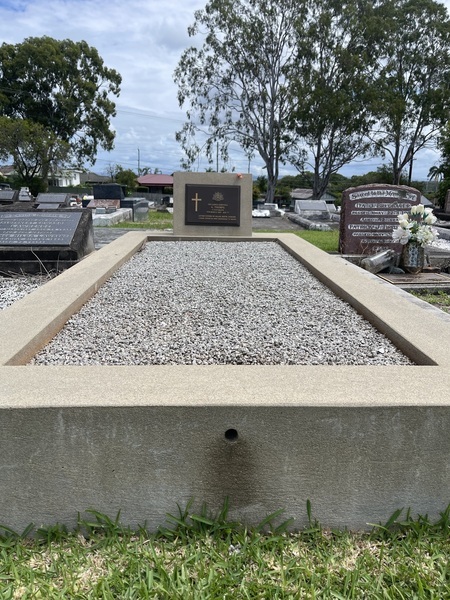
| Cemetery: |
Redcliffe Cemetery, Qld |
| Memorials: | Ballarat Australian Ex-Prisoners of War Memorial |
World War 1 Service
| 6 May 1915: | Enlisted AIF WW1, Private, 2421, 15th Infantry Battalion | |
|---|---|---|
| 20 Aug 1915: | Embarked Private, 2421, 15th Infantry Battalion, --- :embarkation_roll: roll_number: '11' embarkation_place: Sydney embarkation_ship: HMAT Shropshire embarkation_ship_number: A9 public_note: '' | |
| 18 Jul 1919: | Involvement AIF WW1, Lance Corporal, 2421, 15th Infantry Battalion |
Help us honour Allan Thorpe's service by contributing information, stories, and images so that they can be preserved for future generations.
Add my storyBiography contributed by brandon thorpe
The Life and Service of Lance Corporal Allan Thorpe: A Comprehensive Biography of my Great Grandfather During World Word 1.
Allan Thorpe was born on 2 April 1889 in the small township of Woodstock NSW, he volunteered for service in the Australian Imperial Force (AIF) at 25 years and 1 Month of Age, enduring wounds, captivity, and the harsh realities of trench warfare before returning home as a decorated veteran.
Western Front: First Wounding at Pozières (June–October 1916)
Arriving in France, the 15th Battalion moved to the quiet Armentières sector for acclimatization before the Somme Offensive. In July 1916, they advanced to the front near Pozières, a key village in the German second line during the Battle of the Somme. The AIF's role was to capture Pozières Heights, enduring relentless artillery barrages in what became one of Australia's costliest battles—over 23,000 casualties in six weeks.
Thorpe was wounded in action on 9 August 1916 with a gunshot wound (GSW) to the finger, amid heavy fighting where the 15th Battalion held newly captured ground under German counterattacks. His evacuation chain reflects the AIF's medical system:
- Admitted to 1st Anzac Division Hospital on 9 August 1916.
- Transferred via Ambulance Train on 10 August 1916.
- Admitted to 26th General Hospital, Étaples, on 11 August 1916.
- Evacuated to England aboard Hospital Ship *Brighton* on 15 August 1916.
- Admitted to Voluntary Aid Detachment (V.A.D.) Hospital, Chelmsford, on 16 August 1916.
- Discharged to furlough on 21 August 1916; reported to Perham Down Depot on 4 September 1916.
- Marched out from Perham Down to No. 1 Command Depot on 6 September 1916.
After recovery, Thorpe returned to France on 21 September 1916, marching into the Australian Infantry Base Depot at Étaples on 22 September 1916, and rejoined his unit on 2 October 1916. Later in 1916, he faced venereal disease (V.D.) treatment:
- Admitted to 4th Battalion Depot, Kent, for V.D. on 3 November 1916.
- Transferred to Military Detention Hospital for V.D. on 20 December 1916 (specific type not detailed, but common among troops).
Promotion, the Disaster at Bullecourt, and Captivity (1917)
Promoted to Lance Corporal on 6 March 1917, Thorpe demonstrated reliability amid the unit's winter hardships in the Flers-Gueudecourt sector.
On 11 April 1917, during the First Battle of Bullecourt, Thorpe was reported missing in action. The 4th Brigade assaulted the Hindenburg Line without adequate tank or artillery support, leading to catastrophe: 3,000 casualties, including 1,170 prisoners—the AIF's largest single-day capture. The 15th Battalion advanced at 4:45 AM, capturing trenches but isolated and overrun by German reserves.
Confirmed as a Prisoner of War (POW) on 4 June 1917 (via Prisoner Memorandum 42, C.I P.S.L. 190), Thorpe was interned in Germany, at Limburg an der Lahn German Forces camp. Australian POWs faced malnutrition, forced labor (e.g., in mines or farms), and disease, though survival rates were higher than in Turkish camps. Specific details for Thorpe's time at the camp are not in the provided records, but the AWM holds his Red Cross Wounded and Missing File (AWM: 1DRL/0428), which includes inquiries from family and witnesses confirming his capture unharmed.
Repatriation and Recovery (January–June 1918)
Thorpe was repatriated via neutral Holland on 19 January 1918, arriving in England on 25 January 1918. Granted furlough until 8 February 1918, he marched into the Overseas Training Battalion at Longbridge Deverill.
Post-repatriation health and conduct issues:
- Admitted to Group Hospital, Tidworth, for "gland trouble" (possibly swollen lymph nodes from infection) on 12 February 1918; discharged 18 February 1918.
- Marched in/out of Overseas Training Battalions at Sutton Veny on 3 March 1918.
- Admitted to Military Hospital, Sutton Veny, for V.D.G. (gonorrhea) on 6 March 1918; discharged 13 May 1918, with 69 days total V.D. treatment noted.
- Disciplinary: Absent Without Leave (A.W.L.) from 9:00 AM 5 June 1918 to 9:00 AM 6 June 1918 (forfeit 2 days' pay); A.W.L. from 9:00 AM 12 June 1918 to 9:00 PM 13 June 1918 (forfeit 3 days' pay).
These A.W.L. incidents, common among repatriated POWs adjusting to freedom, resulted in minor penalties.
Return to the Front and Second Wounding (June–November 1918)
Thorpe proceeded overseas to France on 21 June 1918, marching into Havre on 23 June 1918 and rejoining the 15th Battalion on 27 June 1918 amid the German Spring Offensive's aftermath.
Further health setbacks:
- Admitted to 58th Field Ambulance for scabies on 2 July 1918; discharged 5 July 1918.
- Readmitted for scabies on 8 July 1918; transferred to 15th C.C.S. on 9 July, Ambulance Train on 10 July, 3rd Canadian General Hospital on 11 July; evacuated to England on 15 July 1918.
- Admitted to Horton County of London War Hospital, Epsom, on 16 July 1918; discharged to furlough on 25 July 1918, reporting to No. 4 Command Depot, Hurdcott, on 8 August 1918.
- Marched to Overseas Training Battalion on 12 August 1918.
- Additional A.W.L.: 23:59 19 August 1918 to 23:59 20 August 1918 (forfeit 2 days' pay); 23:59 22 August 1918 to 23:59 23 August 1918 (forfeit 2 days' pay).
Returning to France on 3 September 1918, he marched into Rouelles on 4 September and rejoined his unit on 8 September 1918.
On 29 September 1918, Thorpe was wounded a second time with a GSW to the left leg during the Battle of the St Quentin Canal, part of the Hundred Days Offensive breaching the Hindenburg Line. The 15th Battalion supported advances in the Australian Corps sector, mopping up resistance near Bellicourt Tunnel amid intense fighting that shattered German defenses. Evacuation:
- Admitted to 6th Field Ambulance on 29 September 1918.
- To 20th C.C.S. on 29 September, Ambulance Train on 30 September.
- To 8th General Hospital, Rouen, on 1 October 1918.
- Evacuated to England on 5 October 1918.
- Admitted to South General Hospital, Birmingham, on 6 October 1918.
- Discharged to furlough on 14 October 1918; to No. 2 Command Depot, Weymouth, on 28 October 1918.
- To No. 1 Command Depot, Sutton Veny, on 4 November 1918.
- Admitted for influenza on 6 November 1918; discharged 13 November 1918.
The Armistice on 11 November 1918 ended the war while Thorpe recovered.
Demobilization, Discharge, and Medals (1919–1925)
Thorpe returned to Australia aboard HMAT *Takada* on 2 June 1919. A receipt dated 25 October 1918 confirms receipt of his personal effects (one package) from Base Records, ex *Toronto* POW/877, signed by M. O'Hara.
He was discharged from the AIF in the 1st Military District on 8 November 1919 as "medically unfit" due to his GSW to the left leg. Repatriation documents from 7 January 1919 list forwarded items: Form A Black (attestation), B178, B340, B1, D1, D.1287, and two medical envelopes.
Thorpe received the Victory Medal on 17 April 1925 in the 3rd Military District, signed with witness H.M.R. Power. Based on his service (embarked 1915, theaters in Egypt and France), he was also entitled to the British War Medal and 1914–15 Star.
Post-War Life and Legacy (1919–?)
Details of Thorpe's life after discharge are absent from military records, which end in 1919.
He passed away on the 14th of March 1967 at the age of 77. His his son Edward William Thorpe was born in 1932. He moved to Redcliffe Queensland and Towards the end of his life he settled in the quiet seaside town of redcliffe where he lived and were survived and remembered dearly by his son, Wife, grandchildren and great grandchildren.
We Truly thank him for his service during world war one. We know that if he did not survive the western front, we would not be here today.
Thank you Allan, We love.
Biography contributed by brandon thorpe
Additional Information:
After Allan Thorpe was Promoted to Lance Corporal, he became a Lewis gunner until his GSW to the Left Leg and discharge from the army because of it

Click images to start slideshow.