








GARDENER, William Henry
| Service Number: | 4713 |
|---|---|
| Enlisted: | 1 February 1916 |
| Last Rank: | Private |
| Last Unit: | 27th Infantry Battalion |
| Born: | Woolwich, England, 2 November 1871 |
| Home Town: | Port Adelaide, Port Adelaide Enfield, South Australia |
| Schooling: | Not yet discovered |
| Occupation: | Plasterer |
| Died: | DoW - SW, 36th Casualty Clearing Station, Méricourt-L'Abbé, France, 19 November 1916, aged 45 years |
| Cemetery: |
Heilly Station Cemetery Plot VI, Row B, Grave No. 12 |
| Memorials: | Australian War Memorial Roll of Honour, Port Adelaide St Paul's Church Memorial Alcove, The South Australian National War Memorial |
World War 1 Service
| 1 Feb 1916: | Enlisted AIF WW1, Private, 4713, 27th Infantry Battalion | |
|---|---|---|
| 11 Apr 1916: | Embarked AIF WW1, Private, 4713, 27th Infantry Battalion, --- :embarkation_roll: roll_number: '15' embarkation_place: Adelaide embarkation_ship: HMAT Aeneas embarkation_ship_number: A60 public_note: '' |
Help us honour William Henry Gardener's service by contributing information, stories, and images so that they can be preserved for future generations.
Add my storyBiography
"THE LATE PRIVATE W. H. GARDENER.
Private W. H. Gardener came to South Australia from Streatham, England, on June 29, 1912. He was a plasterer by trade, and was employed by Mr. John Kitson. He enlisted last February and left with reinforcements to the 27th Battalion on April 11. He was in Egypt for a few weeks, and thence he went to England. After a short stay there he was sent to France, and had only been there about two months when he died of wounds received in action on November 19. He was well liked and respected by all who knew him." - from the Adelaide Chronicle 13 Jan 1917 (nla.gov.au)
Biography contributed by Evan Evans
From Francois Somme
Pte 4713 William Henry Gardener,
27th Australian Infantry Battalion, D Company,
7th Brigade, 2nd Australian Division, AIF
More than a hundred years ago, on the battlefields of the Somme, the most horrific war humanity had ever known unfolded in relentless horror, in an exacerbated fury engendered by the chaos and savagery of appalling battles that plunged the world into the deadliest century in the history of civilization. Amidst the poppies, in the mud of the trenches and in the barbed wire, alongside their French brothers-in-arms, the entire youth of Australia served and fought bravely, thousands of Diggers who here, in Amiens, Villers-Bretonneux, Flers-Dernancourt, Le Hamel and Pozieres, after the hell of Gallipoli, in the scarred but sacred fields of the Somme, endured the most abominable and deadliest battles in the entire history of the AIF, an army of volunteers, of exceptional men who, by the French soldiers, were described as the bravest soldiers alongside whom they had the honor of defending peace and freedom, like true lions who were never afraid of anything and who always had a comforting smile, a determination in their eyes that nothing could break and who did so much more than what was asked of them, beyond what they were capable of.
While darkness engulfed our destroyed villages in deluges of steel, the Australians brought hope to our hearts, and through their steps, their actions, a wind of freedom blew, a hope for a better world for which they paid the ultimate sacrifice, and in our wheat fields, in an eternal shroud of poppies, thousands of them found eternal peace, a final resting place of silence, the solemnity of a white grave on which, in short epitaphs, in loving words, their stories are told.More than a hundred years after the Great War, under peaceful skies, these young men still stand proudly in immortal camaraderie, extending their hands to us with smiles, asking us never to forget them, entrusting their memory to us, the flame of remembrance, so that they may never cease to live on in each of us who, like me, in the Somme, feel proud and honored to be one of the guardians of their memory, watching over them with care, love, and gratitude alongside my little boy, so that the names of these heroes, in our thoughts and those of future generations, will never be forgotten.
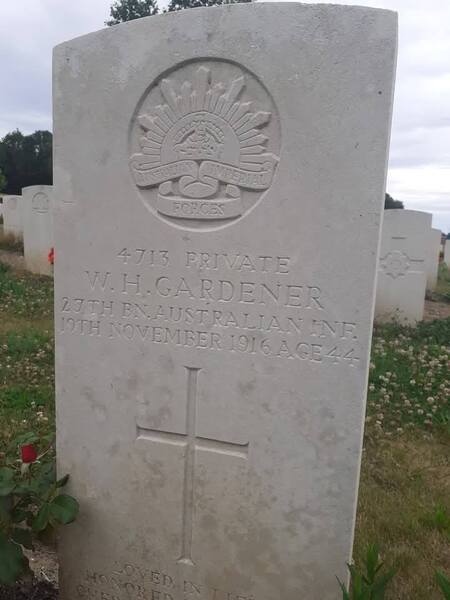
On this day, it is with the deepest sense of gratitude and with the utmost respect that I would like to honor the memory of one of these men, one of my boys of the Somme, who, for Australia and France, for his loved ones and each of us, gave his life. I would like to honor the memory of Private number 4713 William Henry Gardener, who fought bravely in the 27th Australian Infantry Battalion, D Company, 7th Brigade, 2nd Australian Division of the Australian Imperial Force, and who died of wounds received in battle 109 years ago, on November 19, 1916, at the age of 44 on the Somme front.
William Henry Gardener was born on 2 November 1871 in Woolwich, England,and was the son of Dennis Trimming and Annie Gardener, who later lived in Streatham, where William enjoyed a happy childhood. Then, at the age of 41, hoping for a better life, he emigrated to Australia on 29 June 1912 and he settled in Port Adelaide, where shortly afterwards he met and married Rhoda Gardener, originally from Leslies' Creek, Longwood, South Australia, but they later lived together on Fletchers Road, Sandwell, Port Adelaide. A plasterer by trade, he worked for Mr John Kitson until the outbreak of the war.
Australia’s involvement in the First World War began when Britain and Germany went to war on 4 August 1914, and both Prime Minister Joseph Cook and Opposition Leader Andrew Fisher, who were in the midst of an election campaign, pledged full support for Britain. The outbreak of war was greeted in Australia, as in many other places, with great enthusiasm.
The first significant Australian action of the war was the Australian Naval and Military Expeditionary Force’s (ANMEF) landing on Rabaul on 11 September 1914.
The ANMEF took possession of German New Guinea at Toma on 17 September 1914 and of the neighbouring islands of the Bismarck Archipelago in October 1914. On 9 November 1914 the Royal Australian Navy made a major contribution when HMAS Sydney destroyed the German raider SMS Emden.
On 25 April 1915 members of the Australian Imperial Force (AIF) landed on Gallipoli in Turkey with troops from New Zealand, Britain, and France. This began a campaign that ended with an evacuation of allied troops beginning in December 1915. The next year Australian forces fought campaigns on the Western Front and in the Middle East.
Despite his age and driven by the noblest spirit of patriotism and camaraderie, but torn by the thought of leaving his wife, William answered the call of duty and joined the ranks of the AIF. He enlisted on February 1, 1916, in Adelaide, South Australia, in the 27th Australian Infantry Battalion, 12th Reinforcement. The 27th Battalion (nicknamed "Unley's Own") was originally raised on March 16, 1915, at Ascot Park Camp, Adelaide, under the command of Lieutenant Colonel Walter Dollman (who had formerly served in the forerunner volunteer militia unit, the 74th Infantry). The 27th was nicknamed "Unley's Own" as many of the men who first enlisted in the Great War were from the district. Dollman had served as Mayor of Unley, and it was down Unley Road that the troops marched to be greeted and celebrated at the Town Hall prior to their embarkation for Egypt, Gallipoli, and then ultimately to the Western Front. William received an initial period of training of just over two months at the newly established Mitcham Camp, south of the city of Adelaide, during which he learned the rudiments of modern warfare, including bayonet charges and rifle handling, and then embarked with his unit on April 11, 1916, from Adelaide on board the HMAT A60 Aeneas for England, where he arrived on September 9 before departing overseas for France the following day.
On 11 September 1916, after a short journey across the English Channel, William finally arrived in France and was disembarked at Etaples, where he joined the 2nd Australian Divisional Depot. He then underwent a new period of training at the infamous "Bull Ring Camp", known for the discipline that was instilled there and run by a large number of British officers who, with great harshness, wanted to teach the new recruits "the offensive spirit". Shortly afterwards, on 28 September, William proceeded to his unit and was taken on strength at Steenvoorde, where the 27th Battalion remained until 4 October.
On 5 October 1916, William and the men of the 27th Australian Infantry Battalion left Steenvoorde and marched to Godewaersvelde railway station, where they boarded a train to Ypres. There they relieved the 19th Australian Infantry Battalion and, on 12 October, launched a raid on the German trenches, led with daring and courage by Lieutenant Campbell, but were repelled by brutal and deadly machine gun and enemy artillery fire, which caused heavy losses among the ranks of the 27th Battalion. After this action, on 16 October, was relieved from the front line and moved to St Lawrence Camp for a few days' rest behind the lines. A few days later, on 19 October, they returned to Steenvoorde and from there headed for Arques before turning towards the Somme and arriving in the small village of St Riquier, near Amiens. Then, on 27 October, they were transported by motorised bus to Warloy-Baillon before marching later that same day into billets at Dernancourt.
November 1916 marked the beginning of the coldest winter the Somme had ever experienced in its history, and many men suffered terribly from these conditions; many men suffered from trench foot and fever.
Several soldiers testified about this atrocious cold as follows:
Victor Fagence, a private in the Royal West Surrey Regiment:
"The winter of 1916-1917 was notoriously a very, very cold winter. And for my part, I think I almost in my own mind then tasted the depths of misery really, what with the cold and all that sort of thing, you see. We were forbidden to take our footwear off in the front line. Although, I myself disobeyed that on one occasion. I was so cold when I came off sentry go, and we had a bit of a dugout to shelter in, when I went in there, this was before leather jerkins were issued,there was an issue of sheepskin coats. And I took my gumboots off and wrapped my feet in the sheepskin coat to get a bit of extra, you know, to warm them up a bit."
A British artillery officer, Murray Rymer-Jones:
"Now, for our own comfort, to be in a tent with snow on the ground and the appalling cold was nobody’s business. You couldn’t have heating in the tents, you see. So the only thing I could do then was, we had a double loo heavily sandbagged all round in the entrance, you see, it was like little rooms. And although there was no connection between the two, you could talk to the chap next door! So Hammond, from another battery who came and joined us for a bit then, he and I used to sit in the loo most of the night,because it was so heavily sandbagged it kept it reasonably warm,and talked!."
The weather also affected the vehicles used along the Western Front. Antonia Gamwell worked as an ambulance driver with the First Aid Nursing Yeomanry:
"Of course in the winter it was bitter and we couldn’t keep the cars mobile, I mean they just froze of course if they were left to freeze. But we had to keep winding them up. We tried every other way, we tried putting hot bottles in the engines and under the bonnet and heavy bonnet covers and every device we could possibly imagine, but it was no use. We had to simply stay up, there were details. So many of us,six I think it was, used to be on duty and every twenty minutes we went up and wound up the whole lot."
For British sapper George Clayton, the simple task of shaving was made almost impossible by the sub-zero températures:
"You could get a handful of snow and put it into one of them empty Capstan tins, you know we used to get tins of Capstan, had 60 cigarettes, it was just about like a milk thing. And you could warm your snow in there to get water underneath a candle then you had some warm water when the snow melted. Have a shave and by the time you were shaved, they issued us with cut throat razors there wasn’t any safeties in them days, but by the time you were shaved the water was frozen again to ice. And you had to melt the water that you’d left your lather brush in before you could get it out!.It was a block of ice again! I know me I’ve had to do that more than once! Oh, aye."
The cold of that early winter of 1916 did not spare William, and on November 2nd, he was evacuated and admitted to the 7th Australian Field Ambulance suffering from diarrhea and vomiting. However, after a quick recovery, he rejoined the 27th Battalion on November 6th in the trenches of Montauban. Then, on November 15th, they relieved the 26th Australian Infantry Battalion on the front line at Flers, and two days later, on the morning of November 17th, alongside the 5th Brigade, they attacked "The Maze," a network of German trenches that was extremely fortified and well-defended by multiple machine guns and by battle-hardened German regiments that had been on the Somme since July. However, despite heavy losses inflicted by the German troops, but also by the terrain, which was nothing more than an ocean of sticky and deep mud that made any attempt at attack difficult and deadly, the Australians, with great bravery, managed to capture a portion of the German trenches. But,unfortunately, two days later, a powerful German counterattack recaptured the newly won Australian positions, forcing them to retreat to their original trenches.
Sadly, on November 18, 1916, William met his fate. As he was preparing to leave the front line of Flers for a few days of rest in Fricourt, he was seriously wounded by shrapnel and immediately evacuated to the 1st ANZAC Medical Dressing Station then transferred to the 36th Casualty Clearing Station in Méricourt-L'Abbé where, despite the care he received, he died the following day, on November 19, at the age of 44.
Today, William Henry Gardener rests in peace alongside his friends, comrades, and brothers in arms at Heilly Station Cemetery, Méricourt-L'Abbé, Somme, and his grave bears the following inscription: "Loved in life, honored in death, cherished in memory."
William, on this day of remembrance, for every day is a day of remembrance and reflection, it is with infinite gratitude in my heart and with pride for you and your comrades that I feel within me, that I would like to write these few words, coming from the heart of a young Frenchman, an adopted son of Australia, to say to you and all your comrades, to all the Diggers, to the entire Australian nation, thank you, for all that you have done and sacrificed for us in the Somme, we who live each day without ever forgetting, walking before the rows of thousands of white graves, the lives lost, the generation mowed down by bullets, and who, in the silence, still hear your voices tinged with smiles and hope, eternal whispers of heroes to whom we owe so much, whom we do not all know but to whom we will always dedicate our lives so that each of them will never be forgotten and so that with us, down to the hands and hearts of the children who follow us, their story, their memory and their heritage remain strong.
More than a hundred years ago, when war and its darkness ravaged the towns and fields of northern France and in the Somme, the cry of agony of the people of France echoed throughout the world and thousands of kilometers away, in Australia, in Perth, Melbourne, Adelaide, Hobart, Launceston, Geelong, thousands of men and women responded to the distress with their dedication, their loyalty and their courage to come to our aid without knowing what horrors and what pain awaited them so far from home, but with their heads held high and animated by the finest values of fraternity, solidarity, courage, love for their country and their loved ones, they joined the ranks of free men, innocent young boys emerging from childhood who left their fields, the comfort of their homes, the laughter of schoolyards and the promises of a bright future for the battlefields, for the fury of the assaults, the brutality of the horrific hand-to-hand combat.In the fervor of their youth, marching straight ahead alongside their friends, to the sound of bugles and bagpipes, oblivious to the weight of their packs and rifles, they advanced with faith and confidence towards their destiny and towards a horizon illuminated by the flashes of artillery whose storms of metal relentlessly pounded the mud already stained with blood, guts, and bones of the slaughterhouse, the abattoirs of the Somme, which every day and every night, like an insatiable monster, swallowed up thousands upon thousands of lives, of men who, at Pozieres, at Mouquet Farm, in their khaki and gray uniforms, threw themselves at each other and killed one another, not because they wanted to kill their fellow men, but because orders and generals commanded them to do so, and little by little, these once peaceful, sunlit fields, lulled by the flight of birds and butterflies, became open-air cemeteries in which thousands of lifeless bodies piled up alongside mountains of shells whose explosions ceaselessly brought death and despair, shattering the hopes, the innocence, and the minds of men who succumbed to the madness of war, to the savagery engendered by increasingly destructive weapons such as poison gas and flamethrowers that reduced fathers and sons to ashes in this world of death.But, despite this continuous carnage, despite days and nights filled with screams, with the roar of fire and tears that flowed silently behind the parapets, the young Australian soldiers never gave up and never retreated. Alongside their French brothers, they shouted loudly and resolutely, "They shall not pass," and so, watching over each other like brothers, they supported each other in the trenches, ensuring that hope and good humor continued to prevail over the horrors they witnessed. And in this constant camaraderie, from which the ANZAC spirit was born, they continued to stand tall, to show the strength and conviction of all of Australia, which advanced with the greatest momentum towards the enemy lines when, in a moment of silence, the whistles sounded, guiding friends, brothers, husbands, and mates towards the enemy barbed wire and,together, they charged bayonets fixed, shoulder to shoulder in the mud and blood to liberate France, to bring us hope for a better world, for eternal peace, a peace for which so many of them were mowed down by bullets or torn to shreds by shrapnel.For us, for their families, for Australia and France, thousands of them gave their all and rest here today in peace in the serene and silent cemeteries of the Somme, through which children now walk, looking at the names of exceptional men engraved in marble and, moved, sometimes trembling at the sight of so many lost lives, they tell us never to forget and ask us why, why so many men died, for what reason the carnage that took place in the Somme occurred. Then, in a gentle voice, I say to my three-year-old son: these men are not dead, they live with us forever and will live as long as someone remembers them. War did not have the last word on these heroes because their faces, their stories live on in us, and as long as we keep them alive, peace and freedom will endure.
Remember these young men, never forget Australia. There is no nobler or more respectful way to live than to honor the memory of these boys, over whom I will always watch with care and love.Thank you so much William, for everything you did for France, for all of us who will never forget you. At the going down of the sun and in the morning, we will remember him,we will remember them.



Click images to start slideshow.