








S61257
EVANS, Arthur Francis
| Service Numbers: | SN 501, 501 |
|---|---|
| Enlisted: | 8 December 1914 |
| Last Rank: | Corporal |
| Last Unit: | 11th Light Horse Regiment |
| Born: | Gawler, South Australia, Australia, 1885 |
| Home Town: | Hamley Bridge, Light, South Australia |
| Schooling: | Not yet discovered |
| Occupation: | Butcher |
| Died: | Adelaide, South Australia, Australia, 1951, cause of death not yet discovered |
| Cemetery: |
West Terrace Cemetery (AIF Section) |
| Memorials: |
World War 1 Service
| 8 Dec 1914: | Enlisted AIF WW1, Private, SN 501, 9th Light Horse Regiment | |
|---|---|---|
| 2 Jun 1915: | Involvement Private, 501, 11th Light Horse Regiment, --- :embarkation_roll: roll_number: '3' embarkation_place: Brisbane embarkation_ship: HMAT Medic embarkation_ship_number: A7 public_note: '' | |
| 2 Jun 1915: | Embarked Private, 501, 11th Light Horse Regiment, HMAT Medic, Brisbane | |
| 25 Aug 1915: | Embarked To Gallipoli. Transferred to 9th Light Horse Regiment 29 August 1915 | |
| 26 Dec 1915: | Embarked 9th Light Horse Regiment, To Alexandria | |
| 22 Jun 1917: | Promoted Lance Corporal, 11th Light Horse Regiment | |
| 22 Jan 1918: | Promoted Corporal, 11th Light Horse Regiment | |
| 11 Nov 1918: | Involvement Corporal, 501, 11th Light Horse Regiment |
Help us honour Arthur Francis Evans's service by contributing information, stories, and images so that they can be preserved for future generations.
Add my storyBiography contributed by St Ignatius' College
Arthur Francis Evans was born in Gawler, South Australia in 1885, and he was grown up and raised in a Roman Catholic family. After he was born, Arthur moved north of Gawler where he spent most of his life living in the Hamley Bridge area. Before enlisting in the military, he worked as a Butcher in his local town.
He was married to Nora Evans who was also his next of kin, and they had children together before he left for the war. According to Arthur’s service record, he was 5 foot 10 and 74kg, he had blue eyes, fair hair and a fair complexion. He was a healthy man, with no previous sicknesses or injuries, who was considered fit for active service before starting his military training.
On the 8th of December 1914, at the age of 29, Arthur enlisted in the Australian Imperial Force (AIF) as a Private in Hamley Bridge, South Australia. He was assigned to the 33rd Australian Infantry Battalion, where he served throughout the war.
He began basic training in a Queensland Army Camp called ‘Enoggera’ on the 24th of March 1915. During this time, Arthur officially joined the 11th Light Horse Regiment, where he continued to train.
On the 2nd of June, after about 6 months of training, Arthur embarked from Queensland aboard the HMAT A7 Medic, heading to Gallipoli. Once he arrived after the long sea voyage on the 29th of August 1915, Arthur was transferred from the 11th to the 9th Light Horse Regiment (D Squadron).
Arthur fought throughout the entire Gallipoli campaign, beginning with Battle of Hill 60 on the 27th to the 29th of August. Arthur was mainly involved in defending their position in the trenches against the Ottoman Empire. In December 1915 after the Allies had officially lost the Gallipoli campaign, Arthur, along with his unit, evacuated from Gallipoli successfully at night, being one of the last ANZACS to leave Gallipoli.
Arthur left with the 9th Light Horse and sailed to Egypt on the 26th of December 1915 where he began more training. On the 22nd of February 1916, Arthur officially rejoined the C Squadron of the 11th Light Horse Regiment where he continued training until July.
In August 1916, Arthur fought at the Battle of Romani, which was his first big victory, where he used machine guns, rifle guns, grenades and artillery. In September, Arthur was also at the Battle of Bir el Abd, which was a challenging fight for Arthur because of the desert heat.
After this battle during December 1916, Arthur was absent without leave from 1:00pm on the 20th to 2:30pm on the 21st, meaning he missed training and had to forfeit 2 days of pay as a consequence.
On the 26th of March 1917, Arthur fought in the First Battle of Gaza, but the attack failed. A month later, on the 19th of April, Arthur fought in the Second Battle of Gaza, but this battle was even harder, and once again the Allies’ attack failed. From May to September 1917, the Battle of Gaza continued. During this time on the 22nd of June, Arthur was promoted to Lance Corporal because he showed commitment and leadership through this major battle.
On the 6th of October 1917, Athur was admitted to hospital with Malaria, so he did not participate in any battles for a month.
In November 1917, Arthur fought in the Battle of Ayun Kara, where him and his unit helped defeat Ottoman forces in Palestine. From December 1917 to March 1918, Arthur was part of the group that positioned near Jerusalem, where he was promoted to a corporal on the 22nd of January. From the 30th of April to the 4th of May 1918, he took part in the Es Salt Raid, another hard battle that ended in failure for the Allies.
After this battle, Arthur fell sick again and was in the hospital from the 9th of May to the 6th of September 1918, so he missed many months of fighting. He returned in time to join the 11th Light Horse for the Battle of Megiddo from the 19th to the 25th of September.
After this battle, World War 1 was beginning to end. Unfortunately for Arthur, on the 7th of February 1919, he was severely reprimanded for using subordinate language to his superior officer. His punishment for this crime was that he had to forfeit 4 days of pay.
Soon after, he was discharged in April 1919 and started his journey back to Australia on the ‘City of Poona’ on the 9th of April.
After 4 years and 217 days of service, Arthur returned back to Adelaide on the 15th of May 1919, where he was awarded medals in honour of his service. These included the 1914-15 Star for his service, the British war medal for participation during conflict, and the Victory medal for the win of the allied forces over the central powers.
After Arthur returned, he reunited back with his wife, Nora, and his children, where he continued to live his life in Adelaide. Arthur died on the 21st of November 1951 at the age of 66. Today, he is remembered at the West Terrace Cemetery in Adelaide, in the AIF section.
Bibliography:
AIF Project. “The AIF Project.” Adfa.edu.au, 2016, aif.adfa.edu.au/aif/.
Australian War Memorial. “| the Australian War Memorial.” Www.awm.gov.au, 2016, www.awm.gov.au/collection/C1338583.
---. “Advanced Search | the Australian War Memorial.” Awm.gov.au, 2016, www.awm.gov.au/advanced-search.
Google. “Gemini.” Gemini.google.com, 2024, gemini.google.com.
National Archives Of Australia. “RecordSearch | National Archives of Australia.” Naa.gov.au, 2015, recordsearch.naa.gov.au/SearchNRetrieve/Interface/SearchScreens/BasicSearch.aspx.
OpenAI. “ChatGPT.” ChatGPT, OpenAI, 2025, chatgpt.com/.
Wikipedia. “Sinai and Palestine Campaign.” Wikipedia, 24 Nov. 2021, en.wikipedia.org/wiki/Sinai_and_Palestine_campaign.
Wikipedia Contributors. “Battle of Gaza.” Wikipedia, Wikimedia Foundation, 7 May 2025, en.wikipedia.org/wiki/Battle_of_Gaza.
---. “Gallipoli Campaign.” Wikipedia, Wikimedia Foundation, 23 Mar. 2019, en.wikipedia.org/wiki/Gallipoli_Campaign.


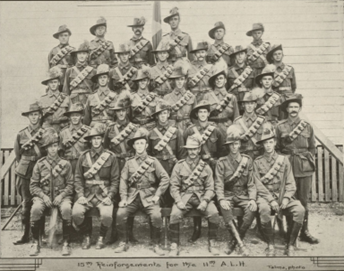
Click images to start slideshow.