








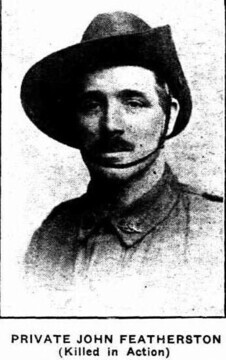
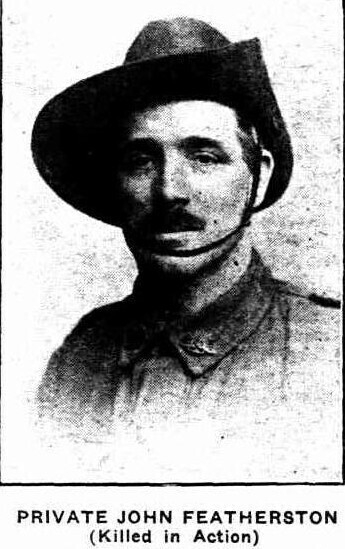
FEATHERSTON, John
| Service Number: | 4693 |
|---|---|
| Enlisted: | 7 February 1916 |
| Last Rank: | Private |
| Last Unit: | 23rd Infantry Battalion |
| Born: | Richmond, Victoria, Australia, June 1887 |
| Home Town: | Richmond (V), Yarra, Victoria |
| Schooling: | Central State School, Richmond, Victoria, Australia |
| Occupation: | Driver |
| Died: | Killed in action, France, 2 September 1918 |
| Cemetery: |
Hem Farm Military Cemetery, Hem-Monacu. France Plot II, Row J, Grave No. 4. FOR GOD SO LOVED THE WORLD THAT HE GAVE HIS ONLY BEGOTTEN SON |
| Memorials: | Australian War Memorial Roll of Honour |
World War 1 Service
| 7 Feb 1916: | Enlisted AIF WW1, Private, 4693, 23rd Infantry Battalion | |
|---|---|---|
| 4 Apr 1916: | Involvement Private, 4693, 23rd Infantry Battalion, --- :embarkation_roll: roll_number: '14' embarkation_place: Melbourne embarkation_ship: HMAT Euripides embarkation_ship_number: A14 public_note: '' | |
| 4 Apr 1916: | Embarked Private, 4693, 23rd Infantry Battalion, HMAT Euripides, Melbourne |
Help us honour John Featherston's service by contributing information, stories, and images so that they can be preserved for future generations.
Add my storyBiography contributed by Stephen Brooks
John was the son of John and Elizabeth Featherston and the husband of Laura Featherston, of Thornbury, Victoria. He was the father of a three-year-old son at enlistment, and worked as a carrier. He was known as ‘Jack’ Featherston to his family and friends.
John Featherston joined the 23rd Battalion in France on 1 October 1916. He suffered back wounds from a shell blast in November 1916 and spent twelve months recuperating in England before re-joining his unit in France.
In January 1918, he was found guilty at a Field Court Martial "when on Active service without reason allowing a person to escape a person committed to his care" – he suffered a forfeiture of 20 days’ pay, plus all entitlements accrued while he was awaiting trial, making 42 days in total.
John was awarded a Military Medal as a stretcher bearer in 1918, "Near Villers Bretonneux in the attack on 22nd July, 1918, this man acted as a stretcher bearer. In the face of heavy rifle and machine gun fire he organised his squads skilfully and dressed the wounded, owing to their being no communication trench he carried the wounded overland although under direct observation and fire of the enemy. He worked with tireless energy and when all our wounded had been carried to the rear, continued working in the open, clearing the trenches and vicinity of enemy wounded"
John Featherston was acting as a stretcher bearer again when he was killed in action during an attack on Mont St. Quentin by the Australians late in 1918, "... He was a man about 5'10", well built, dark complexion about 35 years of age. Casualty was advancing at Mont St. Quentin. As he was going forward a H.E. shell exploded, killing him instantly. I did not see casualty killed but I saw his body next day lying out in the open ..." from 5926 A. I. May, 23rd Battalion AIF.
Jack Featherston was noted on his roll of honour circular by his wife that he was an expert diver and swimmer and "won numerous trophies. Also, an all-round athlete.”
His brother, L-Sgt. Ralph Featherston also won the MM with the 47th Battalion and was captured by the Germans at Dernancourt in April 1918. He survived the war and returned to Australia in 1919. Another younger brother, George Featherston served in the Royal Australian Navy on H.M.A.S. Melbourne.
Jack Featherston’s wife Laura’s address changed a number of times, before moving to Castlemaine in 1921. She was to receive her husband’s Military Medal at a public function sometime in 1919.
Click images to start slideshow.