





KEYES, Robert
| Service Number: | 214 |
|---|---|
| Enlisted: | 15 August 1914 |
| Last Rank: | Staff Sergeant |
| Last Unit: | 6th Infantry Battalion |
| Born: | Galway, Ireland, December 1893 |
| Home Town: | Melbourne, Melbourne, Victoria |
| Schooling: | Not yet discovered |
| Occupation: | Sailor |
| Died: | Brisbane, Queensland, Australia, 25 January 1960, cause of death not yet discovered |
| Cemetery: |
Lutwyche Cemetery, Brisbane, Qld Anzac Portion 9, Lutwyche Cemetery, Brisbane. |
| Memorials: |
World War 1 Service
| 15 Aug 1914: | Enlisted AIF WW1, Private, 214, 6th Infantry Battalion | |
|---|---|---|
| 19 Oct 1914: | Involvement Private, 214, 6th Infantry Battalion, --- :embarkation_roll: roll_number: '8' embarkation_place: Melbourne embarkation_ship: HMAT Hororata embarkation_ship_number: A20 public_note: '' | |
| 19 Oct 1914: | Embarked Private, 214, 6th Infantry Battalion, HMAT Hororata, Melbourne | |
| 19 Jul 1917: | Discharged AIF WW1, Staff Sergeant, 214, AIF Headquarters (London) 3rd MD |
Help us honour Robert Keyes's service by contributing information, stories, and images so that they can be preserved for future generations.
Add my storyBiography contributed by Evan Evans
From Australian Remembrance Army
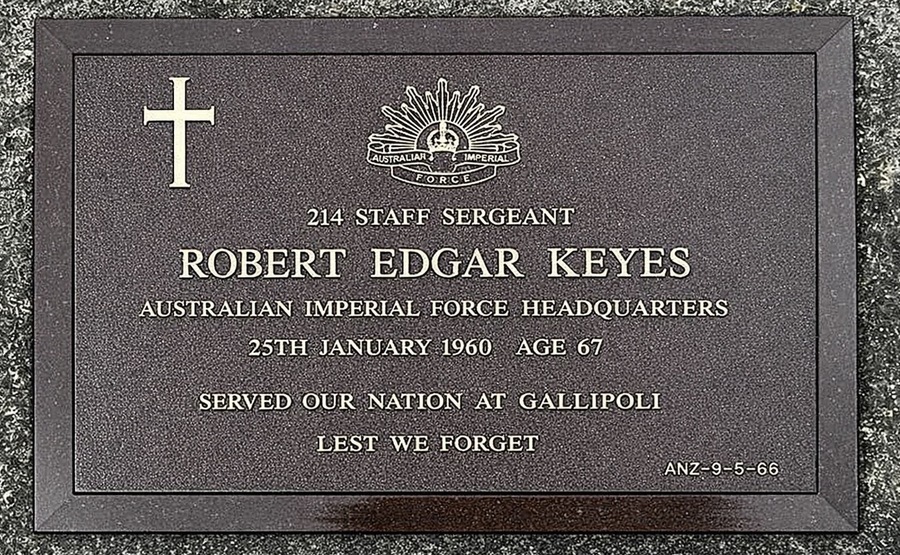
Staff Sergeant Robert Edgar Keyes (Service No. 214), an Australian World War One veteran, is among almost 800 previously unmarked WWI veterans’ graves in Lutwyche Cemetery we have now marked with plaques in recognition of their service for Australia.
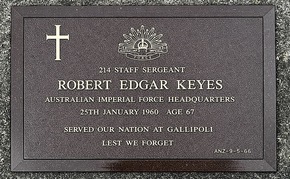
We unveiled his plaque in Lutwyche Cemetery on 20 September 2025, along with a further 161 plaques on the previously unmarked graves of Australian World War One veterans:
See Australian Remembrance Army Facebook page
Robert Edgar Keyes was born in 1893 in Galway, Ireland. He enlisted in the Australian Imperial Force at Eastern Hill, Victoria, in August 1914 at the age of 20, stating his occupation as sailor and nominating his sister, G. Keyes of Ireland, as his next of kin. On 19 October 1914, he embarked from Melbourne for overseas service with the 6th Battalion aboard HMAT Hororata.
After training in Egypt, he proceeded to Gallipoli with the Mediterranean Expeditionary Force, landing with his battalion in April 1915. He served on the peninsula during the early months of the campaign until July 1915, when he was evacuated from the Dardanelles suffering from dysentery and admitted to hospital at Mudros. After a short period of treatment, he returned to duty and rejoined his unit at Anzac at the end of July. However, within days he was again evacuated, this time with “fits and pains in the back,” and was transferred to hospital in Egypt. He subsequently passed through a series of medical facilities and convalescent camps, and although he recovered sufficiently for light duties, his condition resulted in his being medically downgraded and classified as permanently unfit for further front-line service.
In October 1915 Keyes was transferred from the 6th Battalion and taken on strength of A.I.F. Headquarters in Cairo, where his reliability and experience saw him appointed to administrative duties. He was promoted to sergeant on 1 November 1915 and to staff sergeant on 1 May 1916, and later served with A.I.F. administrative headquarters in England. Despite his continued service, his medical classification remained a limiting factor. By early 1917, after more than two years of continuous overseas service since October 1914, he sought permission to return to Australia, citing serious family and business concerns arising from the illness of his uncle, who managed his affairs. His request was supported by his superiors, who noted both his length of service and suitability for duty on a returning transport.
Official correspondence further records that he had been a member of the original 1st Australian Division, had served on Gallipoli, and had been “wounded on Gallipoli and classed as Permanent ‘B’ Class”, indicating a lasting medical impairment that rendered him unfit for active operational service. In light of this classification, together with his personal circumstances, approval was granted for his return and discharge. He embarked for Australia in May 1917 aboard the transport Themistocles, arriving in July, and was formally discharged from the Australian Imperial Force on 19 July 1917.
Staff Sergeant Robert Edgar Keyes died on 25 January 1960 aged 67, and was buried in Anzac Portion 9, Lutwyche Cemetery, Brisbane.
After decades without recognition at his place of burial, his grave now bears a plaque commemorating his service to Australia — ensuring his name endures among those remembered for their duty and sacrifice. His identity and dignity have now been restored.
We have remembered him.
Lest We Forget
Click images to start slideshow.