







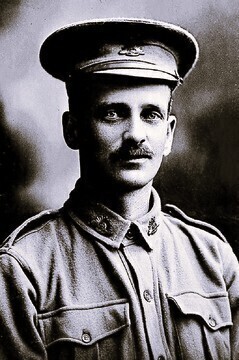
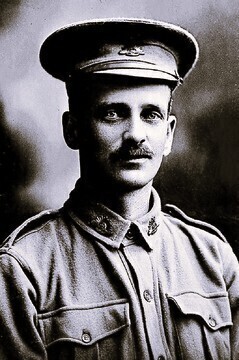
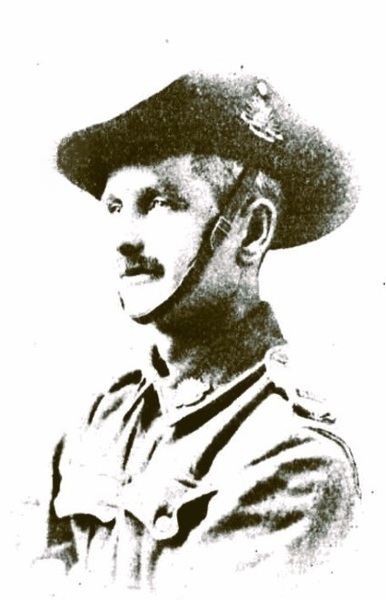
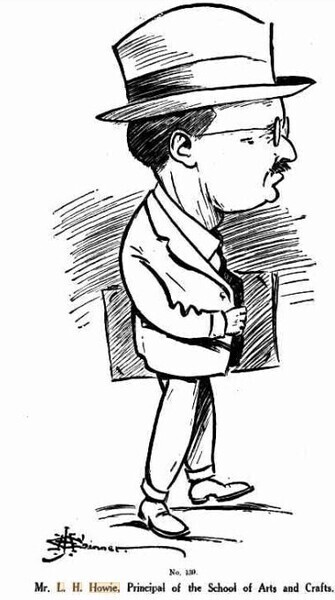
HOWIE, Laurence Hotham
| Service Number: | 5712 |
|---|---|
| Enlisted: | 28 August 1915 |
| Last Rank: | Corporal |
| Last Unit: | 13th Field Company Engineers |
| Born: | Norwood, South Australia, 22 August 1876 |
| Home Town: | Parkside, Unley, South Australia |
| Schooling: | Prince Alfred College, Adelaide, South Australia |
| Occupation: | Chief assistant, Adelaide School of Arts |
| Died: | Parkside, South Australia, 17 October 1963, aged 87 years, cause of death not yet discovered |
| Cemetery: |
Mitcham Anglican Cemetery, South Australia Plot 0299A - Burial reg # 2061 |
| Memorials: | Adelaide South Australian Education Department Roll of Honour, Adelaide University of Adelaide WW1 Honour Roll, Outer Harbor Royal South Australian Yacht Squadron WWI Roll of Honour, Unley Town Hall WW1 Honour Board |
World War 1 Service
| 28 Aug 1915: | Enlisted AIF WW1, Sapper, 5712, 3rd Field Company Engineers | |
|---|---|---|
| 20 Jan 1916: | Involvement 5712, 3rd Field Company Engineers, --- :embarkation_roll: roll_number: '5' embarkation_place: Sydney embarkation_ship: HMAT Runic embarkation_ship_number: A54 public_note: '' | |
| 20 Jan 1916: | Embarked 5712, 3rd Field Company Engineers, HMAT Runic, Sydney | |
| 23 Nov 1917: | Involvement AIF WW1, Corporal, 13th Field Company Engineers |
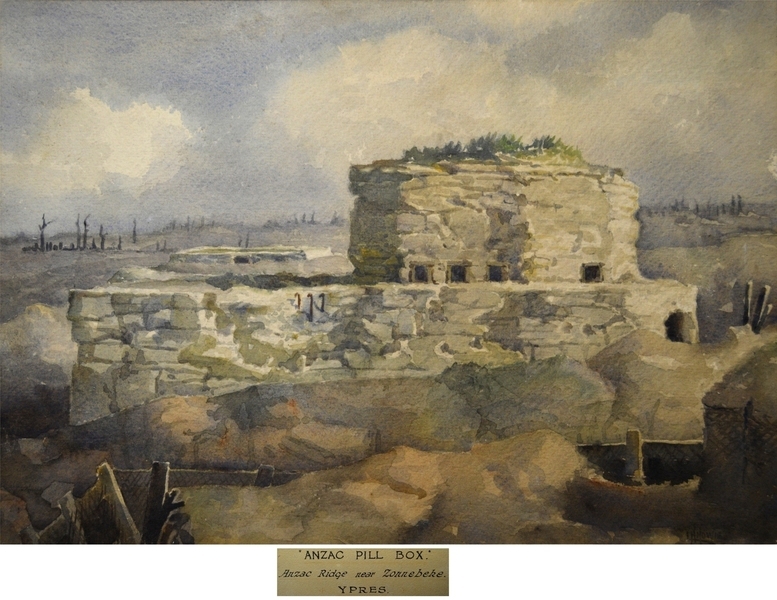
Laurence Howie's Anzac pill box
How did this tale begin?
In 2015 I was selling my house after more than thirty years, and clearing out things I no longer needed.
I took five cage trailer loads to the dump, but on one of those trips, as the dump-hand was about to toss out some papers, I noticed something among them.
It was a small picture of a captured German pill box from the Western Front in World War One, and although I had not seen it for many years, I remembered that it had belonged to my father, so I quickly grabbed it and tossed it into the car to take home.
Who was the artist whose name was on the painting?
A quick look in Army records showed that Laurence Hotham Howie of Adelaide had enlisted in the Army in 1915.
The picture was a little battered, stained and dirty, and I wasn’t sure what it was; was it a print? I couldn’t tell, so I took it to some friends, retired art teachers.
They immediately confirmed it as an original watercolour, and they knew Howie by his reputation.
The story was becoming interesting!
Laurence Howie had enlisted in 1915 when he was almost thirty-nine, and had been Chief Assistant at the Adelaide School of Arts.
By the end of the War, no doubt because of his art teaching background, he was placed in the War Records Section as an artist to record Australia’s involvement in the War. In that role he travelled the Western Front throughout 1919, painting as he went.
In 1920 he returned to Adelaide and became Principal of the School of Arts and Crafts, a position he held until he retired in 1941.
He also donated all of his paintings and notebooks as a war artist to the War Memorial in Canberra, although this painting seems to have escaped being donated.
But what of the painting? What was its story?
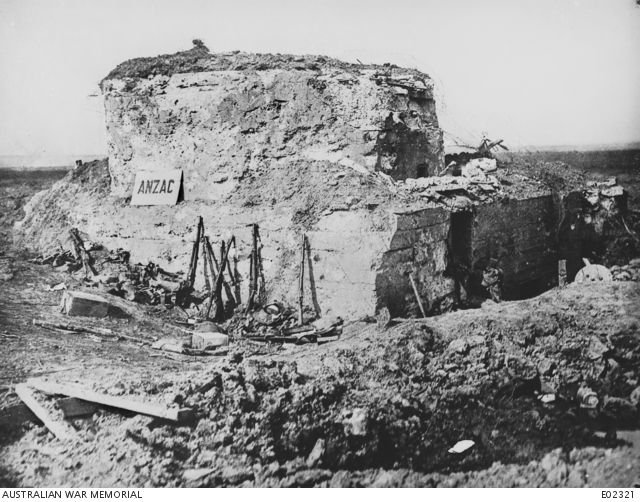
In September 1917 the Australian 18th Battalion had attacked and captured the pill box.
What’s a pill box?
They were small reinforced-concrete armoured forts, designed to survive artillery attacks, and their shape was reminiscent of a pill box in a medicine chest.
Despite their considerable strength, they were not impregnable; the Australians would use artillery to force the Germans to keep their heads down, and would then rush the pill boxes with rifles and Mills bombs (grenades).
This particular pill box immediately became famous, as an Australian flag had been planted atop the fort by one of the officers of the 18th Battalion.
'One of the most inspiring and historic events during the Battle of Polygon Wood (Belgium), was the planting of the Australian Flag on Anzac Redoubt (German Pill-box), at 7.15 a.m., on September 20th, 1917, by Lieutenant A V L Hull, 18th Battalion. He was killed in action three weeks later'. … A Pearse, War Artist
Pearse, another war artist, using a little romantic imagination, painted Hull climbing onto the captured pill box with his flag, and the painting was then printed on thousands of postcards that were sold to raise money for the Australian Comforts Fund, which provided things such as tobacco, soap, razor blades and sweets to our troops.
The pill box had been defended by fifteen German soldiers with two machine guns.
The German Army had been clever; the pill boxes were very strong on the front facing the Allied troops, but were only weakly built on the back, so that if the fort was captured it would be easy to destroy those who had captured it.
A sad tale too: shortly after the capture of the pillbox the Australians received a visit from a German messenger dog, carrying a note to one of the dead German officers. The Australians wanted to keep the dog, but it was killed later on the same day by a German artillery shell. The intentionally weak rear side had claimed another life.
So, how did the painting come to be in my father’s possession?
We don’t know.
We can be fairly sure that my father knew of the pill box, because in October 1917 it became the headquarters for the 27th Battalion, my father’s Battalion.
Did Howie know my father? Possibly; I suspect the returned soldiers could recognise another returnee on sight, and it is quite possible they mixed in similar circles.
As I said, we just don’t know.
And what of Howie?
His Adelaide-born fiancée, Janet Davidson, travelled to meet Laurence in London, where they were married in July 1919.
They had two daughters, Mary and Janet; Mary, who was born in 1920, edited a book about her father’s life and work. I found a copy of the book in the State Library, and as it was published not too long ago, I wondered whether she might still be alive.
The White Pages led me to her cousin, who put me in touch with Mary’s nephew, a friendly fellow who invited me to Mary’s house to view Laurence’s paintings and to buy some copies of the book.
Mary unfortunately was in a nursing home and incapable of receiving visitors, and sadly she died later in the year.
In one of the coincidences for which Adelaide is famous, the house, which had been bought by Howie in 1907, was just one street away from the house I was selling. It was a memorial to Howie’s life and his art, a rare pleasure and an honour to see. The book too was beautiful.
So what happened to the painting?
I took it to Artlab, an offshoot of the Art Gallery of South Australia, to have it appraised and to have a quotation prepared for its conservation.
I also contacted the War Memorial in Canberra, and waited for advice from Artlab and the War Memorial.
I eventually heard from both; Artlab could repair and conserve it, for which I would happily have paid, but the War Memorial were quite excited as it would be an important part of their Howie collection, and they were willing to pay for their own conservation experts to repair it.
So, having given Artlab a copy of Mary’s book as a means of thanking them, I carefully packed it in a carton and mailed it to Canberra, with yet another copy of the book.
It is now on permanent loan from me to the War Memorial, which I have no doubt would have pleased my father.
Stan Woods 2026
Submitted 26 May 2026 by Stan Woods

Click images to start slideshow.