


HOWLEY, James Richard
| Service Number: | 1337 |
|---|---|
| Enlisted: | 30 August 1915 |
| Last Rank: | Private |
| Last Unit: | 4 Battalion Imperial Camel Corps |
| Born: | Gympie, Queensland, Australia, 31 May 1893 |
| Home Town: | Gympie, Queensland |
| Schooling: | Not yet discovered |
| Occupation: | Millhand |
| Died: | Brisbane Mental Hospital, Goodna, Queensland, Australia, 27 August 1957, aged 64 years, cause of death not yet discovered |
| Cemetery: |
Lutwyche Cemetery, Brisbane, Qld Anzac Portion 9, Lutwyche Cemetery, Brisbane. |
| Memorials: |
World War 1 Service
| 30 Aug 1915: | Enlisted AIF WW1, Private, 1337, 11th Light Horse Regiment | |
|---|---|---|
| 30 Nov 1915: | Involvement Private, 1337, 11th Light Horse Regiment, --- :embarkation_roll: roll_number: '3' embarkation_place: Sydney embarkation_ship: HMAT Suffolk embarkation_ship_number: A23 public_note: '' | |
| 30 Nov 1915: | Embarked Private, 1337, 11th Light Horse Regiment, HMAT Suffolk, Sydney | |
| 17 Mar 1917: | Discharged AIF WW1, Private, 1337, 4 Battalion Imperial Camel Corps, 1st MD, Medical Discharge |
Help us honour James Richard Howley's service by contributing information, stories, and images so that they can be preserved for future generations.
Add my storyBiography contributed by Evan Evans
From Australian Remembrance Army
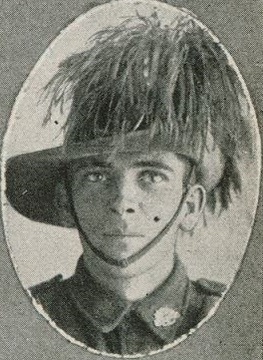
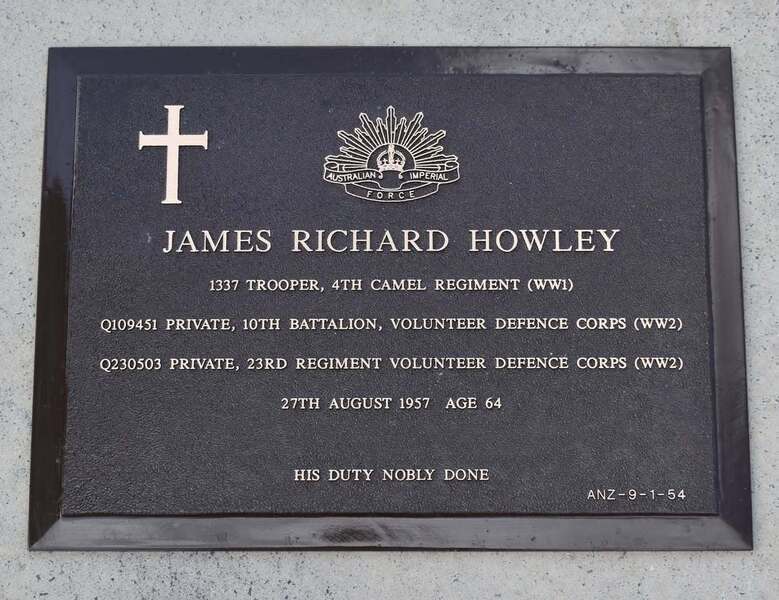
Private James Richard Howley (Service Nos. WWI 1337, WWII Q109451 / Q230503), an Australian who served during both World Wars, is among almost 800 previously unmarked WWI veterans’ graves in Lutwyche Cemetery we have now honoured with a plaque recognising their service for Australia.
On 20 September 2025, his plaque was unveiled in Lutwyche Cemetery, along with a further 161 plaques on the previously unmarked graves of Australian World War One veterans:
See Australian Remembrance Army Facebook page
James Richard Howley was born on 31 May 1893 in Gympie, Queensland, to James and Susan Howley (née Cudmore). He enlisted in the Australian Imperial Force in Brisbane in August 1915, stating his occupation as sawmill hand and naming his mother as next of kin.
While serving in Egypt, he suffered a fractured wrist and was hospitalised at Abbassia in March 1916. Soon after, he contracted mumps and required further treatment before returning to duty later that month. Continued problems with his wrist saw him re-admitted to hospital at Heliopolis in early April, after which he resumed training duties with the 3rd Light Horse Training Regiment at Tel-el-Kebir.
In June 1916, Howley transferred to the 3rd Double Squadron and was stationed at Serapeum, where he again spent a short period in hospital with diarrhoea. On 2 November 1916, he was taken on strength with the 4th Australian Camel Regiment at Abbassia. The following month, his health declined once more, and he was admitted to hospital suffering from debility (disordered action of the heart). Despite several periods of convalescence at Abbassia and Cairo, his health did not improve.
On 7 March 1917 he was transferred to Australia aboard the transport H.T. Willochra for further medical care. He embarked from Suez on 16 March 1917 and was formally discharged medically unfit at the 1st Military District on 4 June 1917.
In 1918 he married Winifred Heilbronn, though the marriage did not last. In 1929 he is recorded as spending time at the Rainbow Bay Soldiers’ Rest Home, Coolangatta, and later living in northern and western Queensland, working as a station hand and labourer.
During the Second World War, he once again volunteered for military service. He enlisted in the Australian Army in north-west Queensland — first at Julia Creek and later at Dalgonally — serving under the numbers Q109451 and Q230503. His duties were of a home-service nature, typical for older returned First World War veterans.
Private James Richard Howley died at the Brisbane Mental Hospital, Goodna on 27 August 1957, aged 64, and was buried three days later in Anzac Portion 9, Lutwyche Cemetery, Brisbane.
After reviewing thousands of WWI service and medical records, it is likely that James was among the many returned soldiers who died without sufficient personal means to pay for their burial. The Repatriation Department (now the Department of Veterans’ Affairs) covered the cost of tens of thousands of WWI veterans’ burials—many of which, like his, have remained unmarked for decades. And volunteers like us are searching for thousands upon thousands more that are yet to be located.
After decades without recognition at his place of burial, his grave now bears a plaque commemorating his service to Australia — ensuring his name endures among those remembered for their duty and sacrifice. His identity and dignity have now been restored.
We have remembered him.
Lest We Forget.
Click images to start slideshow.