








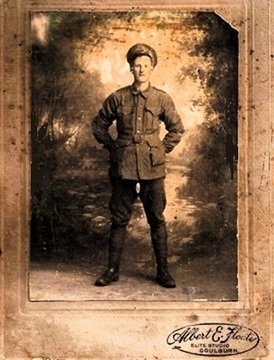
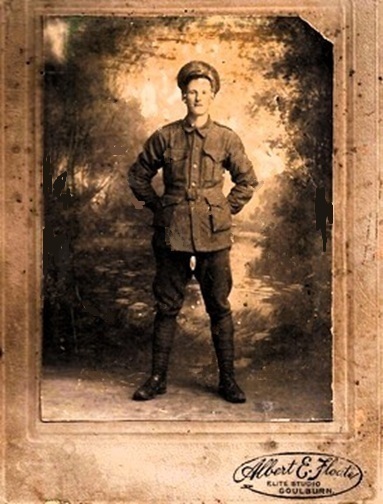
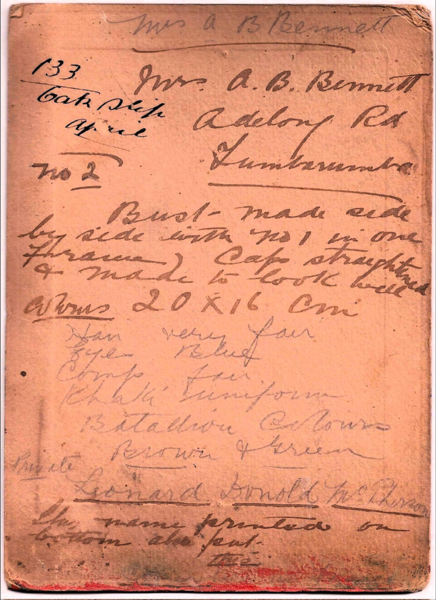
MCPHERSON, Leonard Donald
| Service Number: | 2470 |
|---|---|
| Enlisted: | 5 May 1916, Tumbarumba, NSW |
| Last Rank: | Private |
| Last Unit: | 55th Infantry Battalion |
| Born: | Tumbarumba, New South Wales, Australia, 21 March 1895 |
| Home Town: | Tumbarumba, Tumbarumba, New South Wales |
| Schooling: | Union Jack Public School, Tumbarumba, New South Wales, Australia |
| Occupation: | Labourer |
| Died: | Killed in Action, France, 4 July 1918, aged 23 years |
| Cemetery: |
Franvillers Communal Cemetery Extension Plot I, Row G, Grave No. 10 |
| Memorials: | Australian War Memorial Roll of Honour, Tumbarumba District Roll of Honour WW1, Tumbarumba Union Jack School Memorial |
World War 1 Service
| 5 May 1916: | Enlisted AIF WW1, Private, 2470, 55th Infantry Battalion, Tumbarumba, NSW | |
|---|---|---|
| 30 Sep 1916: | Involvement Private, 2470, 55th Infantry Battalion, --- :embarkation_roll: roll_number: '19' embarkation_place: Sydney embarkation_ship: HMAT Aeneas embarkation_ship_number: A60 public_note: '' | |
| 30 Sep 1916: | Embarked Private, 2470, 55th Infantry Battalion, HMAT Aeneas, Sydney |
Help us honour Leonard Donald McPherson's service by contributing information, stories, and images so that they can be preserved for future generations.
Add my storyBiography contributed
Son of Walter John and Elizabeth Ann (nee SHORE) MCPHERSON
Killed at the front:—Pte. Leonard Donald McPherson, 55th Battalion on July 4th. He was the sixth son of Mrs. A. Bennett of Adelong Road, Tumbarumba, and was 23 years of age. He had been almost two years at the war.
Biography contributed by Cassie Horsley
Early Life
Leonard Donald McPherson was born on 21 March 1895 in Tumbarumba, New South Wales, the 8th child of John Walter McPherson and Elizabeth Ann Shore. His father died in 1898 when Leonard was only 3 years old, leaving Elizabeth a widow with 9 children. She remarried in 1900 to Archibald Bowna Bennett, and Leonard grew up in a large blended family of 11 children.
The family lived along Adelong Road, Tumbarumba and Leonard attended the Union Jack Public School, a small bush school serving the mining and timber families of the district. The McPhersons were well-known locally, working in timber and rural labour. Leonard followed this path, employed as a labourer before the war.
The Men from Snowy River Recruiting March
By early 1916, recruitment across rural NSW had intensified as casualty lists grew and voluntary enlistments declined following the loss of life at Gallipoli.
One of the most visible strategies was the “snowball” recruiting march that saw volunteers travelling between small towns, gathering more men as they passed through the district. The most famous of these was the Men from Snowy River march, which began at Delegate in January 1916 and travelled through the Monaro region.*
The march carried a distinctive hand‑painted flag bearing the words “Men from Snowy River”, a bold and deliberately crafted emblem of regional identity. Although simple in design, the flag quickly became a powerful symbol of the Monaro’s contribution to the war effort.
Although the march did not pass through Tumbarumba, its progress was widely reported in the regional press, and the imagery associated with it, especially the flag, circulated far beyond the towns it visited. For many rural communities, the flag came to represent the spirit of the Snowy Mountains men and their willingness to volunteer at a time when enlistment numbers were falling.^
Influences on Leonard’s Decision
For young rural men in 1916, the pressure to enlist was considerable. Local newspapers, public meetings and recruiting sergeants emphasised duty, sacrifice and loyalty to the Empire, while small communities often knew exactly who had volunteered and who had not. Many men enlisted not only out of personal conviction but because friends, neighbours or workmates had already stepped forward during the snowball campaigns.
Leonard’s decision to enlist in May 1916, just months after the major recruitment marches of that summer, suggests he was well aware of these efforts and may have known men who joined during them.
Even without a march passing directly through Tumbarumba, the atmosphere of patriotic appeal, the visibility of the Men from Snowy River movement and the expectations of a close‑knit rural district would have been impossible to ignore. For Leonard, as for many young men of the region, enlistment was both a personal choice and a response to the collective pressures that shaped wartime life in country NSW.
To the Western Front
Leonard enlisted in the Australian Imperial Force on 5 May 1916 at Goulburn. He was 21 years old, physically strong and accustomed to the demanding work of the Snowy Mountains region.
He embarked from Sydney on 30 September 1916 aboard HMAT A60 Aeneas, arriving at Plymouth on 19 November 1916. Two days later he was posted to the 14th Training Battalion at Codford, where he underwent several weeks of infantry training in preparation for service.
Leonard proceeded overseas to France on 21 December 1916, embarking from Folkestone on the Princess Victoria. He arrived at Étaples the following day and marched into the 5th Australian Divisional Base Depot. On 8 February 1917, he was taken on strength of the 55th Battalion, a unit raised largely from New South Wales recruits and part of the 14th Brigade of the 5th Australian Division. He joined them in the bitter winter conditions of the Western Front.
The 55th Battalion in 1917
The year 1917 was one of the most demanding for the 55th Battalion. When Leonard joined them in February, the battalion was engaged in operations following the German withdrawal to the Hindenburg Line. The Australians advanced through devastated countryside, encountering rearguard actions, booby-trapped villages and fortified positions.
In April and May, the 55th took part in the Second Battle of Bullecourt, one of the most punishing actions fought by the AIF. Although the battalion was not in the first assaulting waves, it was heavily involved in the subsequent fighting, holding exposed positions under relentless artillery fire and counter-attacks.
Later in 1917, the battalion moved north to Belgium for the Ypres offensive. During the Battle of Polygon Wood in September, the 55th supported the main assault by consolidating captured ground and resisting German attempts to retake key positions. The fighting was intense, the conditions muddy and exhausting, and casualties high. Leonard served continuously through this period, gaining the experience and resilience that defined the Australian infantry by late 1917.
The 55th Battalion in 1918
The German Spring Offensive began in March 1918, and the 55th Battalion was rushed south to the Somme to help stem the German advance. The battalion took up defensive positions near Corbie and Villers-Bretonneux, where the fighting was fierce and often confused. It was during this period that Leonard was granted leave to England on 13 February 1918, rejoining his unit on 15 March as the crisis unfolded.
Throughout April and May, the 55th held the line east of Corbie, facing heavy shelling and probing attacks. The battalion played a crucial role in stabilising the front after the German capture of Villers-Bretonneux, and it remained in this sector as the Australian Corps prepared for counter-offensive operations.
By late June, the 55th was positioned near Hamel, supporting the preparations for General Sir John Monash’s meticulously planned attack. Although the battalion was not part of the assaulting force on 4 July 1918, it held the supporting line and endured sustained German artillery fire as the battle unfolded.
Serving Beside His Brother
Leonard’s older brother, Private John Walter McPherson (/explore/people/78544), enlisted on 11 June 1916, only weeks after Leonard. After completing training in England, John joined the 55th Battalion in France on 24 March 1917, entering the line as the battalion advanced toward the Hindenburg Line.
For a brief but intense period in the spring of 1917, the 2 brothers served side by side. They experienced the dangerous advance through devastated villages abandoned during the German withdrawal and were present as the battalion moved into the bitter fighting around Bullecourt.
In mid-April 1917, during heavy shellfire, John was wounded by shell fragments to the face, back and arm. He was evacuated for treatment. This injury ended his service with the 55th Battalion.
After recovering, John was transferred to the 18th Battalion, part of the 5th Brigade of the 2nd Australian Division. He returned to France on 18 August 1917, re-entering the Western Front as the Australian Corps prepared for renewed attacks in the Ypres sector. Leonard remained with the 55th Battalion, part of the 14th Brigade of the 5th Division.
Although no longer in the same battalion, the brothers were again fighting in the same campaign. John’s battalion attacked at the Battle of Menin Road on 20 September 1917, while Leonard’s battalion advanced 6 days later at Polygon Wood. The battlefield east of Ypres was narrow, only a few kilometres across, and Australian divisions attacked along adjoining sectors of the same ridge system. It is likely that at times the brothers were no more than a few kilometres apart, enduring the same artillery barrages, mud and gas shelling.
Their service continued in parallel through the winter. When the German Spring Offensive erupted in March 1918, both battalions were rushed south to the Somme to help defend the vital approaches to Amiens. Once again they fought in the same wider battle zone, though separated by brigade and division.
In early June 1918, John was wounded and severely gassed during operations on the Somme. He was evacuated to England and did not return to the front. Leonard remained with the 55th Battalion.
On 4 July 1918, during the Battle of Hamel, Leonard was killed in action. At the time of his death, John was recovering in England. Their period of serving together in the same battalion had lasted only a matter of weeks in the spring of 1917, yet their war ran in parallel across the same battlefields of France and Belgium. Their story is one of brief shared service, long separation in the same war, and a final parting that neither could have foreseen.
John survived the war but never fully recovered from the effects of the gas, and he died in 1934 at the age of 48, his early death widely understood within the family to be linked to his wartime injuries.
Alick’s Response to His Brothers’ Service
John and Leonard’s youngest brother, Alick Claude McPherson, also enlisted in 1918. The timing of his enlistment suggests that he may have joined the AIF shortly after the family received word that John had been gassed in early June 1918. Like many young men who saw their brothers suffering overseas, he felt a strong pull to join the battalion.
Alick and Leonard were particularly close in age and temperament and Leonard’s death struck him deeply. He was still in training when the news reached Australia that Leonard had been killed in France. Those who knew him later in life recalled that he carried a mixture of grief, disbelief and the quiet ache of someone who had prepared himself to follow his brothers into danger, only to have the war close before he could reach them.
When the Armistice was declared on 11 November 1918, Alick was still in camp in the Northern Territory. The end of the war brought relief, but it also left him with a sense of unfinished duty.
He desired to stand where his brothers had stood, to face the same hardships and to honour Leonard’s memory by continuing the service he could no longer give. Alick's determination to reach the front was shaped by the raw, instinctive loyalty that comes from growing up in a large, tightly knit family where brothers relied on one another. Leonard’s death remained with him throughout his life.
Death in Action
Although Leonard had lost the assurance and familiarity of having John in the same battalion early on, he was never alone. The 55th Battalion included several young men from his home district of Tumbarumba, such as Privates Hugh D. Murdie, Robert Murdie, Charles F. Brown and Arthur Wealands. Serving alongside fellow “Tumba boys” would have given Leonard a sense of home and shared identity even in the midst of the horror of war.
On 4 July 1918, during the Battle of Hamel, Private Leonard Donald McPherson was killed in action. He was 23 years old. The exact circumstances of his death were not recorded, but the 55th Battalion’s position exposed it to heavy shelling throughout the day. His death was reported by official wire to Reverend T. H. O’Dea of Tumbarumba, and in his absence, Mr. D McIntosh conveyed the news to the family.
Leonard was buried in Franvillers Communal Cemetery Extension, a cemetery north of Corbie that became the resting place of many Australians who fell during the 1918 operations on the Somme.
News of His Death
The Tumbarumba Times and the Tumut Advocate both reported Leonard’s death with deep sympathy. The Tumbarumba Times described him as “a very respectable young man” and noted that he had been “almost two years at the war.” A soldier’s memorial service was held for him at the Presbyterian Church in Tumbarumba, conducted by Reverend O’Dea as part of the 4th anniversary of the declaration of war. The service reflected the community’s respect for Leonard and the grief felt by his family.
Commemoration
Leonard is commemorated on the Australian War Memorial Roll of Honour, the Tumbarumba District Roll of Honour, and the Tumbarumba Union Jack School Memorial. His grave at Franvillers remains a permanent and carefully maintained site of remembrance. His medals, the 1914–15 Star, the British War Medal and the Victory Medal, were issued to his mother in the early 1920s, along with a photograph of his grave, and the Memorial Plaque and Scroll.
Legacy
Private Leonard Donald McPherson’s life was short, but his story is deeply woven into the history of Tumbarumba and the service of the 55th Battalion. He represents the thousands of young rural Australians who left small communities to fight on the other side of the world, many never to return.
His sacrifice is remembered not only in official records and memorials but in the enduring memory of a family that grew to include more than 100 hundred grandchildren and great-grandchildren of his mother, Elizabeth Ann, later known as Granny Bennett.
*The 1916 Men from Snowy River recruiting march began with 12 men at Delegate and gathered 144 recruits by the time it reached Goulburn, of whom 133 were accepted into the AIF. Their service records show they were later dispersed across many battalions. Individual fates can be traced through National Archives service dossiers and Australian War Memorial digitised records, although no consolidated casualty list exists.
^ Recruitment organisers understood the influence of such symbols, and the Men from Snowy River flag was later revived during the Second World War to rally volunteers from the Monaro once again. Its reappearance decades later reflects the enduring legacy of the 1916 march within Snowy Mountains communities. For an image of the original flag, see Australian War Memorial collection item C158206 (www.awm.gov.au).

Click images to start slideshow.