







BURNS, James Douglas
| Service Number: | 80 |
|---|---|
| Enlisted: | 17 August 1914, An original member of A Company, 5th Bn. |
| Last Rank: | Warrant Officer Class 1 |
| Last Unit: | Echelon & Records |
| Born: | Richmond, Victoria, Australia, 1893 |
| Home Town: | South Yarra, Melbourne, Victoria |
| Schooling: | Not yet discovered |
| Occupation: | Mechanic |
| Died: | Tauranga, New Zealand, 20 January 1950, cause of death not yet discovered |
| Cemetery: |
Waikumete Cemetery & Crematorium, Auckland, New Zealand |
| Memorials: |
World War 1 Service
| 17 Aug 1914: | Enlisted AIF WW1, Private, 80, 5th Infantry Battalion, An original member of A Company, 5th Bn. | |
|---|---|---|
| 21 Oct 1914: | Involvement Private, 80, 5th Infantry Battalion, --- :embarkation_roll: roll_number: '8' embarkation_place: Melbourne embarkation_ship: HMAT Orvieto embarkation_ship_number: A3 public_note: '' | |
| 21 Oct 1914: | Embarked Private, 80, 5th Infantry Battalion, HMAT Orvieto, Melbourne | |
| 30 Apr 1915: | Wounded AIF WW1, Private, 80, 5th Infantry Battalion, ANZAC / Gallipoli | |
| 20 Jul 1915: | Transferred AIF WW1, Private, Echelon & Records | |
| 1 Aug 1916: | Promoted AIF WW1, Warrant Officer Class 1, Echelon & Records | |
| 9 Apr 1917: | Honoured Mention in Dispatches | |
| 18 Jun 1918: | Honoured Meritorious Service Medal (MSM) | |
| 25 Mar 1920: | Discharged AIF WW1, Warrant Officer Class 1, 80, Echelon & Records |
Help us honour James Douglas Burns's service by contributing information, stories, and images so that they can be preserved for future generations.
Add my storyBiography contributed by Stephen Brooks
An article appeared in the Melbourne Argus on 18 June 1915, a few months after the Anzac landing on Gallipoli, under the headline ‘MAN WHO DESERVED THE V.C.’
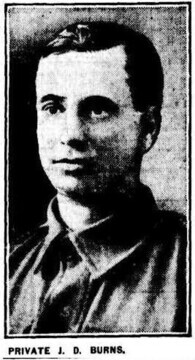
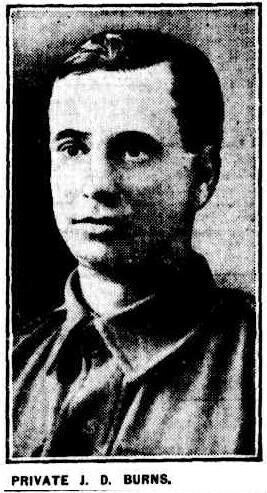
It was a copy of a letter written to his home by 81 Private David L. Bone, A Company, 5th Battalion, 1st A.I.E.F., who was an employee in the tool department of McPherson's Pty. Ltd., Collins Street, Melbourne. Private Bone was a patriotic young Scotch man, who though given an opportunity of rejoining his old regiment (Queen's Own Edinburgh Territorials), preferred to throw in his lot with the Australians. Whilst in Egypt he was offered promotion, but decided not to accept it, but to fight alongside the friends he had made in the ranks of A Company. The "Bobby Burns" referred to in the following extract of the letter is 80 Private J.D. Burns of Davis Street, South Yarra, an ex-employee of J. Bartram and Son Pty. Ltd.
“My left shoulder was shattered, and the concussion knocked all the power out of my legs and arms. However, I managed to crawl to a gully, and Bobby, the dear old boy, carried me for nearly a mile, when we came across a poor chap with his shoulder blown off, and both legs shot clean through. I got Bobby to drop me, and he got the other fellow on his back, and together we all managed to crawl to the ambulance, two miles further on. I might mention that on the way down the gully, for over a mile, we were under heavy shrapnel fire and snipers were picking off the wounded as they were carried or crawled back. How I got back, God alone knows, as quite a number of the wounded were killed by shrapnel and snipers on their way to the ambulance.
If anyone deserves a V.C. Bobby Burns does. He stuck to the two of us like glue, and when he got us safely down to the beach, he quite coolly said: - 'Cheer up, Davie, you'll soon be all right, but, my God, isn't it hellish?' then turned, and walked away. I called out, 'Where are you going, Bobby?' and as long as I live, I'll never forget his determined look. Then he broke into his happy old smile, and said: - 'I'm going to try to get up to the firing line again. Good bye, old boy, join us again soon'. Then he went off at the double.
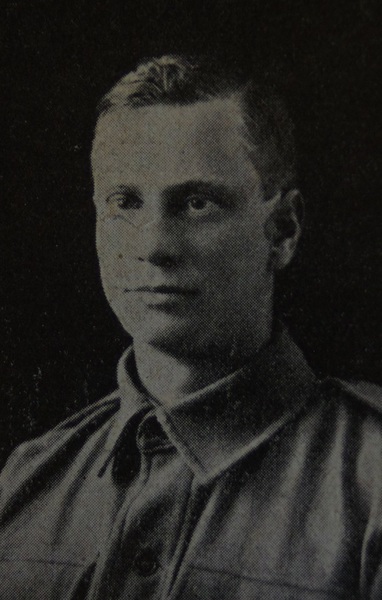
James Douglas Burns was wounded a few days after the Gallipoli landing and was evacuated to Egypt around 30 April 1915, with a crushed or strained back. When he recovered, he was posted to the AIF HQ or 3rd Echelon working in records. He spent the rest of the war doing such work. He was mentioned in Douglas Haig’s despatches during April 1917 and later in 1918 he was awarded a Meritorious Service Medal. He was discharged from the AIF in London during March 1920.
Click images to start slideshow.