







PIOCH, Edward Henry
| Service Number: | 2188 |
|---|---|
| Enlisted: | 28 February 1916, 1 year Senior Cadets |
| Last Rank: | Private |
| Last Unit: | 4th Pioneer Battalion |
| Born: | Maryborough, Queensland, Australia, 30 November 1897 |
| Home Town: | Mount Morgan, Rockhampton, Queensland |
| Schooling: | Not yet discovered |
| Occupation: | Labourer |
| Died: | Sherwood, Queensland, Australia, 27 December 1944, aged 47 years, cause of death not yet discovered |
| Cemetery: |
Lutwyche Cemetery, Brisbane, Qld Anzac Portion 7, Lutwyche Cemetery, Brisbane. |
| Memorials: |
World War 1 Service
| 28 Feb 1916: | Enlisted AIF WW1, Private, 2188, 4th Pioneer Battalion, 1 year Senior Cadets | |
|---|---|---|
| 1 May 1916: | Involvement Private, 2188, 4th Pioneer Battalion, --- :embarkation_roll: roll_number: '5' embarkation_place: Brisbane embarkation_ship: HMAT Clan McGillivray embarkation_ship_number: A46 public_note: '' | |
| 1 May 1916: | Embarked Private, 2188, 4th Pioneer Battalion, HMAT Clan McGillivray, Brisbane | |
| 12 Jul 1919: | Discharged AIF WW1, Private, 2188, 4th Pioneer Battalion, Discharge England, diverted to Russian relief |
Help us honour Edward Henry Pioch's service by contributing information, stories, and images so that they can be preserved for future generations.
Add my storyBiography contributed by Evan Evans
From Australian Remembrance Army
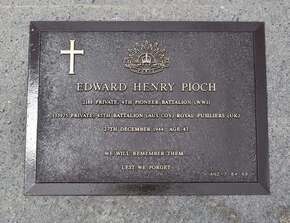
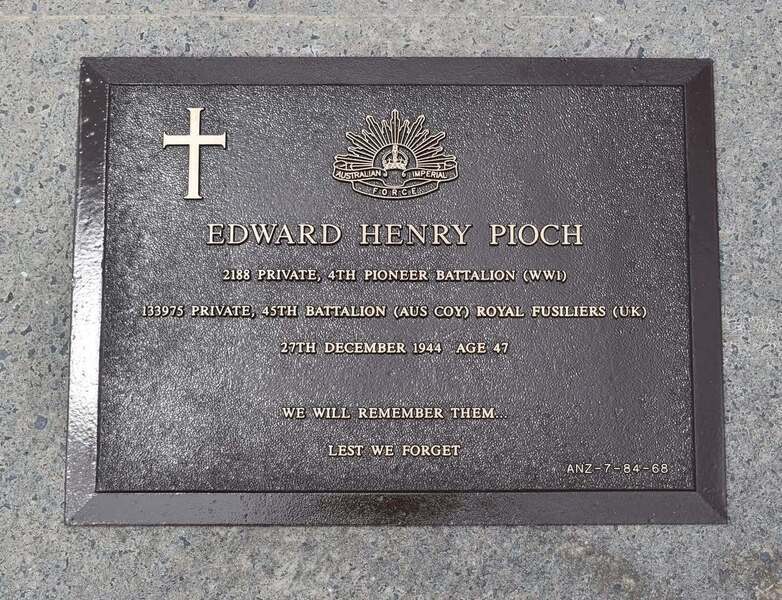
Private Edward Henry Pioch (Service Nos. 2188 & 133975), an Australian World War One veteran who also served with the UK Army (Australian Company) in the North Russia Relief Force in 1919, is among almost 800 previously unmarked WWI veterans’ graves in Lutwyche Cemetery we have now marked with plaques in recognition of their service for Australia.
We unveiled his plaque in Lutwyche Cemetery on 15 April 2023, along with a further 246 plaques on the previously unmarked graves of Australian World War One veterans:
See Australian Remembrance Army Facebook page
WWI:
2188, 4th Pioneer Battalion
North Russia Relief Force 1919:
133975, UK Army, 45th Battalion (AUS Coy) Royal Fusiliers
Private Edward Henry Pioch was born on 30 November 1897 in Maryborough, Queensland, to Theodore Henry Pioch and Augustina Pioch (née Kopp). He enlisted in the Australian Imperial Force at Rockhampton, Queensland, on 28 February 1916, stating his occupation as labourer, his age as 19, and nominating his mother, Augustina, as next of kin. On 1 May 1916, he embarked from Brisbane aboard HMAT Clan McGillivray with the 4th Pioneer Battalion for overseas service. He arrived in England in August and, after further training, proceeded overseas in November 1916 to join his battalion in the field.
While serving in France in April 1918, he was admitted to hospital suffering from trench fever, and in July 1918 he sustained gunshot wounds to the face and thigh. He returned to duty with his battalion in September.
On 12 July 1919, he was formally discharged from the Australian Imperial Force in London, having completed three years and 135 days of service, including more than three years overseas. His discharge was recorded as “demobilised,” with his intended place of service noted as the Russian Relief Force. He subsequently enlisted in the British Army for service with the North Russia Relief Force, joining the 45th Battalion, Royal Fusiliers (Australian Company). After the First World War, Russia was engulfed in civil war as the Bolsheviks consolidated power. In mid-1918, British, French, and American forces landed at Murmansk and Archangel to secure Allied supplies sent to the White Russian forces and to oppose the Bolshevik regime.
In 1919, the North Russia Relief Force was formed to reinforce Allied troops in the region. British and Australian volunteers, many of them late war enlistees, joined the campaign. Australians were enlisted into the British Army and assigned mainly to the 45th Battalion, Royal Fusiliers, including two companies composed entirely of Australians.
On 10 August 1919, a British offensive destroyed a large Bolshevik force and captured about 3,000 prisoners. On 29 August, the two Australian companies routed another force in a bayonet charge. These actions were followed by the Allied evacuation of North Russia in September and October 1919.
In February 1920, he embarked from London for Australia aboard HMT Orontes, arriving in Brisbane on 9 April 1920. His intended place of residence was recorded as Patterson Street, Mount Morgan, Queensland.
After returning to Australia, he was recorded as living at Mount Morgan, Queensland, where he worked as a labourer. By 1943, he and his parents were residing in the Brisbane suburb of Sherwood, and he remained employed as a labourer.
Private Edward Henry Pioch died on 27 December 1944, aged 47, and was buried in Anzac Portion 7, Lutwyche Cemetery, Brisbane. He was unmarried and had no known children.
After decades without recognition at his place of burial, his grave now bears a plaque commemorating his service to Australia — ensuring his name endures among those remembered for their duty and sacrifice. His identity and dignity have now been restored.
We have remembered him.
Lest We Forget
Click images to start slideshow.