






CLARK, Albert Henry
| Service Number: | 3717 |
|---|---|
| Enlisted: | Not yet discovered |
| Last Rank: | Private |
| Last Unit: | 10th Infantry Battalion |
| Born: | Parkside, South Australia, October 1898 |
| Home Town: | Adelaide, South Australia |
| Schooling: | Not yet discovered |
| Occupation: | Driver |
| Died: | 3 March 1939, cause of death not yet discovered, place of death not yet discovered |
| Cemetery: |
West Terrace Cemetery (AIF Section) (Row 1B, Grave No. 11 West) |
| Memorials: | Adelaide Gilles Street Primary School WW1 Honour Roll (New) |
World War 1 Service
| 2 Dec 1915: | Involvement Private, 3717, 10th Infantry Battalion, --- :embarkation_roll: roll_number: '10' embarkation_place: Adelaide embarkation_ship: RMS Malwa embarkation_ship_number: '' public_note: '' | |
|---|---|---|
| 2 Dec 1915: | Embarked Private, 3717, 10th Infantry Battalion, RMS Malwa, Adelaide |
Help us honour Albert Henry Clark's service by contributing information, stories, and images so that they can be preserved for future generations.
Add my storyBiography contributed by St Ignatius' College
Alfred Henry Clark was born in Parkside, SA, to Mrs Emma Jane Clark. He had 12 siblings, 5 of whom died before 3 years old. He was eighteen and two months old when he enlisted in the Australian Imperial Force. Growing up in South Australia in a large family, he worked as a Driver. Before the war, he also served in the Senior Cadets and Citizens Forces, where he learned foot drills, rifle handling, navigation and first aid10. These experiences meant he entered the army with skills many new recruits did not have.
Clark enlisted in Adelaide on 10 August 1915 and began training. His early months were spent at Morphettville Camp, where days began at dawn with reveille and inspections, followed by marching, bayonet practice, musketry and physical conditioning.
Clark embarked on RMS Malwa on December 2nd 1915 and arrived in Egypt. After further training, he was sent to France, disembarking at Marseilles in early April. He joined the 10th Battalion, a South Australian unit preparing for the Western Front. They moved into the Armentières sector, an area known for shelling, trench raids and gas attacks. This was Clark’s first real experience of trench warfare.
On 8 July 1916, Clark was wounded during the battalion’s long march toward the Somme. The 10th Battalion’s war diary shows they were constantly on the move through towns such as Sailly, Godewaersvelde, Doullens and Halloy. These movements were exhausting and dangerous, and German artillery regularly shelled the roads. At this time, the Somme offensive had already been raging for weeks, and Pozières had become a critical objective because it sat on a fortified ridge that gave the Germans commanding observation over the entire battlefield, meaning any unit moving toward the front—like the 10th Battalion—was exposed to constant long‑range shelling as the Germans tried to disrupt Allied preparations before the main assault.
In April 1917, Clark became ill with an infection and was treated by the 5th Field Ambulance before being transferred through hospitals in Boulogne. By July he developed pulmonary tuberculosis, a severe lung infection that affected him for the rest of his life. He was evacuated to England on the hospital ship Prince Elizabeth and spent months moving between hospitals in London, Camberwell and Harefield.
By late 1917, the strain of illness, exhaustion and trauma began to show. Clark was repeatedly absent without leave. His first AWL incident occurred in September 1917, resulting in the loss of 36 days of pay. On 31 December 1917, he disappeared again and remained missing for nearly a month. He faced a Field General Court Martial on 15 February 1918 and was sentenced to 90 days of Field Punishment. Only weeks later, he went missing again for an entire month between 25 March and 25 April 1918. He was originally charged with desertion but was found guilty of being AWL and sentenced to two years of hard labour. His sentence was suspended in October.
Clark’s health continued to decline. He attempted to return to Australia in March 1918 but became too ill to complete the voyage and was hospitalised in South Africa6. He eventually returned home on the Suffolk, disembarking on 3 May 1919. He was officially discharged on 25 July 1919.
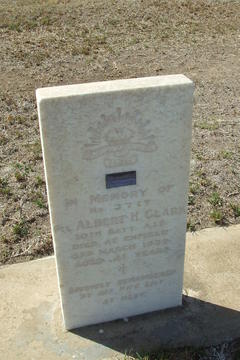
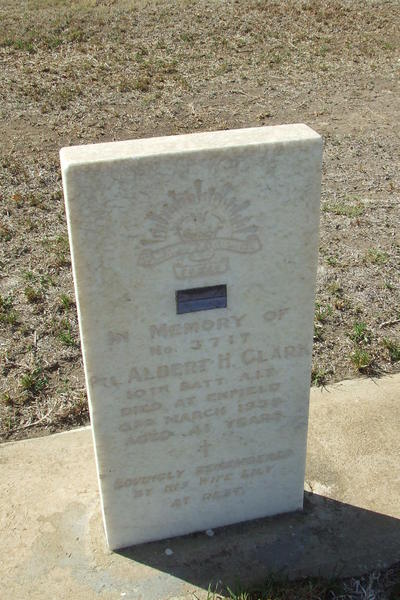
After the war, Clark returned to Adelaide and lived near his mother on Sturt Street. He married Lily Taylor in 1920 and tried to rebuild his life, but the long-term effects of tuberculosis and the psychological strain of war never fully left him. He died on 3 March 1939 at the age of 41 and was buried in the AIF section of West Terrace Cemetery.
Click images to start slideshow.