







PRITCHARD, James
| Service Number: | 2713 |
|---|---|
| Enlisted: | 17 September 1914, 8 months transport service, SS Dongala |
| Last Rank: | Driver |
| Last Unit: | 1st Divisional Train |
| Born: | Liverpool, Lancashire, England , December 1882 |
| Home Town: | South Yarra, Melbourne, Victoria |
| Schooling: | Not yet discovered |
| Occupation: | Fireman |
| Died: | Rupture of abdominal aneurysm into duodenum, Brisbane Hospital, Brisbane, Queensland, Australia, 25 August 1951 |
| Cemetery: |
Lutwyche Cemetery, Brisbane, Qld Anzac Portion 8, |
| Memorials: |
World War 1 Service
| 17 Sep 1914: | Enlisted AIF WW1, Private, 2713, 1st Divisional Train, 8 months transport service, SS Dongala | |
|---|---|---|
| 22 Dec 1914: | Involvement Private, 2713, 1st Divisional Train, --- :embarkation_roll: roll_number: '21' embarkation_place: Melbourne embarkation_ship: HMAT Borda embarkation_ship_number: A30 public_note: '' | |
| 22 Dec 1914: | Embarked Private, 2713, 1st Divisional Train, HMAT Borda, Melbourne | |
| 27 Apr 1916: | Discharged AIF WW1, Driver, 2713, 1st Divisional Train, 3rd MD, medically discharged |
Help us honour James Pritchard's service by contributing information, stories, and images so that they can be preserved for future generations.
Add my storyBiography contributed by Evan Evans
From Australian Remembrance Army
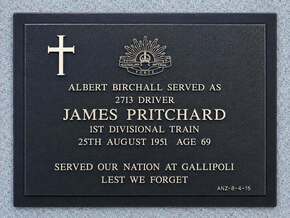
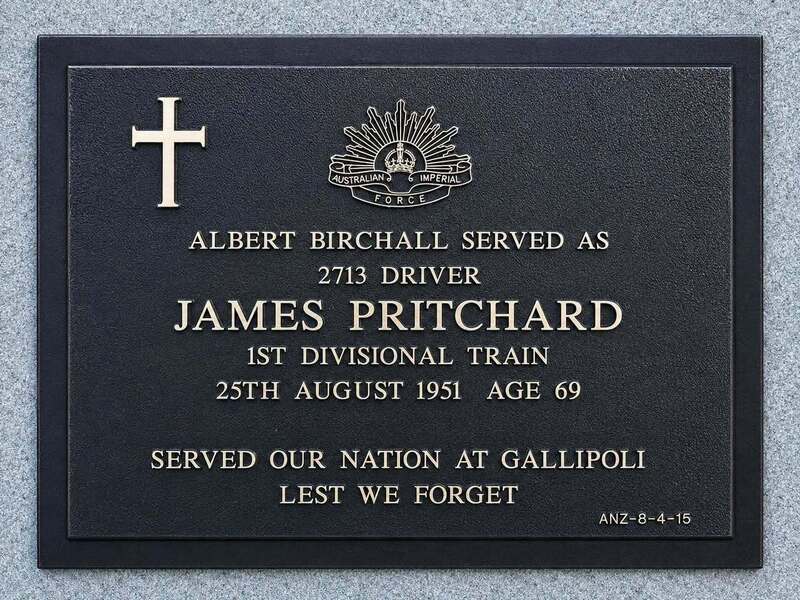
Australian World War One veteran Albert Birchall who served as Driver James Pritchard, Service No. 2713, is among almost 800 previously unmarked WWI veterans’ graves in Lutwyche Cemetery we have now marked with plaques in recognition of their service for Australia.
We unveiled his plaque in Lutwyche Cemetery on 16 May 2026, along with a further 185 plaques on the previously unmarked graves of Australian World War One veterans:
See Australian Remembrance Army Facebook page
Albert Birchall was born in 1882 in Lancashire, England, to Samuel Birchall and Mary Birchall, née Hughes. He later married Margaret Louisa in Victoria, Australia. Divorce records from Victoria confirm that Albert used the alias James Pritchard, the name under which he enlisted and served during the First World War.
On 22 September 1914, Albert enlisted in the Australian Imperial Force at Sydney under the name James Pritchard. He stated his occupation as fireman and nominated his wife, Mrs Margaret Louisa Pritchard, of 21 Barry Street, South Yarra, Melbourne, Victoria, as his next of kin. On 21 December 1914, Driver James Pritchard embarked for overseas service.
On 5 April 1915, he proceeded to join the Mediterranean Expeditionary Force at Gallipoli. It was there, in June 1915, that the illness which would lead to his return to Australia began. His medical records state that he suffered from diarrhoea for about a fortnight while at Gallipoli. After this, he developed swelling of the limbs. Although the swelling subsided, he was left with pain and stiffness in his back and hips, together with nervousness. Medical officers recorded the disability as rheumatism of the back and hip after diarrhoea and gave the cause as infection, attributed to active service.
His condition worsened through the following months. On 31 July 1915, he was admitted to the Fleet Sweeper Clacton and then transferred to Mudros, where he was admitted to HMT Neuralia. On 4 August 1915, he was admitted to No. 1 Australian General Hospital in Cairo suffering from rheumatism. He was then transferred through convalescent hospitals, including the Australian and New Zealand Convalescent Hospital at Helouan, Egypt.
A detailed medical history completed in November 1915 recorded his disability as rheumatism, originating at Gallipoli in June 1915. The cause was stated to be exposure on active service. At that time, he was suffering pain and tenderness in the right knee, shortness of breath and palpitation. The report stated that the disease had been aggravated by military service through strain and exposure. It was considered permanent, and his capacity to earn a livelihood was assessed as totally impaired at present. Treatment included massage and sulphur baths, and no operation was performed or advised.
On 31 October 1915, he embarked at Suez for return to Australia aboard the troopship Aeneas, suffering from rheumatism. He was discharged from the AIF in April 1916.
Following the war, Albert Birchall’s military and repatriation records continued to link his birth name with the name under which he had served. A later Repatriation Commission record identified him as “BIRCHALL, Albert — enlisted as PRITCHARD, James,” with regimental number 2713. This confirmed that Albert Birchall and Driver James Pritchard were the same man.
Albert Birchall who served as Driver James Pritchard died on 25 August 1951 at Brisbane Hospital, aged 69, and was buried and was buried on 30 August in Anzac Portion 8, Lutwyche Cemetery, Brisbane. His primary cause of death was the rupture of an abdominal aneurysm into the duodenum, with atheroma recorded as an underlying condition. Salmonella infection of the bowel was also listed as a contributing condition.
After decades without recognition at his place of burial, his grave now bears a plaque commemorating his service to Australia — ensuring his name endures among those remembered for their duty and sacrifice.
His identity and dignity have now been restored.
We have remembered him.
Lest We Forget
Click images to start slideshow.