








PRIOR, William Stanley
| Service Numbers: | 2779, 2779A |
|---|---|
| Enlisted: | 10 February 1916 |
| Last Rank: | Corporal |
| Last Unit: | 32nd Infantry Battalion |
| Born: | Marrabel, South Australia, 27 March 1893 |
| Home Town: | Julia, Goyder, South Australia |
| Schooling: | Friederichswalde School |
| Occupation: | Farm labourer |
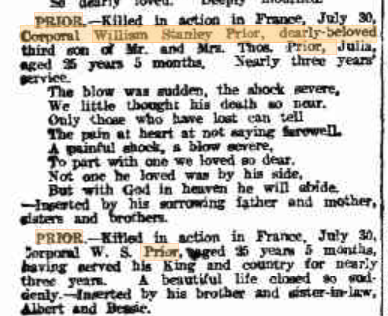
| Died: | Killed in Action, France, 30 July 1918, aged 25 years |
| Cemetery: |
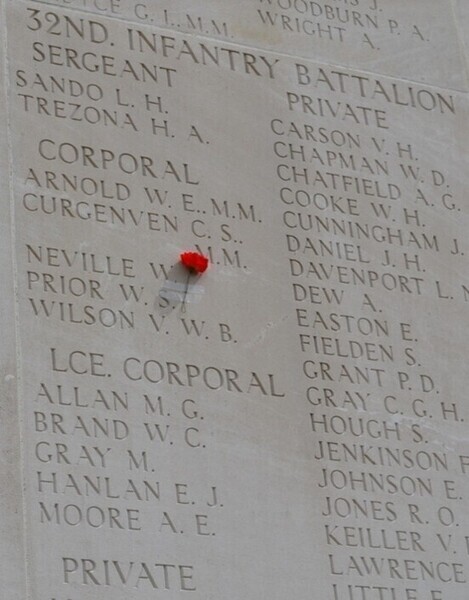
No known grave - "Known Unto God" Villers-Bretonneux Memorial, Villers-Bretonneux, Picardie, France |
| Memorials: | Australian War Memorial Roll of Honour, Eudunda War Memorial, Eudunda and District WW1 Roll of Honour, Marrabel District Honour Roll, Marrabel War Memorial, The South Australian National War Memorial, Villers-Bretonneux Memorial |
World War 1 Service
| 10 Feb 1916: | Enlisted AIF WW1 | |
|---|---|---|
| 25 Mar 1916: | Involvement Private, 2779, 32nd Infantry Battalion, --- :embarkation_roll: roll_number: '17' embarkation_place: Adelaide embarkation_ship: HMAT Shropshire embarkation_ship_number: A9 public_note: '' | |
| 25 Mar 1916: | Embarked Private, 2779, 32nd Infantry Battalion, HMAT Shropshire, Adelaide | |
| 30 Jul 1918: | Involvement Corporal, 2779A, 32nd Infantry Battalion, --- :awm_ww1_roll_of_honour_import: awm_service_number: 2779A awm_unit: 32nd Australian Infantry Battalion awm_rank: Corporal awm_died_date: 1918-07-30 |
Letter from commanding officer
In 2012 we did a tour of Australia's western front battlefields and cemeteries. As we did not have any direct relatives who fought in WW1, we "adopted" a soldier to honour for his tour of duty. From an old copy of the Kapunda Herald, dated 5th May 1916 that we held for our own family's records, we found a brief report;
"Mr T Prior, of Julia has received a cable message from his son, Private W. S. Prior, that he had arrived at Cairo, "all is well" ". So we decided research William.
Prior to leaving for our trip, I searched the AWM records and found that William Stanley Prior, a member of the 32nd Battalion was killed in action on 30th July 1918 tragically a few months before war's end. William had no known grave.
From 32nd Battalion's war diary of July 1918 and our tour guide's trench map information, we achieved our goal of being able to visit the approximate spot where William was killed.
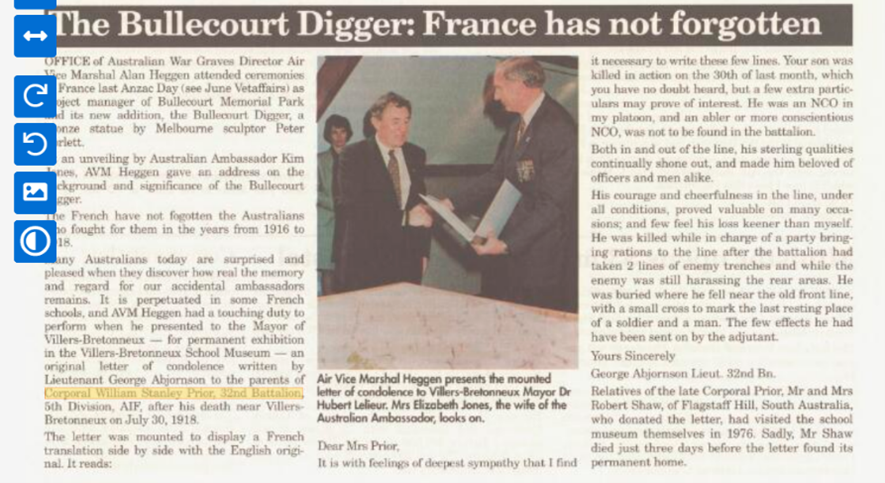
We then visited the museum above the Australia School in Villers Brettonneux. As we looked through the exhibits, to our astonishment, displayed there was the original letter from William's commanding officer to his mother explaining his death.
What are the chances of picking, at random, one of 400,000 Australian soldiers of the Great War to honour, finding he has no grave but then being "guided" by him to find such a very tangible and personal link.
Even though we are not family, we will remember you William and your service to Australia.
Submitted 25 April 2015 by Philip Sykes
Biography
Letter to the Mother of William Stanley PRIOR
France 3rd August 1918
Dear Mrs Prior,
It is with feelings of deepest sympathy that I find it necessary to write these few lines. Your son was killed in action on the 30th of last month, which you have no doubt long since heard, but a few extra particulars may prove of interest. He was an N.C.O. in my platoon, and an abler or more conscientious NCO was not to be found in the battalion. Both in and out of the line his sterling qualities continually shone out, and made him beloved by officers and men alike. His courage and cheerfulness in the line, under all conditions, proved valuable on many occasions, and few feel his loss keener than myself. He was killed while in charge of a party bringing rations to the line, after the battalion had taken 2 lines of enemy trenches, & while the enemy was still barraging the rear areas. He was buried where he fell near the old front line, with a small cross to mark the last resting place of a soldier and a man. The few effects he had have been sent on by the adjutant.
Sincerely Yours,
George Abjornson Liet 32nd Bn
(George Vincent Abjornson, Lieutenant, 32nd Battalion, aged 23 at the time of writing)
Biography contributed by St Ignatius' College
William ‘Bill’ Stanley Prior was born on March 27th, 1893, in the small town of Friederickswalde (now known as Tarnma), 116 kilometres northeast of Adelaide. He grew up on the family farms in Tothill Creek and Hampden. He lived with his father, Thomas, a member of Hamilton Council and local organisations, his mother, Maria, and his 9 siblings, 7 of whom survived well into adulthood. William went to school in Friederickswalde, an 8 kilometre walk from his home. After leaving school, he became a farm labourer,.
He enlisted in the Australian Imperial Force (AIF) on February 10th, 1916, in Adelaide. His enlistment application states that he was 22 years and 11 months old, 6 feet 1 inch tall, weighed 182 pounds and was unmarried.
He left Adelaide on March 26th aboard HMAT Shropshire. He arrived in Port Suez, Egypt, on April 24th, stopping at Fremantle along the way. From here, he was transported to Tel-el-Kebir, Egypt. From June 18th to 22nd he was in hospital with dermatitis.
On August 2nd he boarded RMS Franconia, a Cunard ship repurposed as a hospital ship, and sailed from Alexandria to England, joining the 8th Training Battalion at Larkhill, Wiltshire. From August 22nd to 25th, and September 5th to October 19th he had two more hospital stays, with infections and pleurisy.
He proceeded to France on HMPS Golden Eagle on November 12th. He joined the 32nd Battalion, of the 8th Brigade, of the 5th Division and was allotted the regimental number 2779.
William Stanley Prior’s first battle involvements were multiple small skirmishes at Ancre and Dernancourt, in March 1917. Shortly after, the Germans made a surprise withdrawal to the heavily fortified Hindenberg Line. This line was protected by defenses including pillboxes and concrete frontline. trenches. Australian troops chased after and fought with the Germans through many ‘outpost villages’, giving the campaign its name. The 32nd Battalion undertook defensive duties after the Battle of the Outpost Villages. These could include protecting trenches or training away from the frontline.
On April 11th the 4th Division unsuccessfully tried to take Bullecourt, whilst the British 3rd Army gained ground further north. The ANZACs needed to match the British success, meaning William Stanley Prior’s 5th Division, alongside the 1st and 2nd Divisions, launched another attack on May 3rd. The 32nd Battalion’s specific objective was to protect a flank of the army from counter-attack. The ANZACs took Bullecourt in 2 weeks, but at the cost of 7000 casualties. The attack, despite resulting in victory, was a strategic and physical failure.
Throughout the summer, the 32nd Battalion spent most of their time away from the frontline in the border area with France, including in Racquinghem, Martinsart, Bapaume and Vaulx. It was important for soldiers to have respite from the frontline, as conditions were extremely difficult. The trenches had poor hygiene, a lack of food and water and crammed living space, causing sickness amongst soldiers. The constant witnessing of death also caused psychological harm, such as shellshock.
On July 31st, the Allies began the Third Battle of Ypres campaign. The 32nd Battalion were not involved until September 26th, at Polygon Wood. They again defended the attackers from counter attack. The aim of the battle was to take the woodland and keep the momentum of the offensive. The ANZACs were heavily shelled by German artillery, whilst their own artillery cleared the path ahead. Despite fierce German counter attacks, the Allies took Polygon Wood on October 3rd.
After this, the Battalion remained in the Zonnebeke area. They fought off German counter-attacks and participated in decoy attacks on Celtic Wood, moving the Germans from the more strategically important battles north. In mid-October, the 32nd Battalion was moved to a temporary camp, where they were kept in reserve over the winter.
In1918 the German Spring Offensive began, and was a last effort to seize French territory. The 32nd Battalion fought in the area surrounding Ancre and Dernancourt at the start of this offensive. The Germans had fortified positions to the southeast, with the towns constantly switching hands. It was crucial for the Allies to hold their ground. The 5th Division acted in a supporting role to the more offensive 4th Division, who managed to take some land.
Throughout the rest of April and May the battalion fought in and around Villers-Bretonneux, specifically Corbie, guarding key strategic positions. On the June 11th, William Stanley Prior was promoted to Lance Corporal. He became a temporary Corporal on the June 28th, after another Corporal was wounded.
On July 29th the 5th Division launched an overnight attack on the German trenches, taking ground near Corbie. On July 30th, William Stanley Prior was killed in action. He was bringing rations to the new trenches when he was shot by a hidden German. He was 25 years and 5 months old at his time of death.
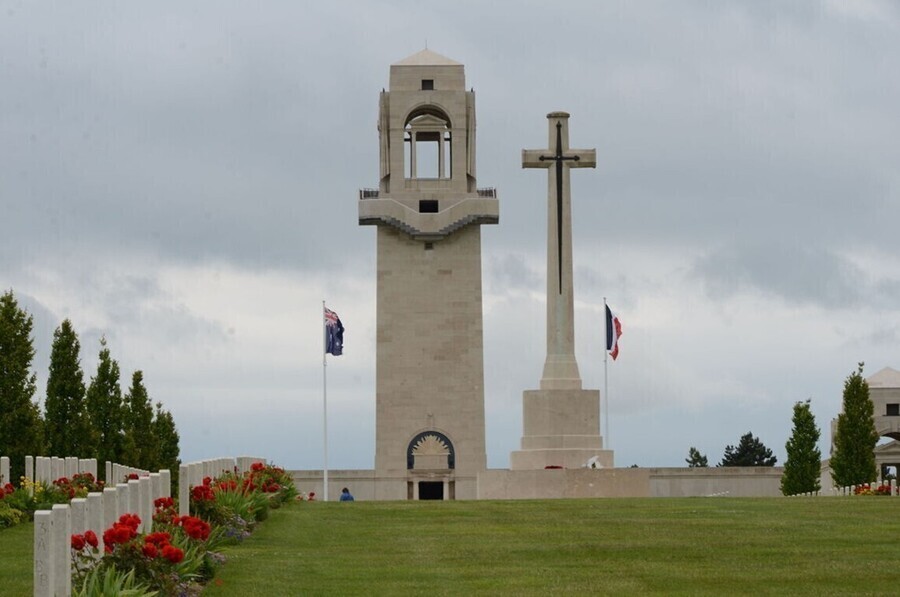
William Stanley Prior has no known grave. He is however commemorated at multiple sites around the world, including:
· The Australian National Memorial, Villers-Bretonneux
· The Australian War Memorial Roll of Honour, Canberra
· The National War Memorial, Adelaide
· Eudunda and District WW1 Roll of Honour, Eudunda
· Marrabel District Honour Roll, Marrabel
· Marrabel War Memorial, Marrabel
He left all of his personal estate to his older brother, Frederick ‘Johnny’ Thomas Prior. Frederick received William’s personal effects from the field including photos, a notebook and a religious book. Frederick sufferred meningitis as a child resulting in him losing function in his right leg for the rest of his life and William leaving all his possessions to him in his will, despite his parents still being alive, reflects the strong bond the two of them shared.
He was posthumously awarded the British War Medal and the Victory Medal for his service. In July 1993, the condolence letter to his mother was gifted to the Victoria School Museum, Villers-Bretonneux.
Bibliography
Australian War Memorial (2025a). | The Australian War Memorial. [online] www.awm.gov.au. Available at: https://www.awm.gov.au/collection/U51472.
Australian War Memorial (2025b). AWM4 Subclass 23/49 - 32nd Infantry Battalion. [online] Awm.gov.au. Available at: https://www.awm.gov.au/collection/C1339197.
Birtwistlewiki.com.au. (2023). HMAT A9 Shropshire - Our Contribution. [online] Available at: https://birtwistlewiki.com.au/wiki/HMAT_A9_Shropshire#Fremantle_to_Port_Suez_31_March_-_24_Apr_1916 [Accessed 29 Sep. 2025].
Cwgc.org. (2019). Commonwealth War Graves Commission. [online] Available at: https://www.cwgc.org/.
Google (2025a). Gemini . [online] Google Gemini. Available at: https://gemini.google.com/app [Accessed 11 Sep. 2025].
Google (2025b). Google Maps. [online] Google Maps. Available at: https://www.google.com/maps/.
Naa.gov.au. (2025). Service Record. [online] Available at: https://recordsearch.naa.gov.au/SearchNRetrieve/Interface/ViewImage.aspx?B=8022425 [Accessed 11 Sep. 2025].
Prior, H. and Prior, I. (1986). Prior Family History. Lutheran Publishing House.
sarcib.ww1.collections.slsa.sa.gov.au. (n.d.). South Australian Red Cross Information Bureau | 1914 - 1918. [online] Available at: https://sarcib.ww1.collections.slsa.sa.gov.au/.
Scott, J. (2012). 32nd Infantry Battalion memorial, Adelaide. [online] State Library of South Australia. Available at: https://collections.slsa.sa.gov.au/resource/B+72928 [Accessed 12 Sep. 2025].
Trove (2025). Family Notices - The Express and Telegraph (Adelaide, SA : 1867 - 1922) - 29 Aug 1918. [online] Trove. Available at: https://trove.nla.gov.au/newspaper/article/209722942?searchTerm=William%20Stanley%20Prior [Accessed 11 Sep. 2025].
Trove. (2022). (July 1993). [online] Available at: https://nla.gov.au/nla.obj-1108109873/view?sectionId=nla.obj-1302713711&partId=nla.obj-1108134224#page/n4/mode/1up [Accessed 12 Sep. 2025].
UNSW (2025). Details. [online] Adfa.edu.au. Available at: https://aif.adfa.edu.au/showPerson?pid=246330 [Accessed 11 Sep. 2025].
Virtual War Memorial Australia (2013). Villers-Bretonneux. [online] Vwma.org.au. Available at: https://vwma.org.au/explore/campaigns/23.
Virtual War Memorial Australia (2025a). Australian Soldiers, Memorials and Military History. [online] Vwma.org.au. Available at: https://vwma.org.au/explore/projects/196067/edit?wizard-page-index=0 [Accessed 11 Sep. 2025].
Virtual War Memorial Australia (2025b). Bullecourt (Second). [online] vwma.org.au. Available at: https://vwma.org.au/explore/campaigns/6.
Virtual War Memorial Australia (2025c). Dernancourt/Ancre. [online] vwma.org.au. Available at: https://vwma.org.au/explore/campaigns/35.
Virtual War Memorial Australia (2025d). Eudunda War Memorial. [online] Vwma.org.au. Available at: https://vwma.org.au/explore/memorials/245 [Accessed 11 Sep. 2025].
Virtual War Memorial Australia (2025e). German Spring Offensive 1918. [online] vwma.org.au. Available at: https://vwma.org.au/explore/campaigns/80.
Virtual War Memorial Australia (2025f). Polygon Wood. [online] vwma.org.au. Available at: https://vwma.org.au/explore/campaigns/19.
Virtual War Memorial Australia (2025g). The Outpost Villages - German Withdrawal to Hindenburg Line. [online] vwma.org.au. Available at: https://vwma.org.au/explore/campaigns/21.
Willoughby, L. (2015). The Stubing Family Journey 1858-2015. Lorraine Willoughby.


Click images to start slideshow.