


83364
EARLE, John Oliver
| Service Number: | 2995 |
|---|---|
| Enlisted: | 19 April 1916 |
| Last Rank: | Trooper |
| Last Unit: | 9th Light Horse Regiment |
| Born: | Belton, South Australia, 1 November 1892 |
| Home Town: | Hallett, Goyder, South Australia |
| Schooling: | Unknown |
| Occupation: | Labourer |
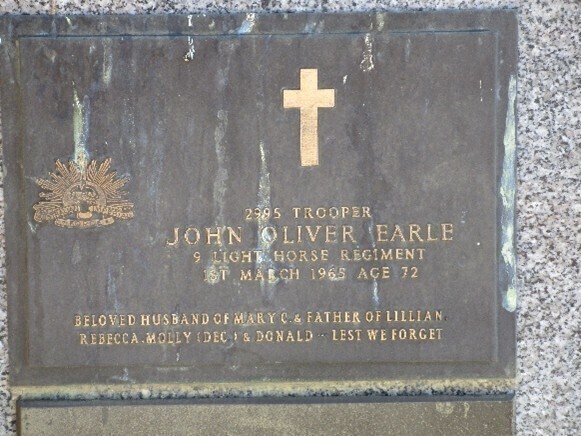
| Died: | Illness, Heidleberg, Victoria, 1 March 1965, aged 72 years |
| Cemetery: |
Swan Hill Memorial Park |
| Memorials: | Carrieton Honour Roll, Carrieton War Memorial, Willalo & District WW1 Roll of Honour |
World War 1 Service
| 19 Apr 1916: | Enlisted AIF WW1, Private, 2995, 9th Light Horse Regiment | |
|---|---|---|
| 4 Nov 1916: | Involvement Private, 2995, 9th Light Horse Regiment, --- :embarkation_roll: roll_number: '2' embarkation_place: Adelaide embarkation_ship: HMAT Bakara embarkation_ship_number: A41 public_note: '' | |
| 4 Nov 1916: | Embarked Private, 2995, 9th Light Horse Regiment, HMAT Bakara, Adelaide | |
| 11 Nov 1918: | Involvement Trooper, 2995, 9th Light Horse Regiment | |
| Date unknown: | Wounded 2995, 9th Light Horse Regiment |
Help us honour John Oliver Earle's service by contributing information, stories, and images so that they can be preserved for future generations.
Add my storyBiography contributed by Elizabeth Allen
John Oliver EARLE was born in Belton, South Australia on 1st November, 1892
His parents were George EARLE & Frances Harriet BRUMBY
He married Mary Catherine PARKER on 15th March, 1922 in South Australia
John died in Heidleberg, Victoria on 1st March, 1965 and is buried in the Swan Hill Public Cemetery
Biography contributed by St Ignatius' College
John was born on the 1st of November 1892 in the town of Belton, South Australia. John lived in Hallet, South Australia and was born to his Mother Mrs Francis Harriet Earle and his Father George Earle. John had 2 brothers and was the oldest out of the 3 boys. Both his Brothers Walter Leslie Earle and Clarence Percy Earle participated in World War 1. John wasn’t married before departing for WW1 on the HMAT A41 Bakara ship that was headed to Moascar, Egypt.
According to John’s service records he had brown hair, grey eyes and was a Methodist. John enlisted in Adelaide on the 19th of April 1916. John was 23 years and 5 months old when he enlisted. Once John was enlisted, he began his training in Moascar, Egypt at an Isolation camp. The conditions were intense as this prepared the soldiers for the feel of the war. After the completion of the training John was transferred to the 3rd Light Horse Regiment but soon transferred to the 9th Light Horse Regiment.
John was a part of the 9th Light Horse Regiment resulting in his role being mounted infantry. Mounted infantry were soldiers who used horses as their form of transport but would dismount in the event of fighting. Members of the 9th Light Horse would be equipped with a bayonet and a Short Magazine Lee-Enfield Mark III rifle. The bayonet was famously used in the battle of Beersheba as it was used in a mounted charge at a rival. The Short Magazine Lee-Enfield Mark III rifle was the most commonly used battle rifle in World War 1.
John was deployed to the Battle of Maghdaba which took place on the 23rd of December 1916. The war involved the British Empire Forces attacking and defeating the Ottoman Empire Forces near the village of Magdhaba. The total casualties included 22 killed and 124 wounded from the Australia’s Allied Forces. The 9th Light Horse unit diaries state that the Battle of Maghdaba involved rough terrain and intense fighting. Despite facing heavy fire from the Ottoman Empire, the regiment played an important role for WW1. The British Empire had advanced so much that the battle was over that night as the Ottoman Empire/Turks had surrendered.
John was then admitted to hospital as he contracted tonsilitis on the 18th of March 1917. 5 months later on the 2nd of August 1917 John was admitted to hospital as he contracted influenza. The next day John was diagnosed with gastritis.
John was later deployed to the Battle of Beersheba in which took place on the 31st of October 1917. The conditions of these battles where very harsh as the troops faced desert terrain, limited water access and scorching temperatures. The battle of Beersheba involved the British Empire’s Egypt Expeditionary force attacking and capturing the Ottoman Empire’s Yildirim Army Group Garrison at Beersheba which begun the Southern Palestine Offensive of the Sinai and Palestine Campaigns of WW1. The battle resulted in 31 soldiers killed, 36 wounded and 70 horses killed from the Australian Light Horse Regiment.
John later got married to Mary Catherine Parker on the 15th of March 1922 at Ironmine Methodist Church. John sadly later passed away at the age of 72 on the 1st of March 1965 due to unknown circumstances and was later buried in the Swan Hill Cemetery, Victoria.
Bibliography:
• Wikipedia Contributors. “9th Light Horse Regiment (Australia).” Wikipedia, Wikimedia Foundation, 28 Jan. 2025, en.wikipedia.org/wiki/9th_Light_Horse_Regiment_(Australia).
• “John Oliver EARLE.” Vwma.org.au, 2025, vwma.org.au/explore/people/331730. Accessed 12 Sept. 2025.
• “AIF.” Adfa.edu.au, 2025, aif.adfa.edu.au/showPerson?pid=87516&printFormat=print. Accessed 12 Sept. 2025.
• “AWM4 10/14/21 - November 1916.” Awm.gov.au, 2025, www.awm.gov.au/collection/C1352037?image=2. Accessed 12 Sept. 2025.
• “WEDDING. - EARLE—PARKER. - Burra Record (SA : 1878 - 1954) - 22 Mar 1922.” Trove, 2025, trove.nla.gov.au/newspaper/article/39716358?searchTerm=EARLE%2C%20John%20Oliver. Accessed 12 Sept. 2025.
• “John Oliver Earle | South Australian Red Cross Information Bureau.” Sa.gov.au, 2025, sarcib.ww1.collections.slsa.sa.gov.au/soldier/john-oliver-earle. Accessed 12 Sept. 2025.
• Terrace, Victoria. “View Digital Copy.” Naa.gov.au, 2025, recordsearch.naa.gov.au/SearchNRetrieve/Interface/ViewImage.aspx?B=3532191&S=8&R=0. Accessed 12 Sept. 2025.
• Wikipedia Contributors. “9th Light Horse Regiment (Australia).” Wikipedia, Wikimedia Foundation, 28 Jan. 2025, en.wikipedia.org/wiki/9th_Light_Horse_Regiment_(Australia).
• ---. “Advanced Search | the Australian War Memorial.” Awm.gov.au, 2016, www.awm.gov.au/advanced-search.


Click images to start slideshow.