







CAMPBELL, John Leslie
| Service Numbers: | 17983, 17683 |
|---|---|
| Enlisted: | 22 January 1916 |
| Last Rank: | Sapper |
| Last Unit: | 3rd Field Company Engineers |
| Born: | Young, New South Wales, Australia, 10 September 1892 |
| Home Town: | Ashfield, Ashfield, New South Wales |
| Schooling: | Not yet discovered |
| Occupation: | Architectural draughtsman |
| Died: | Acute myocardial failure and hypertension, General Hospital, Windsor, Queensland, Australia , 3 November 1957, aged 65 years |
| Cemetery: |
Lutwyche Cemetery, Brisbane, Qld Anzac Portion 9 |
| Memorials: |
World War 1 Service
| 22 Jan 1916: | Enlisted AIF WW1, Sapper, 17983, Field Company Engineers | |
|---|---|---|
| 10 May 1917: | Involvement Sapper, 17683, Field Company Engineers, --- :embarkation_roll: roll_number: '5' embarkation_place: Sydney embarkation_ship: HMAT Marathon embarkation_ship_number: A74 public_note: '' | |
| 10 May 1917: | Embarked Sapper, 17683, Field Company Engineers, HMAT Marathon, Sydney | |
| 8 Sep 1919: | Discharged AIF WW1, Sapper, 17683, 3rd Field Company Engineers, 2nd MD, medically discharged |
Help us honour John Leslie Campbell's service by contributing information, stories, and images so that they can be preserved for future generations.
Add my storyBiography contributed by Evan Evans
From Australian Remembrance Army
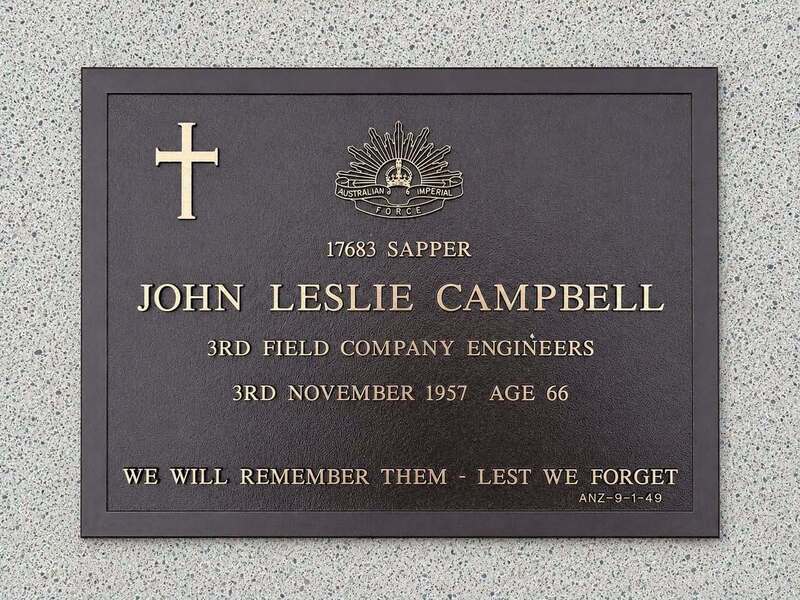
Australian World War One veteran Sapper John Leslie Campbell (Service No. 17683), is among almost 800 previously unmarked WWI veterans’ graves in Lutwyche Cemetery we have now marked with plaques in recognition of their service for Australia.
We unveiled his plaque in Lutwyche Cemetery on 16 May 2026, along with a further 185 plaques on the previously unmarked graves of Australian World War One veterans:
See Australian Remembrance Army Facebook page
John Leslie Campbell was born on 10 September 1892 in Young, New South Wales, to Alexander Campbell and Ida Campbell, née Jones.
He enlisted in the Australian Imperial Force in Sydney, New South Wales, on 3 February 1916, stating his occupation as architectural draughtsman and nominating his mother as his next of kin. On 10 May 1917, he embarked from Sydney for overseas service with the March 1917 Reinforcements aboard HMAT Marathon.
After arriving in England, Campbell was attached to Engineer training units before proceeding overseas to France in February 1918. He marched in from England at Rouelles on 20 February 1918, and the following day was marched out to join the 3rd Field Company Engineers in the field.
In July 1918, while serving in France, he was recorded as wounded, having sustained gunshot wounds to the thigh and shoulder. A later medical report stated that he had been temporarily blinded and deafened after a shell burst near his dugout, and recorded deafness in both ears, chiefly the left, as well as an inguinal hernia. A medical board later found him permanently unfit for general service and recommended discharge.
Campbell returned to Australia on 9 December 1918, and he was discharged from the Australian Imperial Force. He was later recorded as living in Brisbane.
In 1941, he gave evidence in support of a pension claim, stating that he was incapable of earning his livelihood because of his war service and ongoing physical condition. Medical notes from 1941 recorded right inguinal hernia, and stated that this condition would affect his ability to carry out heavy work.
In 1946 and 1947, Campbell was recorded in Repatriation Department and General Hospital, Windsor, medical notes for ongoing hernia-related treatment. These records refer to his use of a truss, pain and discomfort, and a right inguinal hernia which was described as difficult to control. In 1949, hospital notes recorded that he had undergone an operation for right inguinal hernia and was later considered to have made a satisfactory post-operative recovery. In January 1952, he was again admitted for treatment, and by 1956 he was still recorded in Repatriation Department notes in relation to hernia symptoms and ongoing review.
Sapper John Leslie Campbell died on 3 November 1957, aged 66, and was buried in Anzac Portion 9, Lutwyche Cemetery, Brisbane. His death was due to acute myocardial failure and hypertension.
His death certificate also records that he was unmarried and had no known children.
After decades without recognition at his place of burial, his grave now bears a plaque commemorating his service to Australia — ensuring his name endures among those remembered for their duty and sacrifice.
His identity and dignity have now been restored.
We have remembered him.
Lest We Forget
Click images to start slideshow.