





RICHARDSON, Edward
| Service Number: | 2790 |
|---|---|
| Enlisted: | 12 August 1915, Brisbane, Queensland |
| Last Rank: | Private |
| Last Unit: | 15th Infantry Battalion |
| Born: | Crows Nest, Queensland, Australia , 24 June 1892 |
| Home Town: | Crows Nest, Toowoomba, Queensland |
| Schooling: | Glenaven State School, Queensland, Australia |
| Occupation: | Labourer |
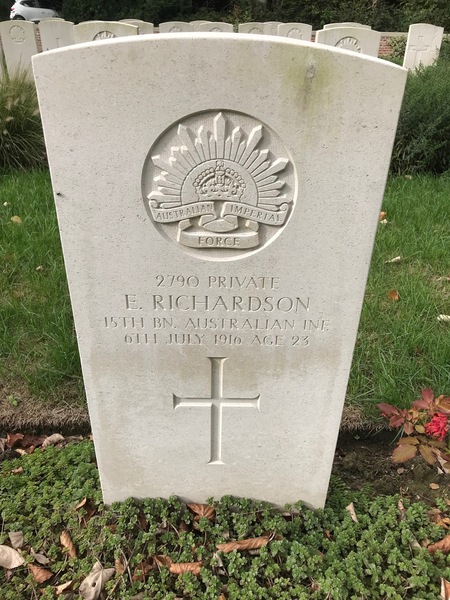
| Died: | Killed in Action, France, 6 July 1916, aged 24 years |
| Cemetery: |
Brewery Orchard Cemetery, Bois-Grenier |
| Memorials: | Australian War Memorial Roll of Honour, Crows Nest (Qld) War Memorial, Nanango War Memorial |
World War 1 Service
| 12 Aug 1915: | Enlisted AIF WW1, Private, 2790, 15th Infantry Battalion, Brisbane, Queensland | |
|---|---|---|
| 1 Sep 1915: | Involvement AIF WW1, Private, 2790, 15th Infantry Battalion, Enlistment/Embarkation WW1, --- :embarkation_roll: roll_number: '11' embarkation_place: Sydney embarkation_ship: HMAT Ayrshire embarkation_ship_number: A33 public_note: '' | |
| 1 Sep 1915: | Embarked AIF WW1, Private, 2790, 15th Infantry Battalion, HMAT Ayrshire, Sydney |
Help us honour Edward Richardson's service by contributing information, stories, and images so that they can be preserved for future generations.
Add my storyBiography contributed by Ian Lang
#2790 RICHARDSON Edward 15th Battalion
Ted Richardson was born either on the family farm at Glenaven or in Crows Nest, a few miles away. He was the youngest of three boys and three girls born to William and Elizabeth Richardson. Like his other siblings, Ted attended school at Glenaven and then worked on the farm or in agricultural labouring in the Crows Nest district.
Ted attended the Brisbane Recruiting Depot in Adelaide Street on 12th August 1915. His elder brother Syd had enlisted four months earlier. Ted advised the officer he was 23years and 2 months old and gave his occupation as labourer. Both William and Elizabeth were deceased and Ted named his eldest brother, Ernest of Gilla near Blackbutt, as his next of kin. At Enoggera, Ted was allocated to the 9th reinforcements of the 15th Battalion. There was not much time for training before the reinforcements travelled to Sydney by train to embark for overseas on the “Ayrshire” on 1stSeptember 1915.
Ted and the 9th reinforcements landed at Suez at the southern end of the Suez Canal before making their way to the AIF Infantry Depot at Zeitoun on 13th October. On 4th November, Ted embarked on a transport ship in Alexandria and sailed to the Greek island of Lemnos. On 13th November, Ted landed at Gallipoli and proceeded to join the 15thBattalion, part of the 4th Brigade of the Australian and New Zealand Division. Ted’s time on Gallipoli was quite short as after an inspection by Lord Kitchener Minister for War in the British Government about the time that Ted arrived on the peninsula, the decision was made to abandon the whole Mediterranean campaign. The withdrawal from Gallipoli, achieved in secret and at night by the Australian forces was one of the few successes of those seven and a half months. Ted and the 15th Battalion arrived back in Alexandria on Christmas Day.
Over the next few months, the AIF in Egypt went through an expansion, effectively doubling in size from two divisions to four. This doubling was achieved by splitting the original Gallipoli battalions to form the nucleus of two battalions, with additional numbers being drafted from the many reinforcements in the camps. The 15th Battalion was to be split with half of its number forming a new battalion, the 47th. Ted avoided being re-assigned and remained with his original battalion which along with the 47th was to be part of the new 4th Division AIF.
On 1st June 1916, the 15th Battalion boarded a transport at Alexandria for the crossing of the Mediterranean to Marseilles. One in France, the battalion travelled by train across France to the northern sector of the Western front near the city of Armentieres. There the 15th went into billets near the town of Bailleul and began training in musketry, map reading and bomb throwing. This part of the front was considered to be relatively quiet as the ground was so boggy that frontal assaults on a large scale were impossible. The boggy ground also meant that there were no actual trenches but rather earthen embankments reinforced with wicker panels. For the Gallipoli veterans in the battalion, this period of the war was seen as almost a holiday. Battalions routinely rotated in and out of the line with comfortable billets in the rear areas. Hot food from the battalion cook wagons was delivered to the frontline daily and there was even fresh water delivered via a system of pipes. There was time for recreation when not in the line with sports and games organised as well as the ability to frequent the numerous cafes in the villages.
At the end of June, it was considered that the newly arrived 15th Battalion needed to experience some front line occupation and on 30th June, the 15th relieved the 20th Australian Battalion in the front line at Bois Grenier, on the outskirts of Armentieres. Ted and the other infantrymen spent two days in the line and were then relieved. The battalion went back into the line on 4th July for a longer stint. Even though the terrain was not suited to large scale assault, both sides engaged in trench raiding to obtain intelligence, capture weapons and take prisoners. A successful raid often sparked retaliatory action through counter raids or artillery barrages, often at times when the men in the front line were occupied with food. There is no record of what actually happened on 6th July, except that Ted Richardson was killed in the front line. Ted was taken to the rear and buried in a small cemetery that had been established near a dressing station in an orchard adjacent to a brewery. Ted’s few personal effects were included in a parcel sent to his brother at Blackbutt.
There was a considerable amount of correspondence in the 1920s surrounding the disposal of Ted’s service medals, the 1914/15 Star, Empire medal and Victory Medal which were eventually delivered to Edward Richardson at Blackbutt.
When permanent headstones were being erected in war grave cemeteries in the 1920s, Edward Richardson declined to choose a personal inscription for Ted’s headstone in the Brewery Orchard Cemetery.




Click images to start slideshow.